Muscle and fat loss
Weight Loss for Men Over 50: What Actually Works After the Easy Years
Your metabolism did not break. What changed is how much muscle you have to lose, and how easy it is to lose the wrong thing.

You did this before. Twenty-five years old, cut out beer and bread for six weeks, dropped fifteen pounds, felt sharp again. Same plan at fifty-five and the scale barely moves. When it does move, you look softer at the end than you expected.
The usual explanation is that your metabolism died. That is the wrong diagnosis, and it matters, because it sends men chasing metabolism boosters instead of fixing the thing that actually changed.
Here is the verdict up front. The rules of fat loss still work at fifty. What changes is the margin for error. You have more muscle to protect and a slower repair system protecting it, so a sloppy aggressive diet takes a bigger bite out of your lean mass. Get four things right and this is still very winnable.
Your metabolism is not the problem
Start here, because it clears the deck.
The largest analysis of human energy expenditure ever assembled pooled doubly labeled water measurements, the gold standard, across people from 8 days to 95 years old. After adjusting for fat-free mass, daily energy expenditure was stable through all of adulthood, from 20 to 60. The decline does not begin until roughly age 60, and it is gradual after that (Pontzer et al., 2021).
Read that again if you are fifty-two and blaming your thyroid. Pound for pound of lean tissue, you burn about what you burned at thirty.
What did change is the amount of lean tissue. Muscle is metabolically active, so losing it lowers your total burn. That is not aging destroying your metabolism. That is aging quietly taking your muscle while you were not lifting, and your metabolism doing exactly what it should with a smaller engine. Which is good news, because muscle is trainable and a broken metabolism is not.
If your fatigue and weight gain feel like something more than this, thyroid disease is worth ruling out properly, and what TSH and free T4 actually tell you covers how to read that test without panicking.
The real change: strength leaves faster than size
This is the finding that should shape your plan.
The Health, Aging and Body Composition study tracked 1,880 older adults over three years. Men lost leg strength at 3.4 percent a year, and almost twice as much strength as women. Leg lean mass fell at only about 1 percent a year. Strength was walking out the door roughly three times faster than mass.
The sharpest detail in that paper is what happened to men who gained lean mass. It did not protect their strength. Gaining muscle mass was not associated with maintaining or gaining strength (Goodpaster et al., 2006). The authors read that as declining muscle quality, not just quantity.
The practical translation: chasing scale weight and mirror size is not enough after fifty. You have to train in a way that demands force production, not just volume, and you have to keep doing it while you diet.
Lever 1: lift, and do cardio too
The best evidence here is unusually clean, because someone ran the exact experiment.
Researchers took 160 obese older adults and put them on a weight-management program plus one of three exercise programs, aerobic only, resistance only, or both, or a control group with neither. Everyone in the exercise groups lost about 9 percent of body weight. What separated them was what came off with it.
- Aerobic only: lean mass fell 5 percent, and hip bone density fell 3 percent.
- Resistance only: lean mass fell 2 percent, hip bone density fell 0.5 percent.
- Combined: lean mass fell 3 percent, and physical function improved the most of any group, 21 percent versus 14 percent for either alone.
Strength climbed 18 to 19 percent in the resistance and combined groups and only 4 percent with aerobic work alone. Peak oxygen uptake climbed 17 to 18 percent in the combined and aerobic groups and only 8 percent with resistance alone (Villareal et al., 2017). Each type of training bought a different thing, and the men who did both got the best overall result.
An earlier trial from the same group makes the case for dieting and training together rather than picking one. In 107 obese adults over 65, diet plus exercise beat diet alone and exercise alone on physical function, and lean mass and hip bone density fell less in the diet-exercise group than in the diet-only group (Villareal et al., 2011).
So the answer to lift or run is both, with lifting as the non-negotiable. For the specific moves and a week laid out day by day, see the weight loss exercises for men that the trials actually back. If you want the wider case for the barbell past forty, what resistance training does for all-cause mortality lays out the minimum effective dose, and the case for easy aerobic base work covers the cardio side without wrecking your recovery.
Lever 2: eat more protein than you think you need
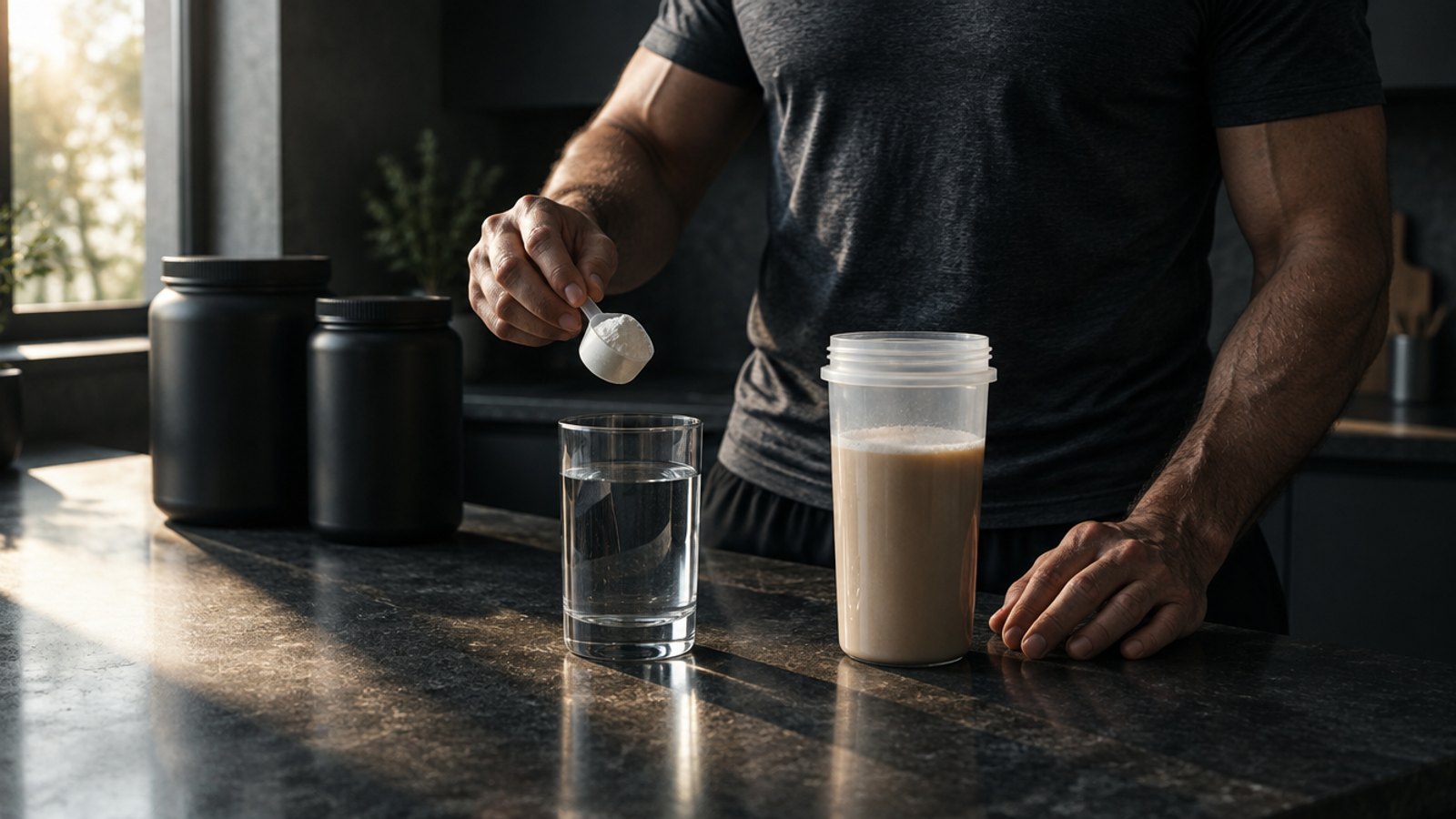
Protein is doing something specific here. It is not a fat burner. It is what keeps a calorie deficit from eating your legs.
In a double-blind trial, 80 obese older adults averaging 63 years old ran a 600 calorie daily deficit with resistance training three times a week for 13 weeks. Half got a high whey protein, leucine, and vitamin D supplement, which pushed them to 1.11 g of protein per kg of body weight per day. The control group sat at 0.85 g/kg.
Both groups lost the same weight and the same fat. The difference was muscle. The supplemented group gained 0.4 kg of appendicular muscle mass while dieting. The control group lost 0.5 kg (Verreijen et al., 2015). Same fat loss, opposite outcome for the tissue you cannot afford to lose.
For a target, the PROT-AGE group reviewed the evidence and recommends at least 1.0 to 1.2 g/kg/day for adults over 65 to maintain lean mass and function, and 1.2 g/kg/day or higher for those who are exercising and active (Bauer et al., 2013). That is well above the old 0.8 g/kg number most men have in their heads. For a 200 pound man, 1.2 g/kg lands around 110 g of protein a day.
There is a ceiling. A meta-analysis of 49 trials in 1,863 people found protein supplementation reliably improved strength and lean mass gains during resistance training, but the benefit for fat-free mass flattened out beyond a total intake of about 1.6 g/kg/day. Notably, the effect got smaller with increasing age (Morton et al., 2018). Older muscle is less responsive, which is an argument for hitting the target consistently rather than for giving up on it.
One caveat worth stating plainly: men with significant kidney disease are the exception to all of this and should not raise protein without talking to their doctor. PROT-AGE flags the same limit.
For how to actually hit those numbers, how much protein it takes to build muscle covers the sources, and what per-meal protein doses actually matter handles the spread across the day, which matters more as you get older.
Lever 3: sleep, or lose the wrong tissue
This is the lever most men over fifty are quietly failing, and it hits body composition directly rather than through willpower.
Ten overweight adults, seven of them men, went through 14 days of moderate calorie restriction twice: once with 8.5 hours in bed and once with 5.5. Total weight lost was the same both times. The split was not. On short sleep, the proportion of weight lost as fat dropped by 55 percent, from 1.4 kg down to 0.6 kg, while loss of fat-free mass rose 60 percent, from 1.5 kg to 2.4 kg. Hunger went up too (Nedeltcheva et al., 2010).
That is ten people over two weeks, so hold the exact numbers loosely. But the direction is the thing. Same diet, same weight on the scale, and short sleep flipped the result from mostly fat to mostly muscle. If you are dieting on six hours a night, you may be doing the work and buying the worse version of the outcome.
Sleep also sits upstream of your hormones, and what the sleep-restriction studies did to testosterone covers how fast that shows up. If you snore, wake up unrefreshed, or your partner has mentioned you stop breathing, read the signs of sleep apnea men write off as snoring first, because no amount of sleep hygiene fixes an untreated airway.
Lever 4: alcohol, honestly counted
Nobody wants this one, so keep it simple and non-moralistic.
Alcohol is 7 calories a gram, it arrives without protein or fiber, it reliably wrecks the second half of the night's sleep, and it lowers the bar on what you eat afterward. Four beers is not a rounding error on a 500 calorie deficit; it is the deficit.
You do not have to quit. Count it, or move it to two nights a week instead of five, and watch what happens to your sleep and your Saturday morning appetite. The dose-response of alcohol on testosterone and body fat has the numbers if you want to see where the real damage starts.
The diet itself matters less than you think
Here is where you can stop agonizing.
DIETFITS randomized 609 adults to a healthy low-fat or a healthy low-carbohydrate diet for a full 12 months, with real coaching and real macronutrient separation. Weight change was 5.3 kg on low fat and 6.0 kg on low carb, a difference of 0.7 kg with a confidence interval that crossed zero. Genotype pattern did not predict who did better on which diet. Neither did baseline insulin secretion (Gardner et al., 2018).
Twelve months, 609 people, two well-run diets, no meaningful winner. The lesson is not that food quality is irrelevant, since both arms emphasized whole foods and cut added sugar and refined grains. The lesson is that the specific macronutrient split is not the variable holding you back. Pick the one you can run for a year with 110 g of protein in it and stop reading diet comparisons. If you want that on a plate, here is a simple weight loss meal plan for men with a full 2,000 calorie day.
What you are trying to build alongside it is a body that holds muscle while fat comes off, which is exactly the question whether you can add muscle and lose fat at once past 40 takes on directly. And if the belly is your specific complaint, why abdominal fat behaves differently as men age is the closer look.
How to actually run this
- Go slower than you did at 25. A moderate deficit, roughly 500 calories a day, is what the trials above used to get 9 to 10 percent body weight off while protecting lean mass. Aggressive crash diets are exactly how a man over fifty loses strength he will not easily get back.
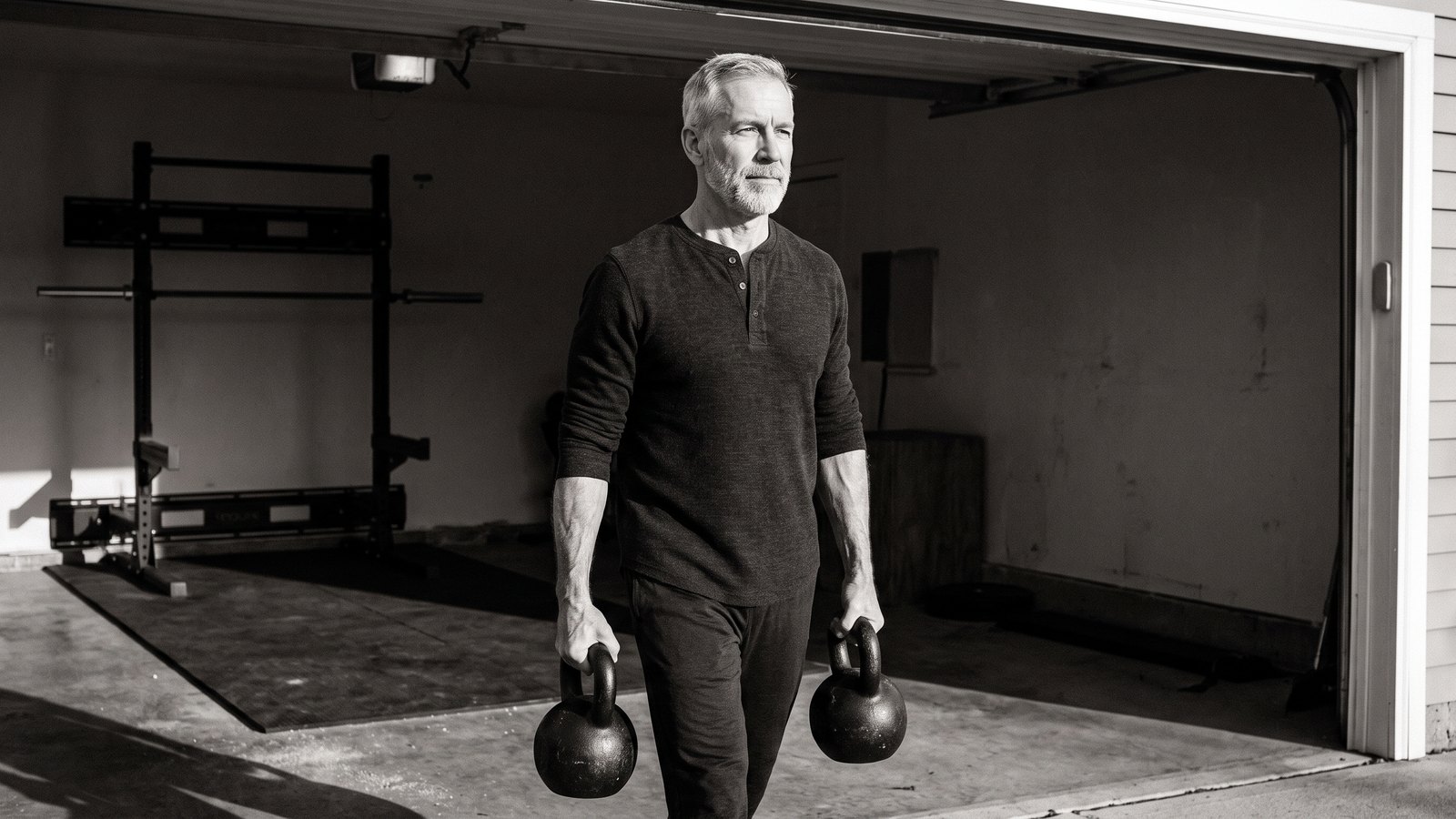
- Lift at least twice a week, and treat it as mandatory. Resistance training is the single intervention that changed lean mass and bone density outcomes in the Villareal trials. Add aerobic work on top for function and fitness, not instead of.
- Aim for 1.2 g of protein per kg of body weight, spread across your meals. About 110 g a day for a 200 pound man. Kidney disease is the exception; ask your doctor.
- Protect seven hours of sleep like it is part of the program, because it is. Short sleep changed what tissue came off, not just how much.
- Count the alcohol you actually drink. Not the amount you would like to be drinking.
- Track strength, not just the scale. If your weight is falling and your working sets are getting lighter, the diet is winning and you are losing. Add protein, add sleep, cut the deficit.
- Give it twelve weeks. Every trial cited here ran 13 weeks to 12 months. Six weeks of judging yourself in the mirror is not a test of anything.
The verdict
Weight loss after fifty is not harder because your body quit on you. Pound for pound of lean tissue you burn what you burned at thirty. It is harder because the cost of doing it badly went up. Diet carelessly and you pay in strength, and strength is what leaves fastest at your age and comes back slowest.
Do it deliberately and the picture is genuinely good. Moderate deficit, lift twice a week, 1.2 g/kg of protein, seven hours of sleep, honest accounting on the beer. The men in these trials were older than you and heavier than you, and they came out of six months lighter, stronger, and better at the things they wanted to be able to do. If you are already past 60, the over-60 version of this plan, with the protein-per-meal numbers for older muscle picks up where this one leaves off.
That is the verdict.
If you are a decade behind these men, the job is a little easier and the fixes are slightly different, which we laid out in what actually changes about weight loss for men over 40. More on training and body composition after forty is collected in our muscle and fat loss coverage.
This article is for general education and is not medical advice. If you have kidney disease, heart disease, diabetes, or take prescription medication, talk to your doctor before starting a calorie deficit or a new training program, and talk to your prescriber before raising your protein intake. Unexplained weight loss is a reason to see a doctor, not to celebrate.
References
- Pontzer H, Yamada Y, Sagayama H, et al. Daily energy expenditure through the human life course. Science. 2021. https://pubmed.ncbi.nlm.nih.gov/34385400/
- Goodpaster BH, Park SW, Harris TB, et al. The loss of skeletal muscle strength, mass, and quality in older adults: the Health, Aging and Body Composition Study. J Gerontol A Biol Sci Med Sci. 2006. https://pubmed.ncbi.nlm.nih.gov/17077199/
- Villareal DT, Aguirre L, Gurney AB, et al. Aerobic or resistance exercise, or both, in dieting obese older adults. N Engl J Med. 2017. https://pubmed.ncbi.nlm.nih.gov/28514618/
- Villareal DT, Chode S, Parimi N, et al. Weight loss, exercise, or both and physical function in obese older adults. N Engl J Med. 2011. https://pubmed.ncbi.nlm.nih.gov/21449785/
- Verreijen AM, Verlaan S, Engberink MF, et al. A high whey protein-, leucine-, and vitamin D-enriched supplement preserves muscle mass during intentional weight loss in obese older adults: a double-blind randomized controlled trial. Am J Clin Nutr. 2015. https://pubmed.ncbi.nlm.nih.gov/25646324/
- Bauer J, Biolo G, Cederholm T, et al. Evidence-based recommendations for optimal dietary protein intake in older people: a position paper from the PROT-AGE Study Group. J Am Med Dir Assoc. 2013. https://pubmed.ncbi.nlm.nih.gov/23867520/
- Morton RW, Murphy KT, McKellar SR, et al. A systematic review, meta-analysis and meta-regression of the effect of protein supplementation on resistance training-induced gains in muscle mass and strength in healthy adults. Br J Sports Med. 2018. https://pubmed.ncbi.nlm.nih.gov/28698222/
- Nedeltcheva AV, Kilkus JM, Imperial J, Schoeller DA, Penev PD. Insufficient sleep undermines dietary efforts to reduce adiposity. Ann Intern Med. 2010. https://pubmed.ncbi.nlm.nih.gov/20921542/
- Gardner CD, Trepanowski JF, Del Gobbo LC, et al. Effect of low-fat vs low-carbohydrate diet on 12-month weight loss in overweight adults and the association with genotype pattern or insulin secretion: the DIETFITS randomized clinical trial. JAMA. 2018. https://pubmed.ncbi.nlm.nih.gov/29466592/
Common questions
Does your metabolism really slow down after 50?
Your metabolism does not slow down after 50 the way most men think. The largest analysis of human energy expenditure, using doubly labeled water across ages 8 days to 95 years, found that once you adjust for fat-free mass, daily energy expenditure is stable from age 20 to 60, and only starts declining around 60 (Pontzer et al., 2021). What usually falls is the amount of muscle you are carrying, which lowers your total burn. That is a muscle problem, not a metabolism problem, and muscle is trainable.
How much protein does a man over 50 need to lose weight without losing muscle?
Aim for at least 1.2 g per kg of body weight per day if you are training, which is roughly 110 g for a 200 pound man. The PROT-AGE group recommends 1.0 to 1.2 g/kg/day for older adults and 1.2 g/kg or more for those exercising (Bauer et al., 2013). In a 13-week trial, older adults dieting at 1.11 g/kg gained appendicular muscle while those at 0.85 g/kg lost it, with identical fat loss (Verreijen et al., 2015). Benefits for lean mass flatten out past about 1.6 g/kg (Morton et al., 2018). Men with significant kidney disease are the exception and should talk to a doctor first.
Should I do cardio or lift weights to lose weight after 50?
To lose weight after 50, do both cardio and lifting, with lifting as the non-negotiable. In a trial of 160 obese older adults who all lost about 9 percent of body weight, lean mass fell 5 percent with aerobic training alone versus 2 percent with resistance training alone, and hip bone density fell 3 percent versus 0.5 percent. The combined group improved physical function the most, 21 percent versus 14 percent for either alone (Villareal et al., 2017). Aerobic work built cardiorespiratory fitness that lifting did not, and lifting protected tissue that cardio did not.
Why am I losing weight but looking softer?
You are probably losing a larger share of muscle than you realize, and there are two common causes. Too little protein and too little sleep both shift the composition of what comes off. In a crossover study, cutting sleep from 8.5 to 5.5 hours during a diet reduced the proportion of weight lost as fat by 55 percent and increased fat-free mass loss by 60 percent, with the same total weight lost (Nedeltcheva et al., 2010). Track your working sets: if the scale is falling and your lifts are getting weaker, add protein, add sleep, and shrink the deficit.
Is low carb or low fat better for men over 50?
For men over 50, neither low carb nor low fat wins. DIETFITS randomized 609 adults to a healthy low-fat or healthy low-carbohydrate diet for 12 months and found a 0.7 kg difference in weight change, which was not statistically meaningful. Genotype and baseline insulin secretion did not predict who did better on which diet (Gardner et al., 2018). Both arms cut added sugar and refined grains, so food quality still counted. Pick whichever approach you can sustain for a year while hitting your protein target.
How fast should I try to lose weight at 55?
Slower than you did at 25. The trials that got 9 to 10 percent of body weight off while protecting lean mass and bone density used moderate deficits, on the order of 500 to 600 calories a day, paired with resistance training (Villareal et al., 2011; Villareal et al., 2017). The reason to go moderate is not caution for its own sake: men over 50 lose leg strength about three times faster than they lose leg mass (Goodpaster et al., 2006), and an aggressive deficit accelerates exactly the loss you cannot easily reverse.