Nutrition
Protein Timing: Is the Anabolic Window Real, and Does 30 Grams a Meal Matter?
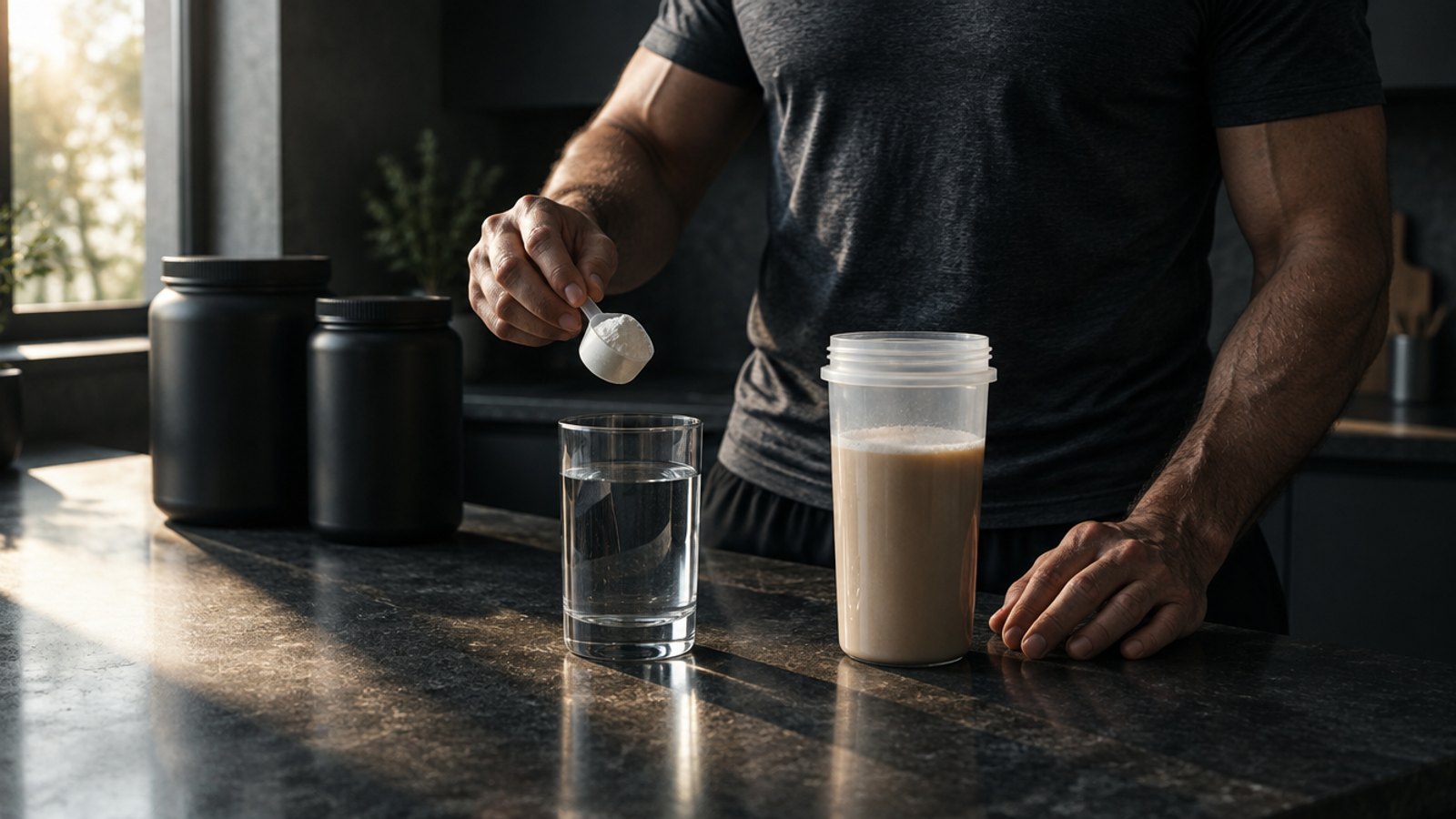
Two rules run every gym conversation about protein: slam a shake within 30 minutes, and never eat more than 30 grams at once. Neither one survives a close read of the research.
Here is the verdict up front. How much protein you eat in a day is the thing that matters, and the effect of timing it around your workout mostly disappears once you account for that. Spreading it across the day beats dumping most of it at dinner. And the famous 30 gram ceiling was never a ceiling on what your body can use, it was a ceiling on one specific measurement in one specific setup.
Walk into any gym and you will hear the same two rules. Get protein in within 30 minutes of your last set or you wasted the session. And do not bother eating more than 30 grams at a time, because your body can only use so much.
Both sound scientific. Both have been tested. Neither holds up the way it gets repeated.
The 30 minute window did not survive testing
The anabolic window is the idea that there is a short period after training when muscle is desperate for protein, and missing it costs you gains. It was plausible enough that it became gospel.
Researchers ran a meta-regression on every controlled trial they could find. The strength analysis covered 478 subjects across 20 studies. The hypertrophy analysis covered 525 subjects across 23 studies. A simple pooled look showed a small to moderate benefit for timing on muscle size. Then they controlled for the obvious confounder: the timing groups were usually eating more total protein.
Once total intake was accounted for, the timing effect vanished for both strength and size. What predicted muscle growth better than anything else was how much protein a man ate per day, full stop (Schoenfeld, 2013).
Be fair about what that means. It does not mean protein after training is pointless. It means the clock is not the lever. The responsive period after a hard session runs for hours, not minutes, and if you eat a normal meal within a few hours of training you are inside it. We cover how long the anabolic window really lasts, hour by hour in its own post.
The number that actually matters is your daily total
If timing is not the lever, total intake is. The largest analysis on this pooled 49 randomized trials and 1,863 people. Protein supplementation on top of resistance training produced real gains: about 2.5 kg more on one-rep max strength and 0.3 kg more fat-free mass than training alone.
The useful part is where the line flattened. Beyond a total intake of roughly 1.62 grams per kilogram of body weight per day, extra protein produced no further gains in fat-free mass. The benefit was also smaller in older men and larger in men who already had training experience (Morton, 2018).
For a 180 pound man that is about 130 grams a day. Not 300. Not a scoop every two hours. Roughly 130 grams, hit consistently.
Where the 30 gram rule came from
The per-meal cap traces back to a clean little study. Six young men did leg resistance training, then drank 0, 5, 10, 20, or 40 grams of egg protein on different days. Muscle protein synthesis climbed with dose and then plateaued at 20 grams. Going to 40 grams did not push it higher, and it did increase how much of the extra was burned off (Moore, 2009).
That is where "20 to 30 grams is all you can use" came from. The problem is what got measured and how.
Change the workout and the number moves. When 30 resistance-trained men did whole-body training instead of legs only, 40 grams of whey stimulated muscle protein synthesis significantly more than 20 grams. More muscle worked meant more protein used. Interestingly, how much lean mass a man carried did not change the answer (Macnaughton, 2016).
Reviewing all of it, the researchers who popularized the per-meal question landed on a target of about 0.4 grams per kilogram per meal across at least four meals, which gets you to 1.6 grams per kilogram for the day. If you are eating at the higher end of 2.2 grams per kilogram, that works out to about 0.55 grams per kilogram per meal (Schoenfeld, 2018).
In plain numbers, a 180 pound man is looking at roughly 33 grams per meal across four meals. Not 20. Not 100.
The study that broke the ceiling
Then a Dutch group did something nobody had done properly. Using four isotope tracers at once, they fed men either 25 grams or 100 grams of protein after resistance exercise and followed what happened for more than 12 hours.
The 100 gram dose produced a bigger and much longer anabolic response. More of those amino acids ended up built into muscle protein. Whole-body net protein balance improved more. And the assumption underneath the old rule, that surplus amino acids just get burned off, did not hold: protein ingestion had a negligible effect on amino acid oxidation rates (Trommelen, 2023).
So there is no hard ceiling. Your body handles a big protein meal better than the old model predicted.
Now the honest caveat, because this got oversold fast. A published commentary on that study pointed out the participants were recreationally active young men, not trained lifters, and warned that the results were being misread as proof that meal distribution does not matter. It also flagged emerging evidence that the no-upper-limit finding may not translate to resistance-trained young women (Witard, 2024).
Read it as what it is. One big meal is not wasted. That is different from one big meal being optimal.
Spreading it out still wins
Two studies make this case well.
In the first, 24 trained men ate 80 grams of whey over 12 hours after training, split three ways: 10 grams every 1.5 hours, 20 grams every 3 hours, or 40 grams every 6 hours. Same total protein. The 20 grams every 3 hours pattern beat both of the others for muscle protein synthesis by 31 to 48 percent (Areta, 2013).
In the second, adults ran two 7-day diets with identical calories and identical protein. One spread it evenly across breakfast, lunch, and dinner at about 30 grams each. The other looked like how most men actually eat: 11 grams at breakfast, 16 at lunch, 63 at dinner. Muscle protein synthesis over 24 hours was 25 percent higher on the even pattern, and it stayed higher after a week (Mamerow, 2014).
That second one is the practical finding. The average man is not failing on total protein by much. He is failing on breakfast. Toast and coffee, a sandwich, then half a chicken at 7pm.
What this looks like on a real day
- Set your daily target first. Around 1.6 grams per kilogram, which is close to 0.7 grams per pound. Hit that before you worry about anything else.
- Split it across three to four meals of roughly 0.4 grams per kilogram. For most men that is 30 to 40 grams a sitting, and it matters even more if you are losing weight on a GLP-1.
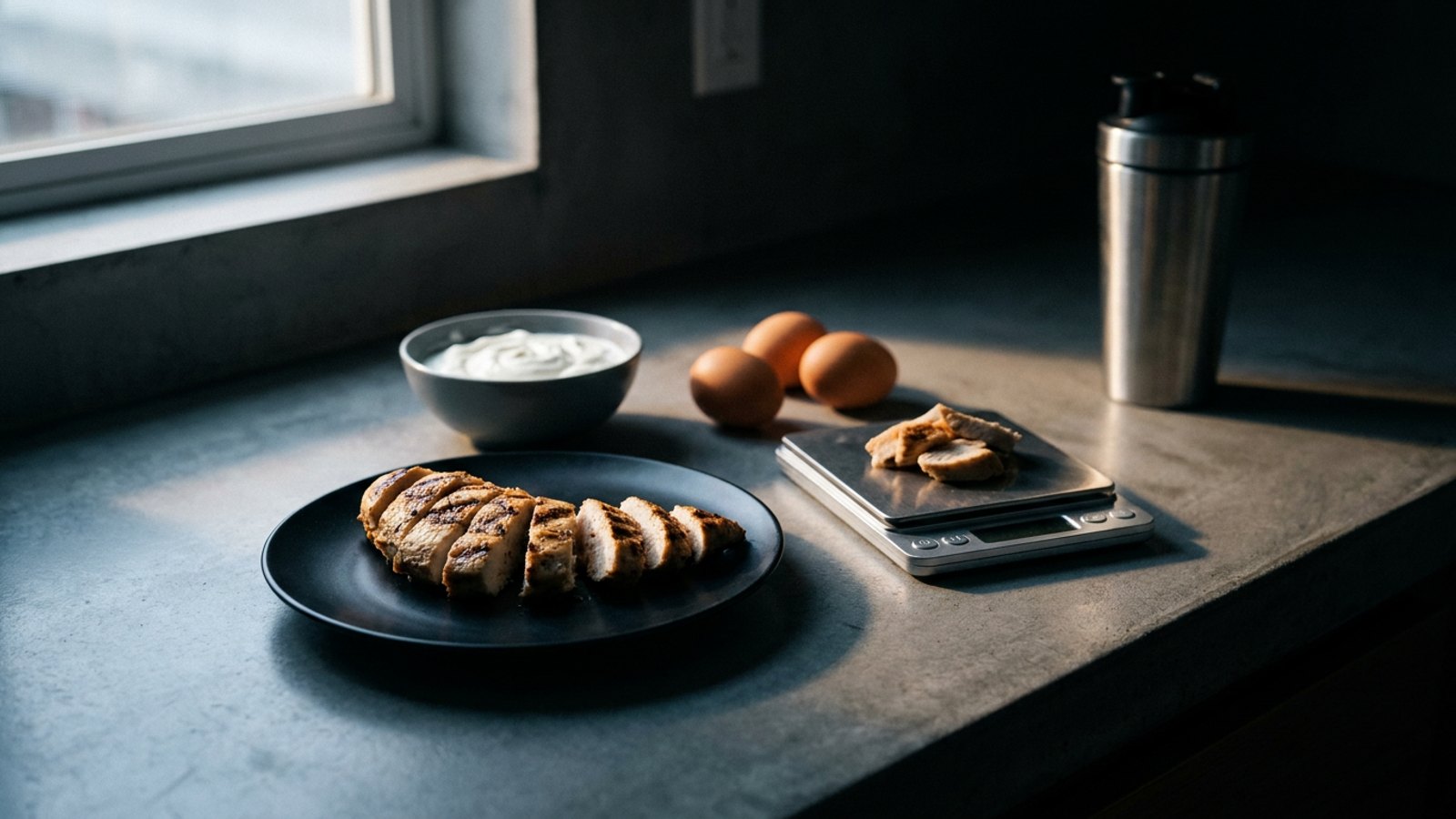
- Fix breakfast. This is where almost every man loses ground, especially anyone chasing recomposition after 40. Eggs, Greek yogurt, cottage cheese, a shake, whatever you will actually eat.
- Eat a normal protein meal within a few hours either side of training. That is the whole timing requirement. No sprinting to the locker room.
- If your schedule forces a big single meal, eat it. It is not wasted. Just do not build your week around it.
The verdict
The anabolic window is real in the sense that muscle stays responsive after training, and fake in the sense that anybody sold you a 30 minute deadline. Once total protein is accounted for, timing stops predicting results.
The 30 gram cap is also wrong, in both directions. Twenty grams was too low a target for a full-body session, and there is no hard ceiling above which protein is thrown away. But the studies that fed men protein evenly still beat the studies that stacked it at night, which is a different question from whether eating late hurts your body composition at all.
So the boring answer wins again. Hit your daily number. Spread it over three or four meals. Stop timing your shaker bottle. That is the verdict. The rest of our muscle and fat-loss guides keep the same standard.
This is general education, not medical advice. If you have kidney disease or any diagnosed condition that affects how you handle protein, talk to your doctor before making big changes to your intake.
References
- Schoenfeld BJ, Aragon AA, Krieger JW. The effect of protein timing on muscle strength and hypertrophy: a meta-analysis. J Int Soc Sports Nutr. 2013. https://pubmed.ncbi.nlm.nih.gov/24299050/
- Morton RW, Murphy KT, McKellar SR, et al. A systematic review, meta-analysis and meta-regression of the effect of protein supplementation on resistance training-induced gains in muscle mass and strength in healthy adults. Br J Sports Med. 2018. https://pubmed.ncbi.nlm.nih.gov/28698222/
- Moore DR, Robinson MJ, Fry JL, et al. Ingested protein dose response of muscle and albumin protein synthesis after resistance exercise in young men. Am J Clin Nutr. 2009. https://pubmed.ncbi.nlm.nih.gov/19056590/
- Macnaughton LS, Wardle SL, Witard OC, et al. The response of muscle protein synthesis following whole-body resistance exercise is greater following 40 g than 20 g of ingested whey protein. Physiol Rep. 2016. https://pubmed.ncbi.nlm.nih.gov/27511985/
- Schoenfeld BJ, Aragon AA. How much protein can the body use in a single meal for muscle-building? Implications for daily protein distribution. J Int Soc Sports Nutr. 2018. https://pubmed.ncbi.nlm.nih.gov/29497353/
- Trommelen J, van Lieshout GAA, Nyakayiru J, et al. The anabolic response to protein ingestion during recovery from exercise has no upper limit in magnitude and duration in vivo in humans. Cell Rep Med. 2023. https://pubmed.ncbi.nlm.nih.gov/38118410/
- Witard OC, Mettler S. The anabolic response to protein ingestion during recovery from exercise has no upper limit in magnitude and duration in vivo in humans: a commentary. Int J Sport Nutr Exerc Metab. 2024. https://pubmed.ncbi.nlm.nih.gov/38991545/
- Areta JL, Burke LM, Ross ML, et al. Timing and distribution of protein ingestion during prolonged recovery from resistance exercise alters myofibrillar protein synthesis. J Physiol. 2013. https://pubmed.ncbi.nlm.nih.gov/23459753/
- Mamerow MM, Mettler JA, English KL, et al. Dietary protein distribution positively influences 24-h muscle protein synthesis in healthy adults. J Nutr. 2014. https://pubmed.ncbi.nlm.nih.gov/24477298/
Common questions
Do I have to drink a protein shake right after lifting?
You do not have to drink a protein shake right after lifting. A meta-regression covering 478 subjects for strength and 525 for muscle size found that once total daily protein intake was accounted for, the timing of protein around training no longer predicted either outcome. Total intake was the strongest predictor of muscle growth (Schoenfeld, 2013). Eat a normal protein meal within a few hours of training and you are fine.
How much protein should I eat per day?
About 1.6 grams per kilogram of body weight, roughly 0.7 grams per pound. Pooling 49 trials and 1,863 people, protein supplementation added about 2.5 kg to one-rep max strength and 0.3 kg to fat-free mass, but gains in fat-free mass stopped improving beyond a total intake of about 1.62 grams per kilogram per day (Morton, 2018). For a 180 pound man that is roughly 130 grams.
Is it true your body can only use 30 grams of protein at a time?
The claim that your body can only use 30 grams of protein at a time is not true. That idea came from a study where muscle protein synthesis plateaued at 20 grams after leg-only training (Moore, 2009). When men did whole-body training, 40 grams beat 20 grams (Macnaughton, 2016). And feeding 100 grams versus 25 grams produced a bigger, longer anabolic response lasting over 12 hours, with a negligible effect on amino acid oxidation (Trommelen, 2023). There is no hard ceiling.
Does it matter how I spread protein across the day?
How you spread protein across the day does matter, and this is the part most men get wrong. In a 7-day crossover, eating about 30 grams at each of breakfast, lunch, and dinner produced 25 percent higher 24-hour muscle protein synthesis than the same total protein skewed toward dinner (Mamerow, 2014). In trained men fed 80 grams of whey over 12 hours, 20 grams every 3 hours beat both smaller frequent doses and larger spaced-out ones (Areta, 2013).
How much protein per meal should I aim for?
About 0.4 grams per kilogram of body weight per meal across at least four meals, which is roughly 30 to 40 grams for most men. If you are eating toward the higher end of the range at 2.2 grams per kilogram per day, that works out to about 0.55 grams per kilogram per meal (Schoenfeld, 2018).
What if I can only eat one or two big meals a day?
If you can only eat one or two big meals a day, eat them. A large protein bolus is not wasted, and the anabolic response to 100 grams ran longer than 12 hours (Trommelen, 2023). But a published commentary cautioned that those participants were recreationally active young men rather than trained lifters, and that the finding may not extend to resistance-trained young women (Witard, 2024). Spread it out when your schedule allows.