Nutrition
Does Eating Late at Night Really Wreck Your Progress?
You eat clean all day and undo it after 9pm. The clock is not the villain here, but the nights it happens on are telling you something worth acting on.
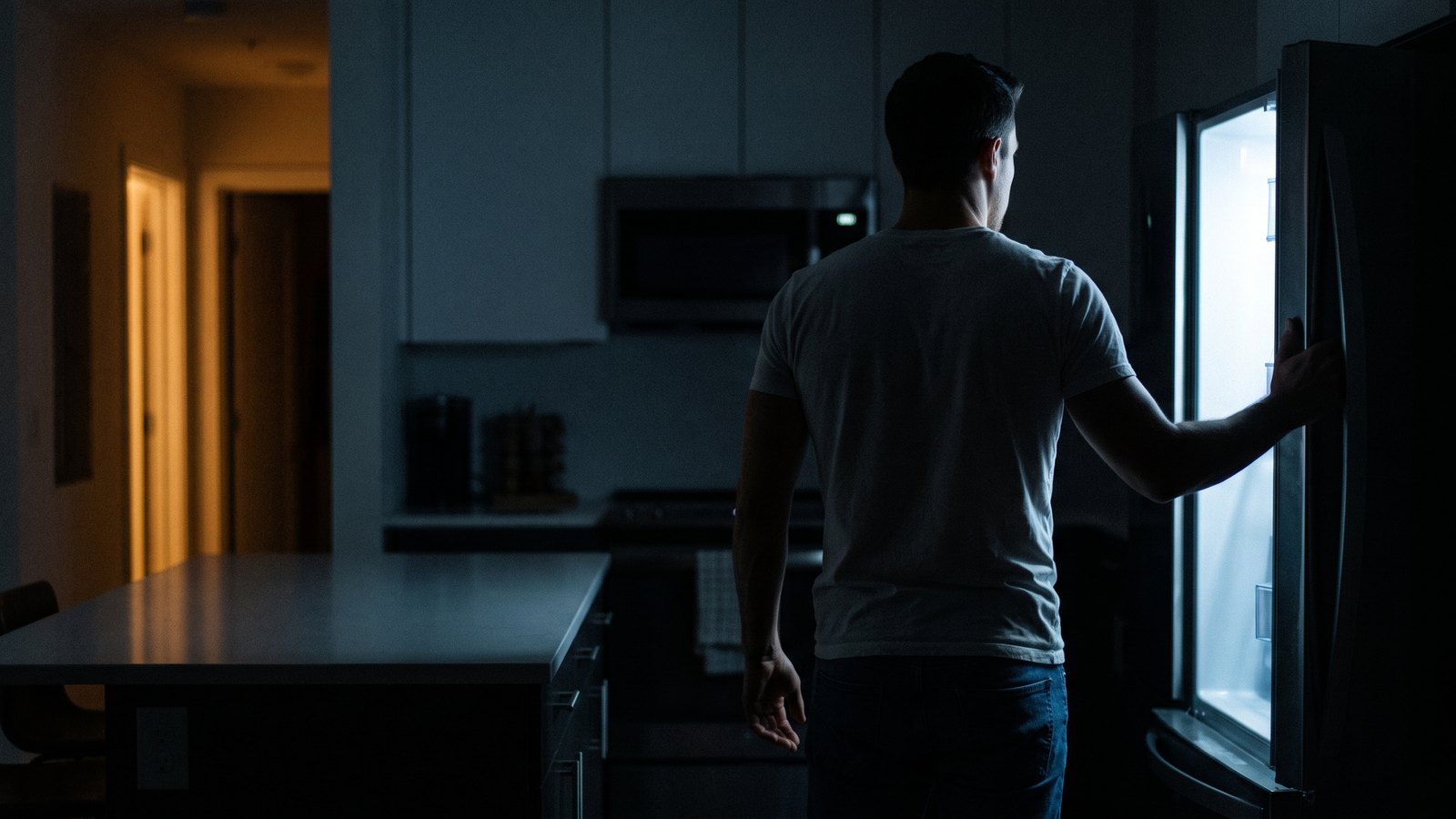
You track your macros all day. Chicken and rice at lunch, a solid session after work, everything on plan. Then it hits 9pm, the house goes quiet, and you are standing in front of the fridge finishing a sleeve of crackers you did not log.
The question every guy asks the next morning is whether the clock made that worse. Would the same crackers at 2pm have been fine?
Here is the verdict up front. Total intake is still the thing that decides your body composition, and no controlled trial has shown that shifting the same calories later wrecks your progress on its own. But late eating is not neutral either. It makes you hungrier, it drops your daytime energy burn slightly, and it usually shows up on the nights you are short on sleep or a few drinks in. The clock is not the villain. It is the setting where the real problems happen.
What happens when researchers control everything
The cleanest study on this locked down every variable that usually muddies the water. Adults with overweight and obesity ran a randomized crossover trial where the food, the nutrients, the physical activity, the sleep, and even the light exposure were held constant. The only thing that changed was whether the meals landed early or roughly four hours later.
Late eating increased hunger. It shifted appetite hormones, raising the ghrelin to leptin ratio both during waking hours and across the full 24 hours. It lowered waking energy expenditure and dropped 24 hour core body temperature. Fat tissue samples showed gene expression moving in a direction consistent with less fat breakdown and more fat storage (Vujovic, 2022).
That is a real finding and it is worth respecting. Read what it actually says, though. Every man in that study ate the same food. The trial was not measuring weight change over months. It was measuring the machinery that makes overeating easier. Late eating did not add fat directly. It stacked the deck so you want more food and burn a little less of it.
Now match the calories and watch the difference shrink
If timing were the main lever, then front-loading your calories should beat back-loading them on a diet. Researchers tested exactly that. Thirty adults with obesity or overweight ran two four week calorie-restricted diets in a crossover, identical in total energy, differing only in distribution: 45 percent of calories at breakfast versus 45 percent at dinner.
Total daily energy expenditure did not differ. Resting metabolic rate did not differ. Weight loss did not differ. The one clear win for the morning-loaded diet was appetite. Those participants reported significantly lower hunger (Ruddick-Collins, 2022).
That is the same story from a different angle. Eating earlier does not burn more fuel. It makes the diet easier to stick to, which is not nothing, but it is a compliance advantage rather than a metabolic one.
The eating window trial nobody quotes correctly
Time-restricted eating gets sold as the fix for late-night eating: close the kitchen at 8pm and the problem solves itself. The largest randomized test of that idea put 116 adults, 60 percent of them men, on either three structured meals a day or a strict noon to 8pm window for 12 weeks.
The window group lost 0.94 kg. The three-meal group lost 0.68 kg. The difference between groups was not statistically significant, and estimated energy intake did not differ either. The authors concluded that time-restricted eating on its own is not more effective than eating throughout the day (Lowe, 2020).
There is a second result in that trial men should know about. In the in-person subgroup, appendicular lean mass index dropped more in the window group. That is arm and leg muscle. Squeezing your eating into eight hours can quietly cut your protein intake and your protein feedings, and if you are past 35 that is the wrong thing to lose. It is the same reason spreading protein across the day beats dumping most of it at dinner.
Where the observational data comes in
Population studies do link later eating to worse outcomes. In 420 adults on a 20 week weight-loss program, late lunch eaters lost less weight and lost it more slowly than early eaters. What makes that study interesting is what was the same between the two groups: energy intake, diet composition, estimated energy expenditure, appetite hormones, and sleep duration all matched. The late eaters were more likely to be evening types, ate lighter breakfasts, and skipped breakfast more often (Garaulet, 2013).
Take that as a signal, not proof. Observational work cannot separate the clock from the kind of guy who eats late. But it lines up with the controlled trials in one useful way: late eating travels with a cluster of other habits, and the cluster is what costs you.
The thing actually driving your 9pm fridge raid
For most men the honest answer is not chronobiology. It is sleep debt.
In the largest controlled laboratory study of its kind, 225 healthy adults were put through five nights of four hours in bed. The sleep-restricted group gained about a kilogram compared with almost nothing in the control group, and men gained more than women. The extra calories were not spread across the day. Participants ate roughly 553 additional calories between 10pm and 4am, from more meals, and a higher share of those late calories came from fat (Spaeth, 2013).
Five hundred and fifty calories a night is the entire deficit you built during the day, gone, four hours after you closed the kitchen mentally. If you are chronically underslept, your late-night eating is a symptom. Fixing bedtime fixes more of it than any rule about what time you stop eating. The same short nights work against you elsewhere too, which is why cutting sleep to five hours drops testosterone within a week.
Alcohol is the other reliable trigger. It lowers the bar on food decisions at exactly the hour your judgment is worst, and it costs you the back half of the night on top of the calories. If your late eating clusters on drinking nights, that is your lever, and it is worth reading what chronic heavy drinking does to a man's hormones before you decide it is a wash.
Eating at night is not automatically working against you
This is the part the fear-based advice leaves out. Food at night is not inherently stored as fat.
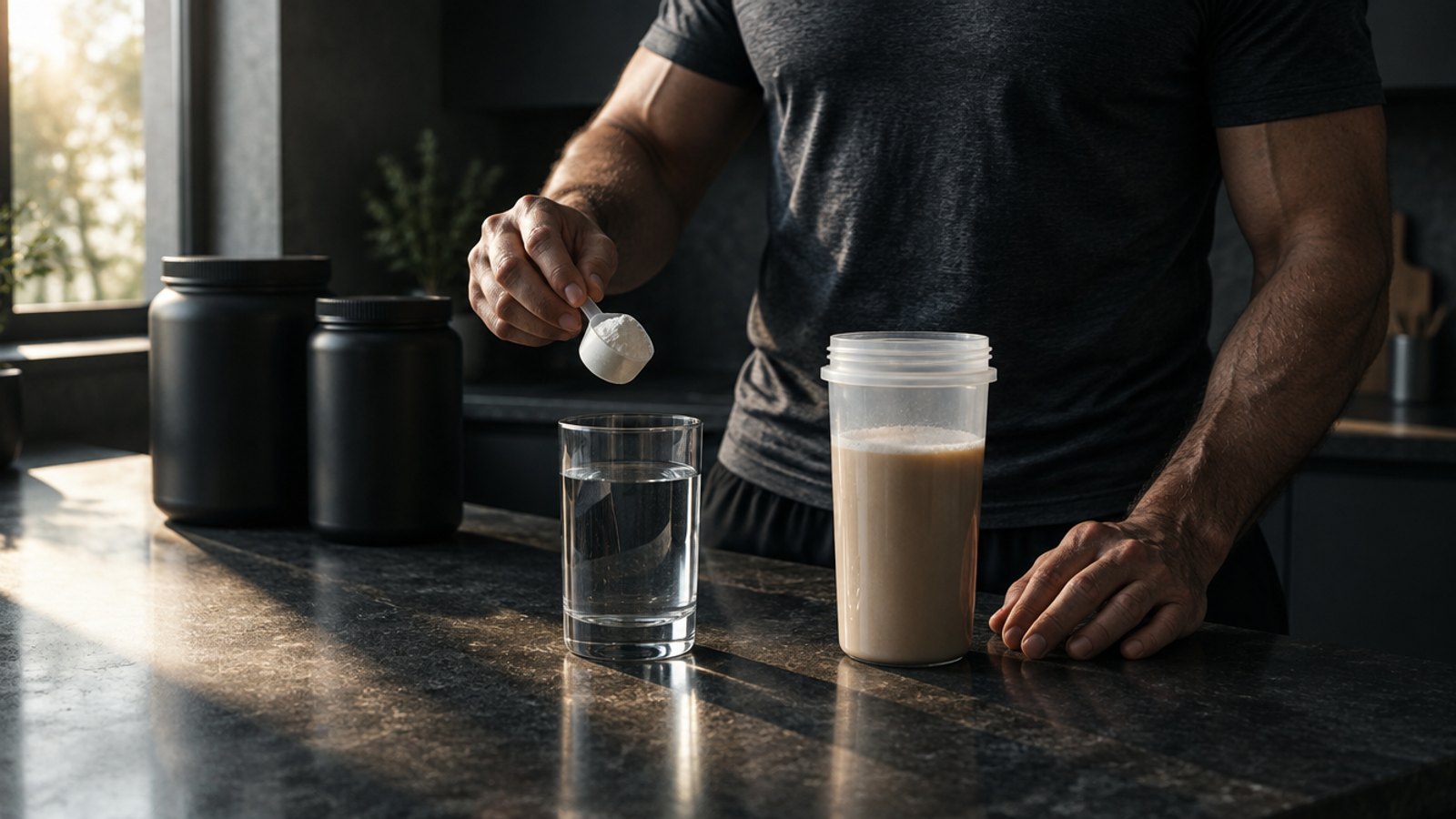
Sixteen healthy young men lifted in the evening, ate a normal recovery meal, and then 30 minutes before bed drank either 40 grams of casein protein or a placebo. The casein was digested and absorbed normally during sleep. Amino acid levels rose and stayed elevated through the night. Whole-body protein synthesis went up, net protein balance went from negative to positive, and mixed muscle protein synthesis was about 22 percent higher (Res, 2012).
Protein before bed after you train is a legitimate tool, not a slip. The problem was never the hour. It was the crackers.
What to actually do about it
Nothing here requires you to close the kitchen at 7pm. Aim at the mechanism instead.
- Fix the front of your day. If breakfast and lunch are thin, the 9pm raid is your body collecting a debt. Front-loading calories did not raise anyone's metabolism in the crossover trial, but it did lower hunger, which is exactly the problem you have.
- Put protein and fiber in your last real meal. Both slow the drift back to the fridge. A dinner that is mostly refined carbs sets up the exact craving you are trying to avoid.
- Treat sleep as a fat-loss variable. Five hundred extra late-night calories is the pooled result of short nights, and men gained more than women in that study. Bedtime is a body composition lever.
- Log the drinking nights separately. Look at a month. If your worst eating nights are your drinking nights, you have a drinking-triggered eating problem, not a meal-timing problem.
- Make the late calories work. If you train in the evening, protein before bed supports overnight recovery. Choose casein, Greek yogurt, or cottage cheese over whatever is in the cupboard.
- Judge it monthly, not nightly. One late meal changes nothing. A pattern of 500 unplanned calories a night is roughly a pound of fat every week.
If evening eating is a standing problem for you rather than an occasional one, the levers that move it are the same ones that move stubborn belly fat after 35, and they work together. More of them are covered across our muscle and fat-loss guides.
The verdict
Eating late does not have some special power to make food turn into fat. When researchers matched the calories, weight loss came out the same whether the food landed at breakfast or dinner. When they gave people an eight hour window, they lost about the same amount as people eating three normal meals, and gave up a little lean mass doing it.
What late eating does is real but indirect. It raises hunger, it nudges your daytime burn down, and it shows up on the nights you are underslept or drinking, when you were going to overeat anyway. That is the honest chain of events, and it is good news, because every link in it is something you can actually change.
Stop watching the clock. Watch your sleep, your protein, and your drinking nights. That is where the calories are coming from.
References
- Vujović N, Piron MJ, Qian J, et al. Late isocaloric eating increases hunger, decreases energy expenditure, and modifies metabolic pathways in adults with overweight and obesity. Cell Metab. 2022. https://pubmed.ncbi.nlm.nih.gov/36198293/
- Ruddick-Collins LC, Morgan PJ, Fyfe CL, et al. Timing of daily calorie loading affects appetite and hunger responses without changes in energy metabolism in healthy subjects with obesity. Cell Metab. 2022. https://pubmed.ncbi.nlm.nih.gov/36087576/
- Lowe DA, Wu N, Rohdin-Bibby L, et al. Effects of Time-Restricted Eating on Weight Loss and Other Metabolic Parameters in Women and Men With Overweight and Obesity: The TREAT Randomized Clinical Trial. JAMA Intern Med. 2020. https://pubmed.ncbi.nlm.nih.gov/32986097/
- Garaulet M, Gómez-Abellán P, Alburquerque-Béjar JJ, et al. Timing of food intake predicts weight loss effectiveness. Int J Obes (Lond). 2013. https://pubmed.ncbi.nlm.nih.gov/23357955/
- Spaeth AM, Dinges DF, Goel N. Effects of experimental sleep restriction on weight gain, caloric intake, and meal timing in healthy adults. Sleep. 2013. https://pubmed.ncbi.nlm.nih.gov/23814334/
- Res PT, Groen B, Pennings B, et al. Protein ingestion before sleep improves postexercise overnight recovery. Med Sci Sports Exerc. 2012. https://pubmed.ncbi.nlm.nih.gov/22330017/
Common questions
Does eating after 8pm make you gain fat?
Eating after 8pm does not make you gain fat by itself. In a randomized crossover where 30 adults ran two isoenergetic calorie-restricted diets, one with 45 percent of calories at breakfast and one with 45 percent at dinner, total energy expenditure, resting metabolic rate, and weight loss all came out the same. The morning-loaded group only reported lower hunger (Ruddick-Collins, 2022). Total intake is what moves your body composition.
So why do controlled studies find anything wrong with late eating?
Controlled studies find problems with late eating because it changes the machinery around eating, not the arithmetic of it. In a tightly controlled crossover that held food, activity, sleep, and light constant, eating the same meals about four hours later increased hunger, raised the ghrelin to leptin ratio, lowered waking energy expenditure, and shifted fat tissue gene expression toward storage (Vujovic, 2022). It makes overeating easier. It does not create fat out of identical calories.
Will a 16:8 eating window stop my late-night snacking?
A 16:8 eating window may enforce a cutoff on late-night snacking, but it is not a fat-loss edge on its own. In a 12 week randomized trial of 116 adults, a noon to 8pm window produced 0.94 kg of weight loss versus 0.68 kg for three structured meals, with no significant difference between groups. The window group also lost more appendicular lean mass in the in-person subgroup (Lowe, 2020). If you use a window, protect your protein intake.
Is protein before bed a bad idea?
Protein before bed is one of the better uses of a late calorie. Sixteen young men who trained in the evening and drank 40 grams of casein 30 minutes before sleep digested and absorbed it normally overnight, raised whole-body protein synthesis, moved net protein balance from negative to positive, and showed about 22 percent higher mixed muscle protein synthesis than placebo (Res, 2012).
What actually causes most late-night eating?
Short sleep, more often than anything else. Across 225 adults in a controlled laboratory study, five nights of four hours in bed led to about 553 extra calories eaten between 10pm and 4am, more weight gain than the control group, and men gained more than women (Spaeth, 2013). Alcohol is the other common trigger. Fix bedtime and drinking nights before you fix the clock.