Muscle and fat loss
Creatine vs Protein for Men Over 40: Which One to Buy First
One is building material you need every day. The other is a cheap fuel-handling aid that adds about three pounds of lean tissue on top of training. Here is which tub a man over 40 should buy first.
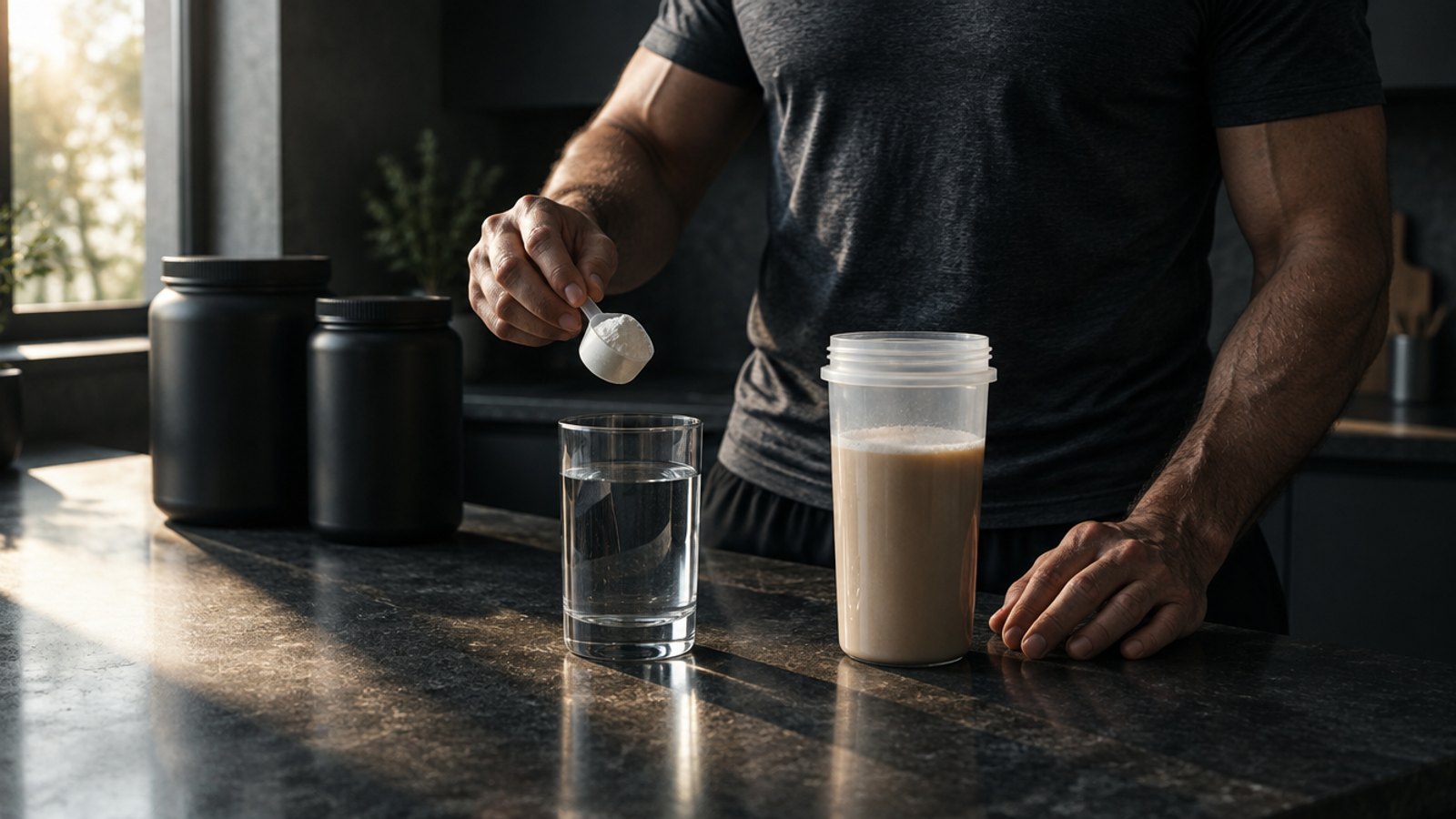
Creatine vs protein is the question most men over 40 ask the first time they stand in front of the supplement wall with a budget for one tub. Here is the straight answer. They are not competing for the same job. Protein is the building material and you need a certain amount of it every day whether it comes from a scoop or a steak. Creatine is a cheap, well-studied fuel-handling aid that lets you do a little more work in the gym, and in men past 40 it adds a small but real amount of lean mass on top of what training alone delivers. If you already eat enough protein, buy creatine first. If you do not, fix the protein first, from food if you can, from a powder if you cannot, and add creatine the month after.
This is education, not medical advice.
Creatine vs protein: what each one actually does
Protein is a macronutrient. Your muscle is built from it and constantly rebuilt with it, so your daily intake sets the ceiling on how much muscle you can repair and add. A protein powder is just a convenient, measured source of the same amino acids you get from chicken, eggs, fish and dairy. It does nothing a well-planned plate cannot do. Its value is that most men do not eat a well-planned plate.
Creatine is a small compound your body already makes and stores in muscle. It helps regenerate ATP, the molecule your muscle spends on short hard efforts, so you get an extra rep or two before you fail. Over months, those extra reps add up to more strength and a little more size. It is not a protein, not a hormone and not a stimulant. If you want the full mechanism, what creatine actually does in a man's body, and what it does not, covers it.
The criteria
- Evidence at the label dose. Randomized trials in adults, ideally men over 40, at the amount on the tub.
- Size of the effect. Pounds of lean mass and kilograms on the bar, not a p-value.
- Dose disclosed. Whether you can see exactly what you are taking.
- Stimulant or not. Both are stimulant-free, so this is a tie, but it rules out nothing.
- Tolerability. Whether it upsets your stomach or your sleep.
- Cost per serving. For the dose the trials used.
Creatine monohydrate
Dose: 3 to 5 g a day. Stimulant: no. Cost: roughly 10 to 25 cents a serving as plain monohydrate powder.
The evidence in older men is better than most men expect. A meta-analysis of 22 randomized trials, 721 adults with an average age of 57 to 70, compared creatine with placebo during resistance training two to three days a week for 7 to 52 weeks. Creatine added 1.37 kg, about three pounds, of lean tissue over training alone, plus a modest extra gain in chest press and leg press strength (Chilibeck et al., 2017). An earlier meta-analysis of 357 older adults averaging 64 found the same pattern: more fat-free mass, better chest and leg press, and a better score on the 30-second chair stand test, with no change in fat mass (Devries and Phillips, 2014).
Two details help a man over 40 use it well. First, you do not have to take it every day to get the muscle effect. A follow-up meta-analysis found that taking creatine only on training days still significantly increased lean tissue and strength over placebo (Forbes et al., 2021). Second, the safety record is long. The International Society of Sports Nutrition's position stand reports that doses up to 30 g a day for five years were safe and well tolerated in healthy people, and recommends about 3 g a day as the habitual intake (Kreider et al., 2017). The only reliable side effect is a pound or two of water inside the muscle in the first weeks.
The honest limit: creatine does nothing without training. Every number above comes from men who were lifting. Take it on the couch and you get the water weight and nothing else. A 2024 review by the field's leading research group summed it up as hope for muscle and strength when combined with resistance training, and mostly hype for bone (Candow and Moriarty, 2024). If you are picking a tub, plain monohydrate beats every fancier form that has been tested against it.
Whey protein powder
Dose: 20 to 40 g per scoop. Stimulant: no. Cost: roughly 1 to 2 dollars per 30 g serving as whey isolate, less as concentrate.
The trial evidence for protein powder is real but smaller per serving than the marketing suggests, because what a powder does is raise your daily total. The largest analysis, 49 trials and 1,863 people, found protein supplementation during resistance training added 0.30 kg of fat-free mass and 2.49 kg on a one-rep max over training alone. Two findings matter for this article. The benefit shrank with increasing age, and it stopped growing once total daily protein passed about 1.6 g per kg of body weight (Morton et al., 2018). An earlier pooled analysis of 22 trials in younger and older subjects put the lean mass gain at 0.69 kg and the leg press gain at 13.5 kg (Cermak et al., 2012).
So a powder helps when it closes a gap and does little when there is no gap. A 2022 meta-analysis of 74 randomized trials found the lean mass benefit of extra protein showed up in adults over 65 at 1.2 to 1.59 g per kg a day, and in younger adults at 1.6 g per kg and up, in both cases alongside resistance training (Nunes et al., 2022). If you already clear those numbers from food, a shake adds calories, not muscle.
The other thing that changes after 40 is per-meal sensitivity. When researchers pooled their lab data, muscle protein synthesis in men around 71 kept rising until about 0.40 g of protein per kg of body weight in a single meal. In men around 22, it topped out near 0.24 (Moore et al., 2015). For a 200 pound man that is roughly 35 g in one sitting, which is where a powder earns its place: it makes a 35 g breakfast easy. The protein-by-bodyweight table gives a straight daily number for your weight, and the protein powder comparison for men over 40 covers isolate, concentrate, casein and plant blends if you decide you need one.
The honest limit: it is food in a tub, priced like a supplement. It only works if your plate is short. Tolerability is good for most men, though whey concentrate bothers the lactose-intolerant, which is one reason the isolate wins that comparison.
Both together: what the head-to-head trials found
This is the comparison that settles the question, because a few trials gave men protein alone, creatine alone, or both, and watched.
In a six-week study, 36 men training with weights took whey protein at 1.2 g per kg a day, whey plus creatine at 0.1 g per kg a day, or a placebo. Lean tissue rose most in the whey plus creatine group, then whey alone, then placebo. Bench press improved more with the combination than with whey alone. Squat strength improved about the same in all three groups (Burke et al., 2001).
In an 11-week trial in resistance-trained men, creatine with carbohydrate, whey alone, and creatine with whey all produced greater one-rep max strength gains on all three lifts and more muscle growth than carbohydrate alone (Cribb et al., 2007). Each one beat nothing. The combination did not lose to either on its own.
The takeaway is simple. They stack. There is no absorption conflict and no overlap in the job each does, so the man who takes both gets both effects.
Protein from food: the free option
Dose: whatever your plate delivers. Cost: already in your grocery bill.
This is the option the supplement aisle does not sell, and it wins on cost every time. A chicken breast, three eggs and a cup of Greek yogurt, spread across the day, deliver what a scoop does with no tub. The trials above measured total daily protein, not powder specifically, so food counts in full. The only reason to buy a powder is that you cannot or will not eat enough of it, and after 40 that is common: appetite drops, breakfast gets skipped, and dinner carries the whole load. The full protein guide shows what 1.6 g per kg looks like on a plate.
All-in-one creatine and protein blends
Dose: usually undisclosed or under the trial amount. Cost: high.
Plenty of tubs now combine whey with a few grams of creatine and a list of extras. The problem is the arithmetic. The creatine dose in a blended scoop is often 1 to 3 g, under the 3 to 5 g the trials used, and you pay a premium for the convenience. Buy the two ingredients separately, and you control both doses for less money. If a blend does not print the exact creatine grams per serving, skip it.
Creatine or protein for men over 40?
Start with a two-question test. Do you lift at least twice a week? Do you eat about 1.6 g of protein per kg of body weight most days?
- Yes and yes: creatine. It is the one that adds something your food cannot.
- Yes and no: protein first, from food if you can manage it, from a powder if you cannot. Add creatine once your daily protein is sorted.
- No and either: neither will do much until you train. Start lifting, then come back to this page. Adding muscle while losing fat after 40 is possible, and the training is the part that makes it work.
Creatine or protein for men over 50?
Same test, with one change: the protein bar moves up. The over-65 trials showed the lean mass benefit starting at 1.2 g per kg a day, and the per-meal number for older men is about 0.40 g per kg (Nunes et al., 2022; Moore et al., 2015). Appetite also tends to shrink, so a powder becomes more useful at 55 than it was at 40. Creatine's evidence in this age group is strong and the chair stand improvement in the Devries meta-analysis is a daily-life benefit, not a gym statistic. For most men over 50 who train, the answer is both, in that order: protein to the target, then creatine.
Which should I take first if I can only afford one?
Creatine, if your protein is already covered, because it costs a fraction of a protein tub and it delivers an effect food cannot. A month of monohydrate costs less than a single tub of whey. If your protein is not covered, the cheaper fix is still food, and the powder comes before creatine only when food has failed.
Can you take creatine and protein together?
Yes. The trials above did exactly that, and the combination outperformed either alone on lean mass. Mix the creatine into the shake if you like. Timing does not matter much for either one; consistency does.
The verdict
Creatine vs protein is the wrong frame. They do different jobs. Protein is a daily requirement and should come from food first, with a powder covering whatever your plate misses. Creatine is the first supplement worth buying for a man over 40 who lifts and already eats enough protein, because it adds about three pounds of lean tissue on top of training, costs cents a day and has decades of safety data behind it. Its downside is that it does nothing without training and adds a little water weight early on. Take both if the budget allows, protein to the target first, then creatine, and give it twelve weeks before judging either. For more on this, browse our muscle and fat loss coverage.
This article is for general education and is not medical advice. If you have kidney disease or take prescription medication, talk to your doctor before starting creatine or raising your protein intake.
References
- Chilibeck PD, Kaviani M, Candow DG, Zello GA. Effect of creatine supplementation during resistance training on lean tissue mass and muscular strength in older adults: a meta-analysis. Open Access J Sports Med. 2017. https://pubmed.ncbi.nlm.nih.gov/29138605/
- Devries MC, Phillips SM. Creatine supplementation during resistance training in older adults: a meta-analysis. Med Sci Sports Exerc. 2014. https://pubmed.ncbi.nlm.nih.gov/24576864/
- Forbes SC, Candow DG, Ostojic SM, Roberts MD, Chilibeck PD. Meta-analysis examining the importance of creatine ingestion strategies on lean tissue mass and strength in older adults. Nutrients. 2021. https://pubmed.ncbi.nlm.nih.gov/34199420/
- Kreider RB, Kalman DS, Antonio J, et al. International Society of Sports Nutrition position stand: safety and efficacy of creatine supplementation in exercise, sport, and medicine. J Int Soc Sports Nutr. 2017. https://pubmed.ncbi.nlm.nih.gov/28615996/
- Candow DG, Moriarty T. Effects of creatine monohydrate supplementation on muscle, bone and brain: hope or hype for older adults? Curr Osteoporos Rep. 2024. https://pubmed.ncbi.nlm.nih.gov/39509039/
- Morton RW, Murphy KT, McKellar SR, et al. A systematic review, meta-analysis and meta-regression of the effect of protein supplementation on resistance training-induced gains in muscle mass and strength in healthy adults. Br J Sports Med. 2018. https://pubmed.ncbi.nlm.nih.gov/28698222/
- Cermak NM, Res PT, de Groot LC, Saris WH, van Loon LJ. Protein supplementation augments the adaptive response of skeletal muscle to resistance-type exercise training: a meta-analysis. Am J Clin Nutr. 2012. https://pubmed.ncbi.nlm.nih.gov/23134885/
- Nunes EA, Colenso-Semple L, McKellar SR, et al. Systematic review and meta-analysis of protein intake to support muscle mass and function in healthy adults. J Cachexia Sarcopenia Muscle. 2022. https://pubmed.ncbi.nlm.nih.gov/35187864/
- Moore DR, Churchward-Venne TA, Witard O, et al. Protein ingestion to stimulate myofibrillar protein synthesis requires greater relative protein intakes in healthy older versus younger men. J Gerontol A Biol Sci Med Sci. 2015. https://pubmed.ncbi.nlm.nih.gov/25056502/
- Burke DG, Chilibeck PD, Davidson KS, Candow DG, Farthing J, Smith-Palmer T. The effect of whey protein supplementation with and without creatine monohydrate combined with resistance training on lean tissue mass and muscle strength. Int J Sport Nutr Exerc Metab. 2001. https://pubmed.ncbi.nlm.nih.gov/11591884/
- Cribb PJ, Williams AD, Stathis CG, Carey MF, Hayes A. Effects of whey isolate, creatine, and resistance training on muscle hypertrophy. Med Sci Sports Exerc. 2007. https://pubmed.ncbi.nlm.nih.gov/17277594/
Common questions
Is creatine or protein better for building muscle after 40?
For building muscle after 40, neither creatine nor protein replaces the other. Protein sets the ceiling on how much muscle you can build and should reach about 1.6 g per kg of body weight a day, from food first (Morton et al., 2018). Creatine then adds roughly 1.37 kg of lean tissue on top of resistance training in adults over 55, in a meta-analysis of 22 trials (Chilibeck et al., 2017). If your protein is already covered, creatine is the one that adds something new.
Should I take creatine or protein powder first?
If you eat enough protein, buy creatine first: it costs cents a day and delivers an effect food cannot. If you do not, fix protein first, ideally from food, with a powder only to cover what your plate misses. Add creatine the following month.
Can I take creatine and protein together?
You can take creatine and protein together. In a six-week trial, men taking whey plus creatine gained more lean tissue and more bench press strength than men taking whey alone or placebo (Burke et al., 2001). There is no absorption conflict; you can mix the creatine into the shake.
Does creatine work without protein?
Creatine only works alongside resistance training, and training only builds muscle if you eat enough protein. Creatine on a low-protein diet gives you the water weight and little else. Get protein to the target, then creatine does its job.
Do I need protein powder if I take creatine?
You need protein powder alongside creatine only if your food falls short of about 1.6 g of protein per kg a day, or about 1.2 g per kg if you are over 65 (Nunes et al., 2022). Protein powder is food in a tub. It adds nothing once your daily total is covered.
How much creatine should a man over 40 take?
Three to five grams of creatine monohydrate a day. No loading phase is needed, and taking it only on training days still increased lean tissue and strength in a meta-analysis of older adults (Forbes et al., 2021). Men with kidney disease should talk to their doctor first.
Is creatine or protein better for men over 50?
Men over 50 are better off with both protein and creatine, in that order: protein to the target first, because appetite drops and older muscle needs about 0.40 g per kg in a single meal to respond fully (Moore et al., 2015), then creatine, which improved lean mass, leg and chest strength and the chair stand test in adults averaging 64 (Devries and Phillips, 2014).