Muscle & Fat Loss
How Much Protein to Build Muscle by Bodyweight: Is 100g Enough?
Is 80g enough? 100g? 150g? The answer depends on what you weigh, so here is the number for your bodyweight, with the trials behind it.
How much protein to build muscle by bodyweight comes down to one number: about 1.6 grams per kilogram of bodyweight a day, which is roughly 0.73 grams per pound. For a 180 pound man that is about 130 grams. So is 100g of protein enough to build muscle? For a man under about 140 pounds, yes. For most grown men, it is a solid start that lands a little short of the target.
That 1.6 figure is not a gym guess. A meta-analysis of 49 trials and 1,863 people found that muscle gains from lifting stopped improving once total protein passed about 1.62 grams per kilogram a day (Morton et al., 2018). Below it, more protein helped. Above it, the extra did not add more muscle. Everything on this page is that number applied to a real bodyweight. For the bigger picture on leucine, food sources and why more is not better, our full guide to how much protein men need to build muscle covers it. This page is the math. It is education, not medical advice.
The quick math: grams per pound
Take your weight in pounds and multiply by 0.73. That is the floor. Multiply by 1.0 for the ceiling. The floor comes from the Morton break point. The ceiling comes from a study that measured protein needs directly in eight trained male bodybuilders and put the recommended intake at 2.2 grams per kilogram, which is exactly one gram per pound (Bandegan et al., 2017). The International Society of Sports Nutrition lands in the same place, calling 1.4 to 2.0 grams per kilogram enough for most people who train (Jäger et al., 2017).
- 150 lb man: about 110 g a day, up to 150 g
- 160 lb: about 115 g, up to 160 g
- 170 lb: about 125 g, up to 170 g
- 180 lb: about 130 g, up to 180 g
- 190 lb: about 140 g, up to 190 g
- 200 lb: about 145 g, up to 200 g
- 220 lb: about 160 g, up to 220 g
So the old gram per pound rule is not wrong. It is the top of the range, not the minimum. Most men building muscle at maintenance calories do fine near the floor.
Is 80g of protein enough to build muscle?
For most men, no. 80 grams covers the 1.6 target only if you weigh around 110 pounds. For a 180 pound man, 80 grams is about 1.0 gram per kilogram. You will still build some muscle if you train hard, because protein does not work like an on and off switch. But you are leaving a lot on the table.
A meta-analysis of 105 trials and 5,402 people mapped exactly where the payoff sits. Below about 1.3 grams per kilogram a day, each extra 0.1 gram per kilogram was linked to roughly 0.39 kg more lean mass. Above that point, the same step added about 0.12 kg (Tagawa et al., 2021). At 80 grams, an average sized man is on the steep part of that curve, which is good news: it is where adding protein pays off the most.
Is 90g of protein enough to build muscle?
Only if you weigh about 125 pounds or less. For a 170 pound man, 90 grams is roughly 1.2 grams per kilogram. That is well above the basic daily minimum and it will support real progress for a beginner, but it still sits under the point where the trials stopped seeing extra gains. Add one more solid protein serving a day and you are there.
Is 100g of protein enough to build muscle?
This is the one most men ask, because 100 grams sounds like a lot. It covers the 1.6 target for a man up to about 140 pounds. For a 180 pound man, 100 grams is about 1.2 grams per kilogram. That is close to the 1.3 bend in the Tagawa curve and short of the 1.6 plateau in Morton.
Translation: 100 grams will build muscle, and it beats a haphazard intake by a mile. But a typical grown man training hard should aim a little higher. The gap is usually one extra meal's worth, about 30 grams.
Is 120g of protein enough to build muscle?
For most men, yes. 120 grams covers the target for a man up to about 165 pounds, and for a 180 pound man it works out to about 1.5 grams per kilogram, inside the ISSN range of 1.4 to 2.0 (Jäger et al., 2017). If you are 200 pounds or heavier, or you are cutting, push it up.
Is 150g of protein enough to build muscle?
Yes, for nearly every man under about 205 pounds. At 150 grams, a 180 pound man is at roughly 1.8 grams per kilogram, which is past the plateau. Going higher will not add much muscle while you eat at maintenance or above. It earns its keep during a diet, which is covered below.
How much protein for a 180 lb man to build muscle?
About 130 grams a day, with 130 to 180 grams as the useful range. 180 pounds is about 82 kilograms. At 1.6 grams per kilogram that is 131 grams. At the 2.2 ceiling from the bodybuilder study it is 180 grams.
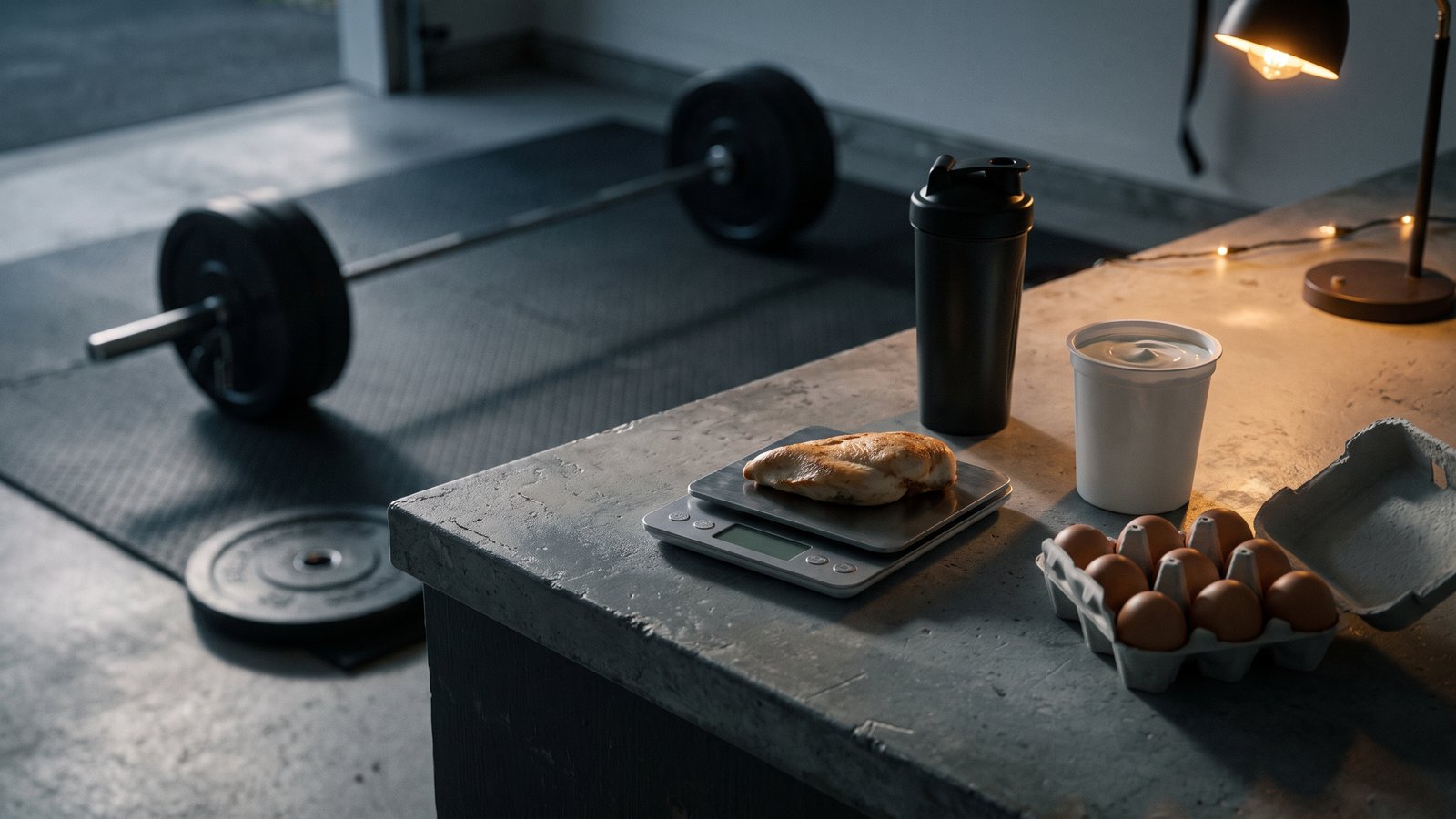
Split across four meals, 130 grams is roughly 30 to 35 grams a sitting. That is a chicken breast, a can of tuna, or a cup of cottage cheese with a couple of eggs. Nothing extreme, and no shake required unless it makes the day easier.
How much protein over 40 and over 50
The daily target barely moves with age, but the per meal dose does. When researchers pooled muscle protein synthesis data from younger and older men, men around 71 needed about 0.40 grams per kilogram in a single meal to max out the response, compared with about 0.24 in men around 22 (Moore et al., 2015). For a 180 pound man over 50, that means meals closer to 30 to 40 grams rather than 20. The Morton meta-analysis pointed the same way: the extra lean mass from added protein got smaller as age went up (Morton et al., 2018). Older muscle is not broken. It just needs a bigger nudge per meal, which is also why the standard scoop size on most tubs comes up short: which protein powder suits a man over 40, and how big the scoop should be compares whey isolate, concentrate, casein and plant blends on that dose.
For adults past 65, an expert panel set the floor at 1.0 to 1.2 grams per kilogram for everyday health, and at least 1.2 for anyone who is active (Bauer et al., 2013). That is a minimum for keeping muscle, not a target for building it. If you are lifting past 50, use the same 1.6 target as a younger man and make each meal count. What actually works for weight loss after 50 leans on this same protein floor to protect muscle while the scale comes down.
How much protein when you are cutting
This is where the higher numbers earn their place. In a deficit your body is more willing to break down muscle, and protein is the main thing pushing back. A systematic review of lean, resistance trained athletes on a diet recommended 2.3 to 3.1 grams per kilogram of lean mass, scaled up the leaner you get and the harder you cut (Helms et al., 2014). The ISSN gives a 2.3 to 3.1 grams per kilogram range for trained people in a calorie deficit (Jäger et al., 2017).
For a 180 pound man at about 15 percent body fat, lean mass is roughly 153 pounds, or 70 kilograms. That puts his cutting target around 160 to 215 grams. In practice, landing near one gram per pound of bodyweight while dieting is a simple way to stay in that zone. High protein is also what makes building muscle while losing fat after 40 possible at all.
What if you are carrying extra weight?
If you are 250 pounds and a fair amount of that is fat, multiplying your full bodyweight by 0.73 gives about 180 grams, which is hard to eat and more than you need. A simple fix is to run the math on your goal weight instead. A 250 pound man aiming for 200 would target about 145 grams. This is a practical rule of thumb rather than a trial result, but it keeps the number realistic.
Can you eat 100 grams of protein in one meal?
You can, and your body uses more of it than the old 30 gram rule claimed. In a 2023 tracer study, eating 100 grams of protein after a workout produced a bigger and longer anabolic response, lasting more than 12 hours, than eating 25 grams, and very little of the extra protein was burned off as fuel (Trommelen et al., 2023).
That does not mean one giant meal beats four normal ones. Total daily protein is still the strongest predictor of muscle growth in the training studies (Schoenfeld et al., 2013), and spreading it out is easier on appetite and schedule. But if your day only allows a big dinner, the protein in it is not wasted. More on whether the anabolic window is real and how to split your protein.
The verdict
Multiply your bodyweight in pounds by 0.73 and that is your daily protein floor for building muscle. Multiply by 1.0 for the ceiling. For a 180 pound man that is 130 to 180 grams. 100 grams is enough for smaller men and a good start for everyone else. Push toward a gram per pound if you are cutting, and eat 30 to 40 gram meals if you are past 50. Then train hard, because protein only builds muscle when lifting gives it a reason to. The rest of our muscle and fat loss guides cover the training side.
This article is for general education and is not medical advice. If you have kidney disease or another health condition, talk to your doctor before raising your protein intake.
References
- Morton RW, Murphy KT, McKellar SR, et al. A systematic review, meta-analysis and meta-regression of the effect of protein supplementation on resistance training-induced gains in muscle mass and strength in healthy adults. Br J Sports Med. 2018. https://pubmed.ncbi.nlm.nih.gov/28698222/
- Bandegan A, Courtney-Martin G, Rafii M, Pencharz PB, Lemon PW. Indicator amino acid-derived estimate of dietary protein requirement for male bodybuilders on a nontraining day is several-fold greater than the current recommended dietary allowance. J Nutr. 2017. https://pubmed.ncbi.nlm.nih.gov/28179492/
- Jäger R, Kerksick CM, Campbell BI, et al. International Society of Sports Nutrition Position Stand: protein and exercise. J Int Soc Sports Nutr. 2017. https://pubmed.ncbi.nlm.nih.gov/28642676/
- Tagawa R, Watanabe D, Ito K, et al. Dose-response relationship between protein intake and muscle mass increase: a systematic review and meta-analysis of randomized controlled trials. Nutr Rev. 2021. https://pubmed.ncbi.nlm.nih.gov/33300582/
- Moore DR, Churchward-Venne TA, Witard O, et al. Protein ingestion to stimulate myofibrillar protein synthesis requires greater relative protein intakes in healthy older versus younger men. J Gerontol A Biol Sci Med Sci. 2015. https://pubmed.ncbi.nlm.nih.gov/25056502/
- Bauer J, Biolo G, Cederholm T, et al. Evidence-based recommendations for optimal dietary protein intake in older people: a position paper from the PROT-AGE Study Group. J Am Med Dir Assoc. 2013. https://pubmed.ncbi.nlm.nih.gov/23867520/
- Helms ER, Zinn C, Rowlands DS, Brown SR. A systematic review of dietary protein during caloric restriction in resistance trained lean athletes: a case for higher intakes. Int J Sport Nutr Exerc Metab. 2014. https://pubmed.ncbi.nlm.nih.gov/24092765/
- Trommelen J, van Lieshout GAA, Nyakayiru J, et al. The anabolic response to protein ingestion during recovery from exercise has no upper limit in magnitude and duration in vivo in humans. Cell Rep Med. 2023. https://pubmed.ncbi.nlm.nih.gov/38118410/
- Schoenfeld BJ, Aragon AA, Krieger JW. The effect of protein timing on muscle strength and hypertrophy: a meta-analysis. J Int Soc Sports Nutr. 2013. https://pubmed.ncbi.nlm.nih.gov/24299050/
Common questions
Is 100g of protein enough to build muscle?
For a man up to about 140 pounds, yes. For a 180 pound man, 100 grams is about 1.2 grams per kilogram, which will build muscle but sits below the roughly 1.6 g/kg point where a meta-analysis of 49 trials stopped seeing extra gains (Morton et al., 2018). Most average sized men training hard should aim for about 30 grams more.
How much protein do I need a day to build muscle?
About 1.6 grams per kilogram of bodyweight, or 0.73 grams per pound, as the floor, and up to 2.2 grams per kilogram, or 1 gram per pound, as the ceiling. The ISSN puts 1.4 to 2.0 g/kg as enough for most people who train (Jäger et al., 2017).
How much protein should a 180 lb man eat to build muscle?
About 130 grams a day, with 130 to 180 grams as the useful range. Split across four meals that is roughly 30 to 35 grams each.
Is 1 gram of protein per pound too much?
One gram of protein per pound is not harmful for a healthy man, but it is the top of the useful range rather than the minimum. It matches the 2.2 g/kg estimate from a study of trained male bodybuilders (Bandegan et al., 2017) and makes the most sense while cutting. At maintenance calories, most men get the same muscle from about 0.73 grams per pound.
How much protein does a man over 50 need to build muscle?
Use the same 1.6 g/kg daily target as a younger man, but eat bigger protein meals. Older men needed about 0.40 g/kg in a single meal to max out muscle protein synthesis, compared with about 0.24 g/kg in young men (Moore et al., 2015). For a 180 pound man that is 30 to 40 grams per meal.
Can your body use more than 30 grams of protein at once?
Your body can use more than 30 grams of protein at once. In a 2023 tracer study, 100 grams of protein after exercise produced a larger anabolic response lasting more than 12 hours compared with 25 grams (Trommelen et al., 2023). Total daily intake still matters most, so spreading protein across the day remains the easy default.
How much protein should I eat while cutting?
You should eat more protein while cutting than at maintenance. A systematic review of lean trained athletes in a calorie deficit recommended 2.3 to 3.1 grams per kilogram of lean mass (Helms et al., 2014). For most men that lands near one gram per pound of bodyweight.