Muscle & Fat Loss
Best Protein Powder for Men Over 40: Isolate, Concentrate, Casein or Plant
Every ranked list crowns a different tub. The thing that actually changes after 40 is the dose per meal, and almost nobody mentions it.

Search "best protein powder for men over 40" and you get ranked lists built out of commission rates. Nine tubs, nine different winners, and not one of them tells you the thing that actually changes after 40.
Here is the verdict up front. The best protein powder for men over 40 is a whey isolate at 30 to 40 grams per serving, from a brand that carries a third-party testing seal. If dairy is a problem, a blended plant powder at a slightly larger scoop does the same job. The reason has nothing to do with brand and everything to do with dose, and that is the part the ranked lists skip.
What actually changes after 40
Aging muscle does not stop responding to protein. It gets less sensitive to small amounts of it.
Researchers pooled data from healthy older men, averaging 71 years, and younger men, averaging 22, who had eaten measured protein doses from zero to 40 grams. Muscle protein synthesis in the younger men plateaued at about 0.24 grams per kilogram of body weight in a single meal. In the older men it did not level off until about 0.40 grams per kilogram (Moore et al., 2015).
Run the numbers on a 200 pound man. That is 0.24 times 91 kilograms, or roughly 22 grams per meal if he is 25. At 55 it is 0.40 times 91, or about 36 grams. Same man, same muscle, a dose that needs to be half again as big to get the same response.
A separate dose-response trial makes the same point with whey specifically. Thirty-seven older men took 0, 10, 20 or 40 grams of whey isolate after a bout of leg training. At rest, 20 grams was enough to lift muscle protein synthesis. After training, 40 grams beat 20 grams outright, which is not what happens in younger men, where the response saturates around 20 (Yang et al., 2012).
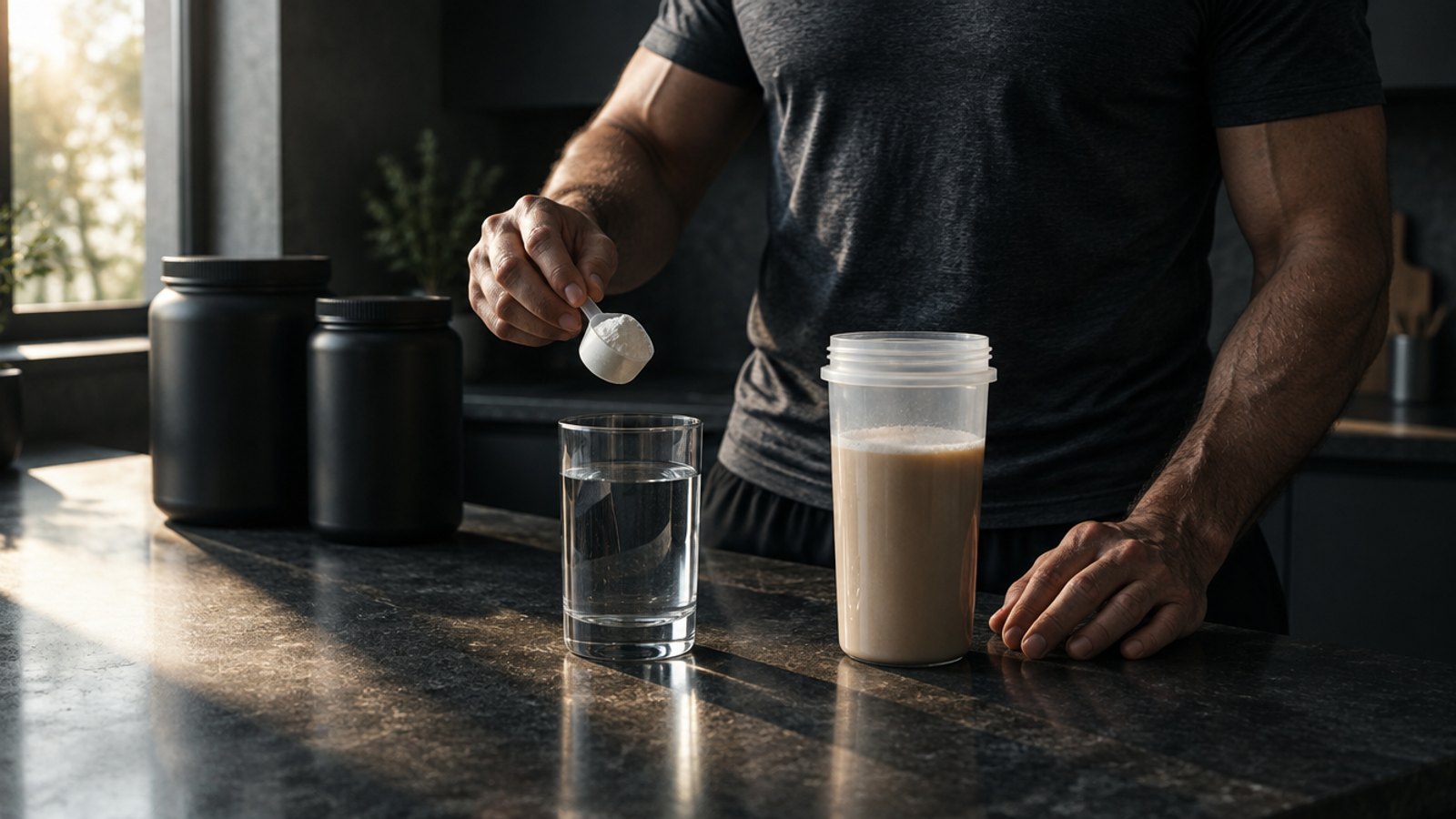
That single finding is the whole reason this article exists. The standard scoop on most tubs is 24 grams of protein, sized for a 25-year-old. If you are over 40 and lifting, you want closer to a scoop and a half.
The criteria this comparison uses
Every powder below gets judged on the same five things:
- Protein per scoop and leucine content. Leucine is the amino acid that flips the switch on muscle protein synthesis, and you want roughly 3 grams of it per serving.
- Digestion speed. Fast proteins spike the response. Slow ones drip it out.
- Lactose and tolerability. A powder you stop taking because it wrecks your stomach builds nothing.
- Third-party testing. NSF Certified for Sport or Informed Choice on the tub, not a promise on the website.
- Cost per 30 grams of protein. The honest unit, since the scoop sizes are all different.
Whey isolate
Protein: about 90 percent by weight, 25 to 27 grams in a typical scoop, close to 3 grams of leucine. Lactose: under a gram. Speed: fast.
Whey is the reference standard for a reason. When young men drank drinks matched for essential amino acids, whey raised muscle protein synthesis about 93 percent more than casein at rest and about 122 percent more after resistance exercise, and it beat soy by 31 percent after exercise (Tang et al., 2009). The researchers put it down to how fast it digests and how much leucine it carries.
Isolate is filtered further than concentrate, which strips most of the lactose and fat out. For a man in his forties or fifties who has quietly become less tolerant of dairy than he was, that filtering is the difference between a shake he keeps drinking and one he abandons in the cupboard.
The catch: it costs more per gram than concentrate, and the extra filtering buys you tolerability, not a bigger muscle response. If your gut handles concentrate fine, you are paying for nothing.
Whey concentrate
Protein: 70 to 80 percent by weight, so 20 to 24 grams in the same size scoop. Lactose: a few grams. Speed: fast.
Concentrate is the budget pick and it is a genuinely good one. The amino acid profile is the same protein, just less concentrated, with some milk fat and lactose along for the ride.
The catch, and it is the one that matters over 40: a 24 gram scoop of concentrate leaves a 200 pound man short of the 36 grams his muscle now wants in a sitting. You end up using a scoop and a half anyway, which erases most of the price advantage and doubles the lactose. If your stomach is fine with dairy, take the savings. If it is not, isolate wins.
Casein
Protein: 24 to 28 grams per scoop. Speed: slow, releasing amino acids over hours.
Casein loses the head-to-head on acute muscle protein synthesis by a wide margin (Tang et al., 2009), and men read that as "casein is worse." It is not worse, it is for a different job. Its job is overnight.
Forty-four young men ran a 12-week resistance training program. One group drank 27.5 grams of protein before bed every night, the other a non-caloric placebo. The pre-sleep group gained more muscle mass and more strength over the twelve weeks (Snijders et al., 2015). An earlier trial showed the mechanism: protein eaten before sleep is digested and absorbed normally overnight and raises muscle protein synthesis during recovery (Res et al., 2012).
Worth knowing that both trials used young men. Nobody has run the same twelve weeks in 45-year-olds. Given that older muscle needs more protein per feeding, not less, there is no reason to expect the effect disappears, but that is reasoning rather than evidence, and it should be labeled as such.
The catch: casein is a second tub, not a replacement for the first. Buy it after you have the basics covered, not instead of them.
Plant blends
Protein: 20 to 25 grams per scoop, varies widely. Speed: moderate. Lactose: none.
This is where the internet is most wrong, in both directions. Pea protein is low in methionine, rice protein is low in lysine, and a single-source plant powder does carry a weaker leucine punch gram for gram. That is real.
What is also real is that it stops mattering once the dose is right. A meta-analysis of 16 randomized trials compared animal protein against plant protein for lean mass and strength. Protein source did not affect changes in absolute lean mass or muscle strength. Animal protein slightly favored percent lean mass, and the only group where it gained an absolute edge was adults under 50, where the difference was 0.41 kilograms (Lim et al., 2021).
Read that as written. Over twelve weeks and change, 0.41 kilograms is about nine tenths of a pound, in the younger group, on percentage measures. If you are lactose intolerant, vegan, or just sick of dairy, the honest answer is that a pea and rice blend at a slightly bigger scoop will get you there.
The catch: read the panel rather than the front. Plant powders vary far more than whey does, and some of them are 60 percent protein with the rest made up of gums and flavoring.
Collagen, and why it is not on this list
Collagen is not a muscle building protein. It has almost no leucine and no tryptophan at all, which means it does not count toward the per-meal threshold that the research above is built on. It has its own use case for connective tissue, and that is a separate conversation from this one. If you are drinking collagen and counting it as your protein, you are shorter on protein than you think.
The verdict
Winner: whey isolate, at 30 to 40 grams per serving. It carries the most leucine per gram, digests fastest, has the strongest direct evidence in older men specifically (Yang et al., 2012), and the low lactose means you keep taking it. Buy a tub with NSF Certified for Sport or Informed Choice on the label, use a scoop and a half after training, and stop reading ranked lists.
If dairy is out: a pea and rice blend, one and a half scoops, on the strength of the meta-analysis showing no difference in absolute lean mass or strength between sources (Lim et al., 2021).
If money is tight: concentrate, and just use more of it.
Add casein only if you already have the first two handled, for the pre-bed dose.
Now the part that undoes all of it if you get it wrong. A meta-analysis of 49 studies and 1,863 participants found protein supplementation significantly increased lean mass and one-rep-max strength during prolonged resistance training, and found the breakpoint: beyond a total intake of about 1.62 grams per kilogram per day, extra protein added no further gains. The effect also shrank as participants got older, and was larger in people who were already training (Morton et al., 2018).
Two things fall out of that. The powder is a tool for hitting a daily total, and the total is the thing that matters. And the fact that the effect shrinks with age is not a reason to take less, it is the reason the per-meal dose has to go up. If you want the full arithmetic, whether 80, 100 or 120 grams a day is enough for your bodyweight runs the numbers, and what protein actually does for muscle growth covers the mechanism.
How much protein do you need over 40
The PROT-AGE study group, an international panel convened by the European Union Geriatric Medicine Society, recommends at least 1.0 to 1.2 grams per kilogram per day for adults over 65 to maintain lean mass and function, and 1.2 or more for those who exercise (Bauer et al., 2013). That is a floor for general health, not a target for building muscle. For a man over 40 who lifts, 1.6 grams per kilogram is the number the training literature converges on, and Morton found nothing above 1.62.
For a 200 pound man that is roughly 145 grams a day. Four meals at 36 grams gets you there, and one of those can be the shake. How you spread it across the day is a smaller lever than the total, but it is not nothing, and what the research says about protein timing and per-meal distribution covers where the anabolic window story came from and what survived it.
What about heavy metals in protein powder
You have seen the headlines. Here is what the actual risk assessment found.
Researchers took the arsenic, cadmium, mercury and lead concentrations reported in consumer testing of protein powders and ran them through EPA reference doses, modeling one and three servings a day. Every hazard index came in under 1, meaning no increased health risk at typical intake, and modeled blood lead levels stayed under the CDC guidance value. The highest readings, the ones that approached the threshold, were in mass gainer products. The lowest were in whey (Bandara et al., 2020).
Worth noting the analysis came from a risk consulting firm, so read it as one careful modeling exercise rather than the last word. The practical takeaway holds either way: buy third-party tested whey, skip the mass gainers, and do not drink six shakes a day.
Does protein powder still work if you are not 25
Yes, and the data is specific about it. Aging muscle is less sensitive to a small dose, not deaf to a proper one. Yang's older men hit a bigger muscle protein synthesis response at 40 grams post-exercise than at 20, which is exactly the result you would want if the fix were simply "eat more per sitting" (Yang et al., 2012).
What powder cannot do is replace the stimulus. Protein supplementation only produced those gains alongside resistance training in every trial in the Morton meta-analysis. If you are drinking shakes and not lifting, you are buying expensive milk. And if fat loss is the goal alongside holding muscle, whether you can add muscle and lose fat at the same time past 40 lays out the conditions that have to be true. More muscle and fat loss verdicts are here.
The bottom line
Whey isolate, a scoop and a half, third-party tested. Plant blend if dairy is out. Concentrate if money is tight. Casein at night once the rest is handled. Hit 1.6 grams per kilogram a day, lift three or four times a week, and stop shopping for a better tub.
This is education, not medical advice. If you have kidney disease, talk to your doctor before raising your protein intake.
References
- Moore DR, Churchward-Venne TA, Witard O, et al. Protein ingestion to stimulate myofibrillar protein synthesis requires greater relative protein intakes in healthy older versus younger men. J Gerontol A Biol Sci Med Sci. 2015. https://pubmed.ncbi.nlm.nih.gov/25056502/
- Yang Y, Breen L, Burd NA, et al. Resistance exercise enhances myofibrillar protein synthesis with graded intakes of whey protein in older men. Br J Nutr. 2012. https://pubmed.ncbi.nlm.nih.gov/22313809/
- Tang JE, Moore DR, Kujbida GW, Tarnopolsky MA, Phillips SM. Ingestion of whey hydrolysate, casein, or soy protein isolate: effects on mixed muscle protein synthesis at rest and following resistance exercise in young men. J Appl Physiol. 2009. https://pubmed.ncbi.nlm.nih.gov/19589961/
- Snijders T, Res PT, Smeets JSJ, et al. Protein ingestion before sleep increases muscle mass and strength gains during prolonged resistance-type exercise training in healthy young men. J Nutr. 2015. https://pubmed.ncbi.nlm.nih.gov/25926415/
- Res PT, Groen B, Pennings B, et al. Protein ingestion before sleep improves postexercise overnight recovery. Med Sci Sports Exerc. 2012. https://pubmed.ncbi.nlm.nih.gov/22330017/
- Lim MT, Pan BJ, Toh DWK, Sutanto CN, Kim JE. Animal protein versus plant protein in supporting lean mass and muscle strength: a systematic review and meta-analysis of randomized controlled trials. Nutrients. 2021. https://pubmed.ncbi.nlm.nih.gov/33670701/
- Morton RW, Murphy KT, McKellar SR, et al. A systematic review, meta-analysis and meta-regression of the effect of protein supplementation on resistance training-induced gains in muscle mass and strength in healthy adults. Br J Sports Med. 2018. https://pubmed.ncbi.nlm.nih.gov/28698222/
- Bauer J, Biolo G, Cederholm T, et al. Evidence-based recommendations for optimal dietary protein intake in older people: a position paper from the PROT-AGE Study Group. J Am Med Dir Assoc. 2013. https://pubmed.ncbi.nlm.nih.gov/23867520/
- Bandara SB, Towle KM, Monnot AD. A human health risk assessment of heavy metal ingestion among consumers of protein powder supplements. Toxicol Rep. 2020. https://pubmed.ncbi.nlm.nih.gov/33005567/
Common questions
What is the best protein powder for men over 40?
Whey isolate, at 30 to 40 grams of protein per serving, from a brand carrying NSF Certified for Sport or Informed Choice. It has the most leucine per gram, digests fastest, and the low lactose means you keep taking it. The dose matters more than the brand: older men needed about 0.40 grams per kilogram of bodyweight in a single meal to maximally stimulate muscle protein synthesis, against 0.24 in younger men (Moore et al., 2015).
How much protein powder should a man over 40 take per serving?
Roughly a scoop and a half, or 30 to 40 grams. In a trial of 37 older men, 20 grams of whey isolate was enough at rest, but after resistance exercise 40 grams produced a significantly bigger muscle protein synthesis response than 20 grams, which is not what happens in younger men (Yang et al., 2012).
Is whey isolate or concentrate better after 40?
Whey isolate and whey concentrate are the same protein at different purities. Isolate is about 90 percent protein with under a gram of lactose, concentrate is 70 to 80 percent with a few grams. Isolate is worth the extra cost only if dairy bothers you or you want the bigger dose without a bigger scoop. If your stomach handles concentrate fine, use more of it and keep the savings.
Does plant protein work as well as whey for building muscle?
At a matched dose, close enough. A meta-analysis of 16 randomized trials found protein source did not affect changes in absolute lean mass or muscle strength. Animal protein slightly favored percent lean mass, and the only absolute edge showed up in adults under 50, worth 0.41 kilograms (Lim et al., 2021). Use a pea and rice blend and take a slightly larger scoop.
Should men over 40 take casein before bed?
For men over 40, casein before bed is a reasonable add-on once your daily protein total is handled, not a first purchase. Forty-four young men doing 12 weeks of resistance training gained more muscle mass and strength when they drank 27.5 grams of protein before sleep than on placebo (Snijders et al., 2015). That trial was in young men, so applying it at 45 is sensible reasoning rather than direct evidence.
How much protein does a man over 40 need per day?
About 1.6 grams per kilogram of bodyweight if you lift, which is roughly 145 grams for a 200 pound man. A meta-analysis of 49 studies found no further gains in lean mass beyond a total intake of about 1.62 grams per kilogram per day (Morton et al., 2018). The PROT-AGE panel recommends 1.0 to 1.2 grams per kilogram as a general health floor for older adults, and more for those exercising (Bauer et al., 2013).
Is there lead or heavy metal in protein powder?
Trace amounts, at levels one risk assessment modeled as below the threshold for concern. Running reported arsenic, cadmium, mercury and lead concentrations through EPA reference doses at one and three servings a day produced hazard indices under 1 across the board, with the highest readings in mass gainer products and the lowest in whey (Bandara et al., 2020). Buy third-party tested whey and skip the mass gainers.