Muscle & Fat Loss
How Much Protein Men Actually Need to Build Muscle
Forget the tub-a-day myth. Here is the real number that builds muscle, backed by the best studies we have, plus what it looks like on your plate.

You have heard the numbers thrown around the gym. A gram per pound. Two grams per pound. Chug a shake the second you rack the bar or the workout was wasted. Most of it is noise, and some of it is expensive noise.
Here is the honest version. Protein matters a lot for building muscle, but the amount you actually need is lower than the internet claims, and the returns flatten out fast once you hit it. Get the target right, lift hard, eat enough food, and your body does the rest.
The number that actually matters
The best evidence points to a clear target. A large analysis of 49 studies and nearly 1,900 people found that gains in muscle stopped improving once total protein passed about 1.6 grams per kilogram of bodyweight per day (Morton et al., 2018). Eat more than that and the extra protein did not add more muscle. It just got used for energy or burned off.
To make that usable: take your weight in pounds and divide by 2.2 to get kilograms, then multiply by 1.6. A 180-pound man is about 82 kg, so his target lands near 130 grams a day. A 200-pound man sits around 145 grams, and the protein target for every bodyweight, from 80g to 150g a day covers the rest. That is it. Not 300 grams. Not a shake every two hours.
Most experts give you a working range rather than a single line in the sand. A position stand from the International Society of Sports Nutrition put the sweet spot for people who train at roughly 1.4 to 2.0 grams per kilogram per day (Jäger et al., 2017). So think of 1.6 as the floor that gets the job done and 2.2 as the ceiling where a few specific guys might want to sit. We will get to who those guys are.
Why more is not better
This is the part the supplement aisle does not advertise. Once you cover your needs, cramming in extra protein does almost nothing for muscle. The curve is not a straight line that keeps climbing. It bends, then goes flat. The Morton analysis showed that plateau clearly, and it is one of the most consistent findings in this whole area of research (Morton et al., 2018).
So if you are already eating enough and you are not seeing progress, more protein is not the fix. Better training, more total food, and more patience usually are. Extra protein past the target is not dangerous for a healthy man, but it is money and appetite you could spend somewhere more useful.
Timing is overrated. Distribution helps a little
The old rule said you had a narrow window after lifting where protein had to hit or the session was pointless. The research does not back that up. When scientists ran the numbers across many training studies, the single biggest predictor of muscle growth was total daily protein, not whether you drank a shake right after your set (Schoenfeld et al., 2013). The window is real, but it is measured in hours, not minutes.
That said, how you spread protein across the day does matter a bit. Your muscles respond to a meal up to a point, then stop responding to more in that single sitting. In young men, the response to a meal maxes out around 0.24 grams per kilogram (Moore et al., 2015). Round that up to roughly 0.4 g/kg per meal to give yourself a comfortable margin, and you land near 30 to 40 grams of protein in a sitting for most men.
One tightly controlled study fed men the same amount of protein in different patterns over 12 hours. Splitting it into four moderate feedings every three hours beat both tiny frequent doses and two giant ones for building muscle protein (Areta et al., 2013). The practical takeaway is simple. Spread your protein across three or four solid meals instead of skipping it all day and slamming it at dinner.
Do not overthink this either. When researchers compared eating protein across three meals versus five, with the same daily total, the muscle and strength gains came out the same (Tavares et al., 2025). Three good meals or four, your call. Hit the daily number and get a decent slug of protein each time you eat.
Leucine and complete proteins
Not all protein pulls the same weight. The amino acid leucine acts like the switch that flips muscle-building on. Complete proteins, the kind from animal foods and a few plant sources, carry enough leucine and the full set of building blocks to do that well. In one study, a small protein dose that normally would not do much stimulated muscle growth just as strongly as a large dose once enough leucine was added to it (Churchward-Venne et al., 2014).
You do not need to count leucine. Just make most of your protein come from quality complete sources, since low-leucine options like collagen do not count toward the target. Eggs, dairy, meat, fish, and poultry cover it easily. If you eat mostly plants, lean on soy, and combine sources across the day so you are not short on any one amino acid.
Protein alone builds nothing
This is the rule that gets ignored the most. Protein is a building material, not a stimulus. Without a reason to grow, your body has no need to turn that protein into muscle. The reason is resistance training. Lifting weights, hard, several times a week. Every study we just walked through paired protein with training, because that is the only setting where the protein does its job.
Calories matter too. Building new tissue takes energy, and if you are eating in a deep deficit, your body has less to work with. You can hold muscle and even gain a little while losing fat if you are new or coming back from a break, but serious muscle gain usually needs enough total food to support it. During a fat-loss phase, that is exactly when protein should climb toward the top of the range to protect the muscle you already have (Jäger et al., 2017).
What the target looks like on a plate
Grams per kilogram means nothing if you cannot see it as food. So here is what roughly 30 to 40 grams of protein looks like in the real world:
- A palm-sized chicken breast, about 5 ounces cooked, gives you close to 40 grams.
- A can of tuna runs about 30 to 35 grams.
- Four large eggs land near 24 grams, so pair them with something.
- A cup of Greek yogurt is about 20 to 25 grams.
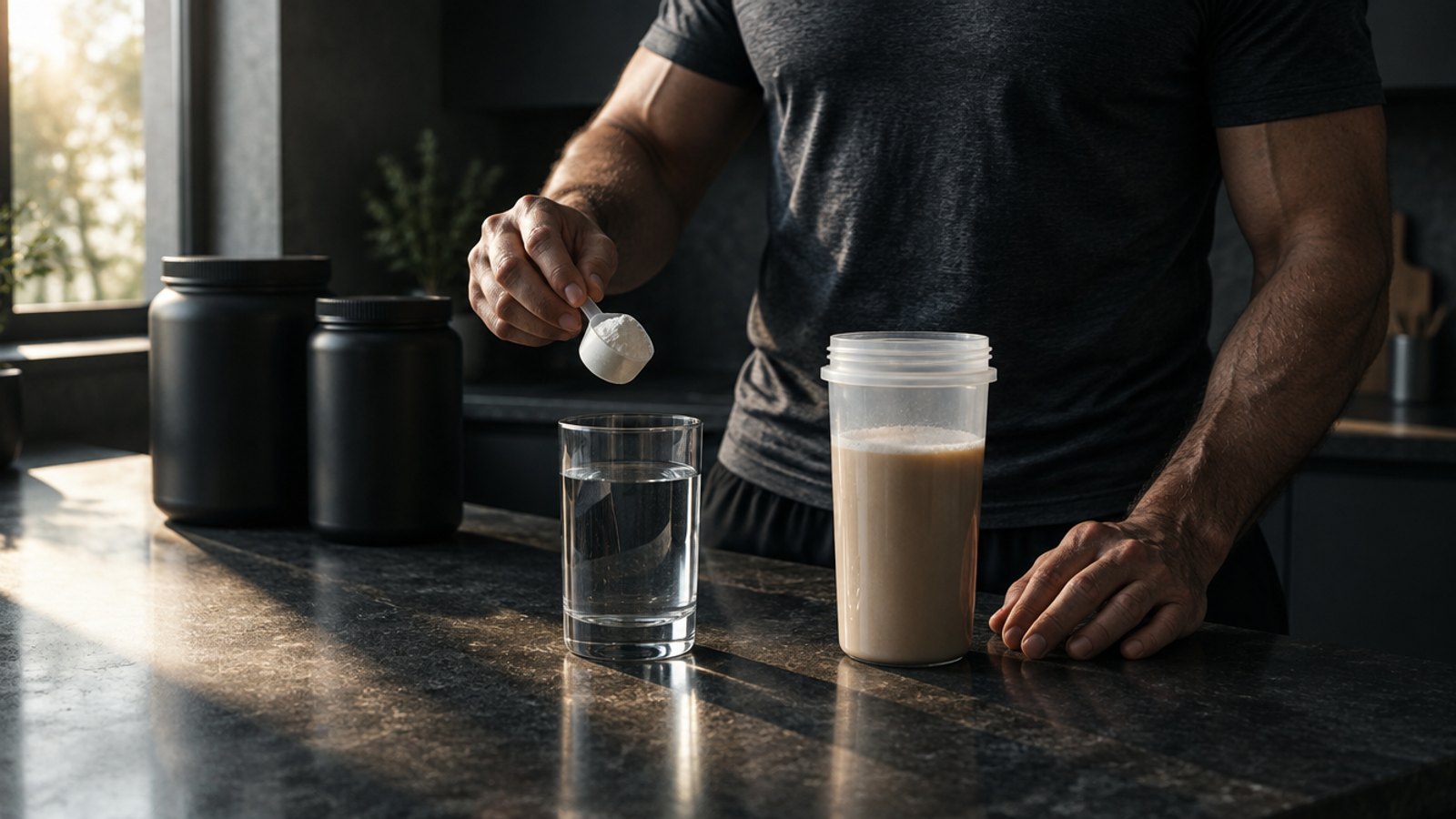
- A scoop of most protein powders is 20 to 30 grams.
- A cup of cottage cheese sits around 25 grams.
- Two cups of milk give you roughly 16 grams.
Stack a few of those across three or four meals and the daily target is easy. A man aiming for 140 grams could hit it with eggs at breakfast, a chicken lunch, yogurt as a snack, and fish or beef at dinner. No shake required, though a scoop is a fine way to top off a day that came up short.
Who should sit higher in the range
Most men do well right around 1.6. Two groups have reason to push toward 2.0 or a touch above. Very active men, the ones training hard most days or in a fat-loss phase, benefit from more to protect muscle and support recovery (Jäger et al., 2017).
Older men are the other group. As you age, your muscles get a little deaf to protein, a change researchers call anabolic resistance. Older men need a bigger dose per meal to trigger the same muscle response younger men get from less (Moore et al., 2015). Expert panels recommend older adults aim for at least 1.0 to 1.2 grams per kilogram, and higher if they are active or dealing with illness (Bauer et al., 2013). If you are past 50 and lifting, land near the top of the range and make sure each meal carries a real amount of protein rather than a token bite.
The verdict
Aim for about 1.6 grams of protein per kilogram of bodyweight per day. That is roughly 130 grams for a 180-pound man. Push toward 2.0 to 2.2 if you are very active, cutting fat, or older. Spread it across three or four meals of 30 to 40 grams, lean on complete protein sources, and eat enough total food. Then lift hard and consistently, because protein only builds muscle when your training gives it a reason to. Everything past that number is marketing, not muscle. The rest of our muscle and fat-loss guides build on that base.
This article is for general education and is not medical advice. If you have kidney issues or another health condition, talk to a doctor before making big changes to your protein intake.
References
- Morton RW, et al. A systematic review, meta-analysis and meta-regression of the effect of protein supplementation on resistance training-induced gains in muscle mass and strength in healthy adults. Br J Sports Med. 2018. https://pubmed.ncbi.nlm.nih.gov/28698222/
- Jäger R, et al. International Society of Sports Nutrition Position Stand: protein and exercise. J Int Soc Sports Nutr. 2017. https://pubmed.ncbi.nlm.nih.gov/28642676/
- Schoenfeld BJ, Aragon AA, Krieger JW. The effect of protein timing on muscle strength and hypertrophy: a meta-analysis. J Int Soc Sports Nutr. 2013. https://pubmed.ncbi.nlm.nih.gov/24299050/
- Moore DR, et al. Protein ingestion to stimulate myofibrillar protein synthesis requires greater relative protein intakes in healthy older versus younger men. J Gerontol A Biol Sci Med Sci. 2015. https://pubmed.ncbi.nlm.nih.gov/25056502/
- Areta JL, et al. Timing and distribution of protein ingestion during prolonged recovery from resistance exercise alters myofibrillar protein synthesis. J Physiol. 2013. https://pubmed.ncbi.nlm.nih.gov/23459753/
- Churchward-Venne TA, et al. Leucine supplementation of a low-protein mixed macronutrient beverage enhances myofibrillar protein synthesis in young men. Am J Clin Nutr. 2014. https://pubmed.ncbi.nlm.nih.gov/24284442/
- Tavares H, et al. Effects of daily protein intake frequency during 8 weeks of resistance training on lean mass and strength adaptations. J Sports Med Phys Fitness. 2025. https://pubmed.ncbi.nlm.nih.gov/40673785/
- Bauer J, et al. Evidence-based recommendations for optimal dietary protein intake in older people: a position paper from the PROT-AGE Study Group. J Am Med Dir Assoc. 2013. https://pubmed.ncbi.nlm.nih.gov/23867520/
Common questions
Is 1 gram of protein per pound of bodyweight necessary?
One gram of protein per pound of bodyweight is not necessary. That popular rule works out to about 2.2 grams per kilogram, which is the top of the useful range, not a requirement. The evidence shows muscle gains flatten out around 1.6 grams per kilogram (roughly 0.73 grams per pound). Eating more will not hurt a healthy man, but it will not build extra muscle either.
Do I have to drink a protein shake right after my workout?
You do not have to drink a protein shake right after your workout. The post-workout window is real but generous, lasting hours rather than minutes. Total protein for the day matters far more than exact timing. If a shake helps you hit your daily number, great. If you would rather eat a normal meal within a couple of hours, that works just as well.
Can I build muscle on a plant-based diet?
You can build muscle on a plant-based diet, but you have to be a bit more deliberate. Plant proteins tend to carry less leucine and are often missing some amino acids on their own. Eat a little more total protein, lean on complete sources like soy, and combine different plant proteins across the day so nothing is short.
Will eating a lot of protein damage my kidneys?
In healthy men, higher protein intakes in the ranges discussed here have not been shown to harm the kidneys. The concern applies to people who already have kidney disease, who may need to limit protein. If that is you, or you are unsure, check with a doctor before increasing your intake.
How much protein can my body actually use in one meal?
For building muscle, the response to a single meal tends to max out around 0.4 grams per kilogram, which is about 30 to 40 grams for most men. Your body still digests and uses protein beyond that, it just does not add more to the muscle-building signal in that sitting. That is why spreading protein across meals beats loading it all at once.