Muscle and fat loss
Weight Loss for Men Over 60: Lose the Fat, Keep the Strength
You can still lose fat after 60. The job now is making sure muscle and bone do not leave with it.
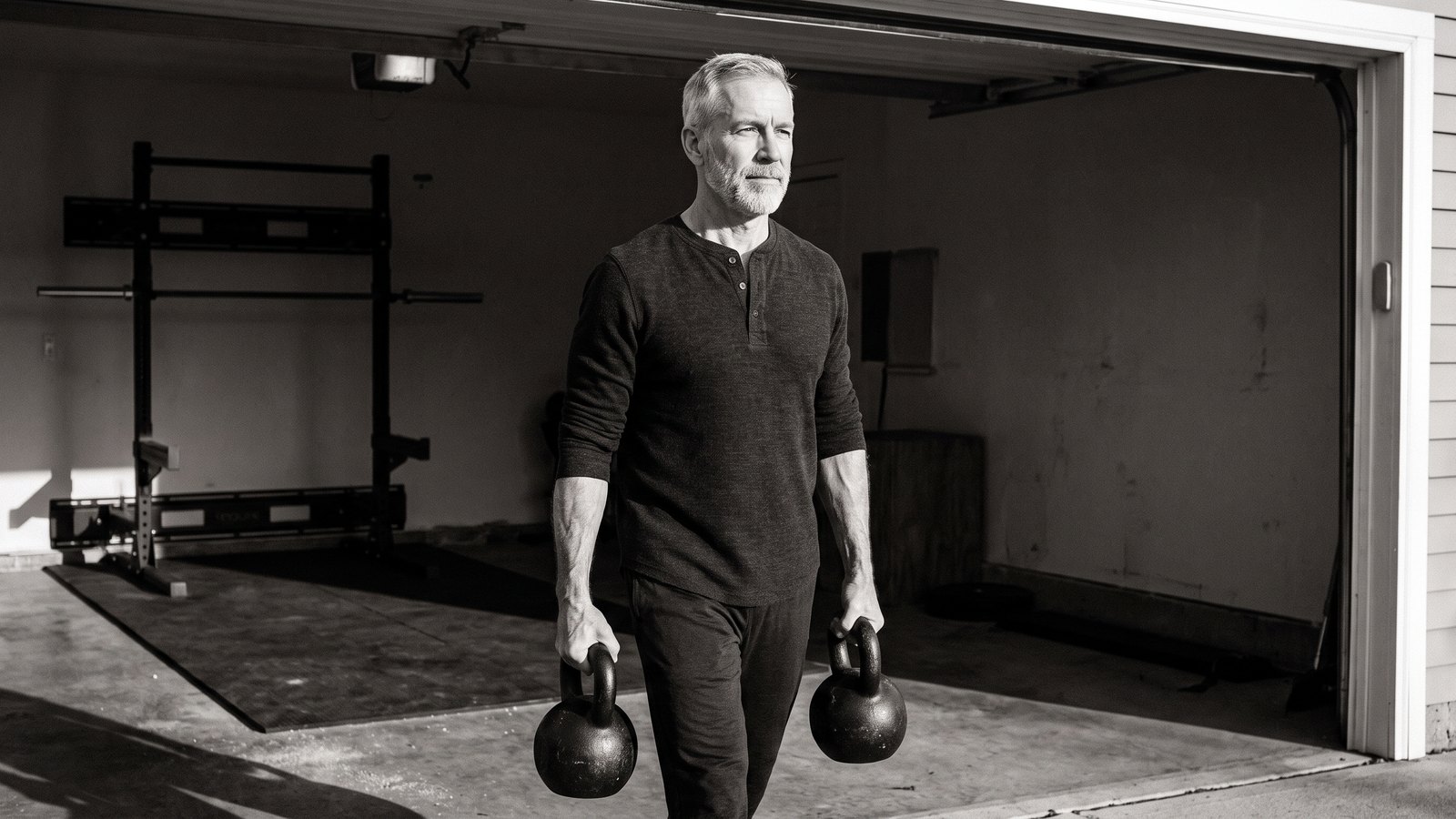
Weight loss for men over 60 is a different job from losing weight at 40, and most of the advice aimed at "older adults" misses why. The honest answer up front: you can still lose fat after 60, the trials in men and women over 65 show it clearly, and it is worth doing. What changes is the price of doing it badly. A crash diet at 62 takes muscle and bone with the fat, and those are the two things that decide how well you move at 75.
So the goal is not just a lower number on the scale. It is losing fat while holding on to strength.
Is it harder to lose weight after 60?
A little, and for a specific reason.
The largest study of human energy expenditure pooled doubly labeled water measurements from people aged 8 days to 95 years. After adjusting for lean mass, daily energy burn was stable from 20 to 60. It only started to decline in older adults, after about 60 (Pontzer et al., 2021). That is the first real metabolic slowdown most men ever get, and it arrives right on schedule for this decade.
It is gradual, not a cliff. The bigger factor is still lean mass. Less muscle means a smaller engine and a lower total burn. If you are in your fifties and reading ahead, the over-50 picture is laid out in what changes about fat loss after 50 and the four levers that still work. After 60, the same levers apply, with less room for error.
Should a man over 60 even try to lose weight?
You will hear that weight loss in older men is linked to dying sooner. That comes from observational studies, which cannot tell the difference between a man who chose to lose weight and a man who lost it because he was getting sick.
Randomized trials can. A meta-analysis of 15 lifestyle weight loss trials, 17,186 adults followed for at least 18 months, found the weight loss groups had about 15 percent lower all-cause mortality. In trials where the average starting age was 55 or older, the result held (Kritchevsky et al., 2015). The average participant was 52, so this is not a pure over-60 dataset, but it clears the main objection. If you are carrying real excess fat, losing it on purpose is not the risk. Losing muscle while you do it is.
How many calories should a 60 year old man eat to lose weight?
There is no single number, because a 5'8" retiree and a 6'2" man who still works a physical job burn very different amounts. Start with what your weight has been doing. If it has been steady on your current eating, that intake is roughly your maintenance.
From there, go moderate. The two big trials in obese adults over 65 used an energy deficit of about 500 to 750 calories a day, and people lost around 9 to 10 percent of their body weight over 6 to 12 months (Villareal et al., 2011; Villareal et al., 2017). That is roughly half a pound to a pound and a half a week for most men. Faster than that and a bigger share of what comes off is muscle.
A practical check: if the scale is falling and your lifts or your stair climbing are getting worse, the deficit is too big. Eat a bit more and keep the protein high.
How much protein does a man over 60 need?
More than the label on the cereal box assumes, and more per meal than a younger man.
The PROT-AGE expert group recommends at least 1.0 to 1.2 grams of protein per kilogram of body weight per day for adults over 65, and 1.2 or more for those who exercise (Bauer et al., 2013). For a 200 pound man, 1.2 g/kg is about 110 grams a day.
How you spread it matters too. When researchers pooled their muscle protein synthesis data, the response in men around 71 years old kept rising until about 0.40 grams of protein per kilogram of body weight in a single meal. In men around 22, it topped out at about 0.24 (Moore et al., 2015). Older muscle is less sensitive to small doses. For a 200 pound man that works out to roughly 35 to 40 grams per meal, which is more than the typical breakfast of toast and coffee gets anywhere near.
If you want the exact math for your weight, the protein-by-bodyweight table with a straight answer for each number does it for you. Men with kidney disease should talk to their doctor before raising protein.
What is the best exercise for a man over 60 to lose weight?
Lifting plus cardio, with lifting as the part you do not skip.
The clearest trial here randomized 160 obese adults over 65 to the same diet plus aerobic training, resistance training, or both. Everyone lost about 9 percent of body weight. Lean mass fell 5 percent in the aerobic-only group, 2 percent with resistance training and 3 percent with both. Hip bone density fell 3 percent with cardio alone and 0.5 percent with lifting. The combined group improved physical function the most, 21 percent versus 14 percent for either alone (Villareal et al., 2017).
Put simply: cardio built fitness, lifting protected muscle and bone, and doing both made people move better in daily life. A systematic review of 52 studies in adults over 50 found the same pattern. In 81 percent of diet-only groups, at least 15 percent of the weight lost was fat-free mass. With exercise added, that dropped to 39 percent (Weinheimer et al., 2010).
A workable week looks like this:
- Two or three full-body lifting sessions. Squats or leg press, a hinge like a deadlift or hip thrust, a push, a pull. Work hard enough that the last two reps of each set are a real effort. The case for lifting as a longevity habit is in what the mortality data says about the minimum dose of strength training.
- Daily walking. It burns more than men give it credit for and costs almost nothing in recovery. Where the step-count benefit curve flattens for older adults is lower than the 10,000 number you have heard.
- Some balance and carry work. Farmer's carries and single-leg work pay off twice after 60: stronger hands and steadier feet.
Is it too late to build muscle at 60 or 70?
No. This is the most encouraging finding in the whole field.
In a classic study, frail nursing home residents with an average age of 90 did eight weeks of high-intensity resistance training. Strength rose 174 percent on average, thigh muscle area grew 9 percent, and walking speed improved 48 percent (Fiatarone et al., 1990). It was a tiny study, ten people, but the direction has held up in every trial since. If a 90 year old in a nursing home can add muscle, a 62 year old man who starts lifting this month can too.
Grip strength is a good simple marker to track along the way, and what your grip strength says about your health explains why it keeps showing up in mortality research.
Can a man over 60 lose belly fat?
Yes. You cannot pick where fat comes off first, but belly fat, and especially the deeper visceral fat around the organs, tends to respond well to a steady deficit and regular exercise. It is also the fat most tied to blood sugar trouble, so losing it is one of the better things you can do for your numbers. If you have not had your fasting glucose or A1c checked recently, what counts as a normal blood sugar level for a man tells you what to ask for and how to read it.
Weight loss for men over 65 and over 70
The same rules apply, with two adjustments. First, protect protein even harder, because appetite often shrinks with age and it is easy to under-eat protein while dieting. Second, go slower and watch function more than weight. If you are getting weaker, more unsteady, or more tired, the plan needs adjusting, not more discipline.
If you are on a GLP-1 medication from your doctor, muscle loss is a bigger concern, and how to protect muscle while on a GLP-1 drug covers the protein and training side. Talk to your prescriber about your targets.
When weight loss after 60 is a warning sign
Losing weight you were trying to lose is progress. Losing weight you were not trying to lose is a reason to see a doctor. Unexplained weight loss, new fatigue, loss of appetite, or changes in bowel habits all deserve a proper look before you celebrate the scale.
The verdict
Weight loss for men over 60 works. The trials show it, and the benefit is real. The plan is simple, even if it is not easy:
- A moderate deficit, around 500 to 750 calories a day, not a crash diet.
- Protein at 1.0 to 1.2 g/kg a day or more, with 35 to 40 grams at each main meal.
- Lifting two or three times a week, plus daily walking.
- Judge success by strength and function, not only the scale.
Get those four right and you will lose the fat while keeping the muscle that makes the rest of your life easier. For more on this, browse our muscle and fat loss coverage.
This article is for general education and is not medical advice. If you have heart disease, kidney disease, diabetes, osteoporosis, or take prescription medication, talk to your doctor before starting a calorie deficit or a new training program. Unexplained weight loss is a reason to see a doctor.
References
- Pontzer H, Yamada Y, Sagayama H, et al. Daily energy expenditure through the human life course. Science. 2021. https://pubmed.ncbi.nlm.nih.gov/34385400/
- Kritchevsky SB, Beavers KM, Miller ME, et al. Intentional weight loss and all-cause mortality: a meta-analysis of randomized clinical trials. PLoS One. 2015. https://pubmed.ncbi.nlm.nih.gov/25794148/
- Villareal DT, Chode S, Parimi N, et al. Weight loss, exercise, or both and physical function in obese older adults. N Engl J Med. 2011. https://pubmed.ncbi.nlm.nih.gov/21449785/
- Villareal DT, Aguirre L, Gurney AB, et al. Aerobic or resistance exercise, or both, in dieting obese older adults. N Engl J Med. 2017. https://pubmed.ncbi.nlm.nih.gov/28514618/
- Bauer J, Biolo G, Cederholm T, et al. Evidence-based recommendations for optimal dietary protein intake in older people: a position paper from the PROT-AGE Study Group. J Am Med Dir Assoc. 2013. https://pubmed.ncbi.nlm.nih.gov/23867520/
- Moore DR, Churchward-Venne TA, Witard O, et al. Protein ingestion to stimulate myofibrillar protein synthesis requires greater relative protein intakes in healthy older versus younger men. J Gerontol A Biol Sci Med Sci. 2015. https://pubmed.ncbi.nlm.nih.gov/25056502/
- Weinheimer EM, Sands LP, Campbell WW. A systematic review of the separate and combined effects of energy restriction and exercise on fat-free mass in middle-aged and older adults: implications for sarcopenic obesity. Nutr Rev. 2010. https://pubmed.ncbi.nlm.nih.gov/20591106/
- Fiatarone MA, Marks EC, Ryan ND, et al. High-intensity strength training in nonagenarians. Effects on skeletal muscle. JAMA. 1990. https://pubmed.ncbi.nlm.nih.gov/2342214/
Common questions
Is it harder for a man to lose weight after 60?
Losing weight is a little harder for a man after 60. Lean-mass-adjusted energy expenditure holds steady from 20 to 60 and only starts to decline after about 60, gradually rather than all at once (Pontzer et al., 2021). The bigger factor is muscle: less of it means a lower total burn. That is why lifting and protein matter more in this decade, not less.
How many calories should a 60 year old man eat to lose weight?
The calorie target for a 60 year old man depends on your size and activity, so start from your maintenance, the intake that has kept your weight steady, and cut about 500 to 750 calories a day. That is the deficit used in the two main trials in obese adults over 65, where people lost about 9 to 10 percent of body weight over 6 to 12 months (Villareal et al., 2011; Villareal et al., 2017).
How much protein should a man over 60 eat when dieting?
At least 1.0 to 1.2 grams per kilogram of body weight per day, and 1.2 or more if you exercise, per the PROT-AGE group (Bauer et al., 2013). Per meal, older men needed about 0.40 g/kg to max out muscle protein synthesis, versus 0.24 g/kg in young men (Moore et al., 2015). For a 200 pound man that is roughly 35 to 40 grams per meal. Talk to your doctor first if you have kidney disease.
What is the best exercise for a 60 year old man to lose weight?
The best exercise for a 60 year old man to lose weight is resistance training plus aerobic work. In dieting adults over 65, lifting cut lean mass loss to 2 percent versus 5 percent with cardio alone and nearly eliminated hip bone loss, while the combined group improved physical function the most (Villareal et al., 2017). Two or three full-body lifting sessions a week plus daily walking covers it.
Can a man over 60 still build muscle?
A man over 60 can still build muscle. Frail nursing home residents averaging 90 years old gained 174 percent in strength and 9 percent in thigh muscle area after eight weeks of high-intensity resistance training (Fiatarone et al., 1990). It was a small study, but no later trial has overturned the direction.
Is weight loss dangerous for older men?
Intentional weight loss in people carrying excess fat is not. A meta-analysis of 15 randomized lifestyle trials found about 15 percent lower all-cause mortality in the weight loss groups, including trials with an average starting age of 55 or older (Kritchevsky et al., 2015). Unintentional weight loss is different and is a reason to see a doctor.