Muscle & Fat Loss
Strength Training for Longevity: The Minimum Effective Dose
Lifting is not just about looking good with your shirt off. It is one of the strongest habits tied to a longer life, and the amount you need is smaller than you think.
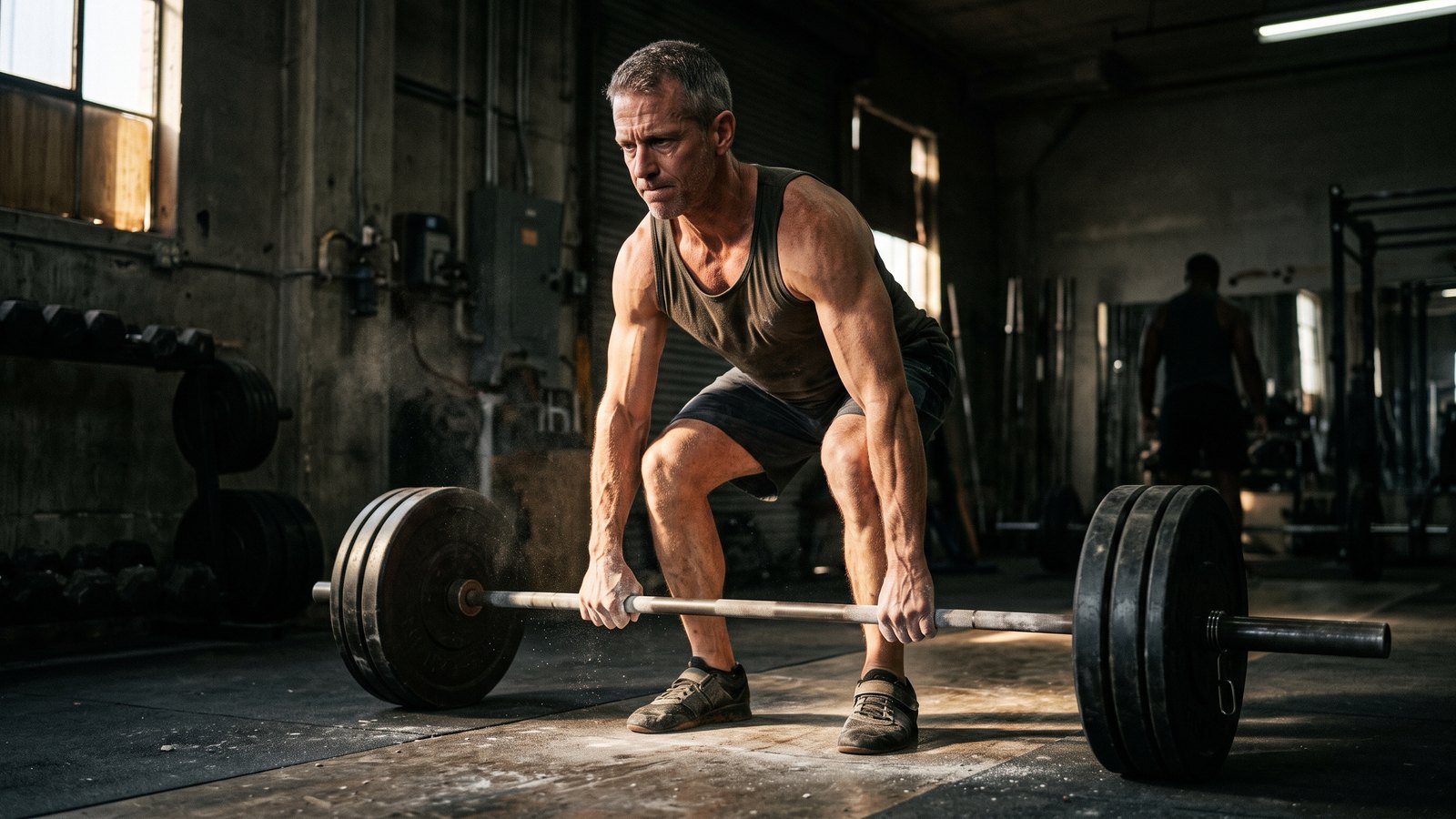
Most men lift to look better, get stronger, or blow off steam. All good reasons. But there is a bigger one hiding under the barbell: the men who keep muscle on their frame tend to live longer, and the research backing that up has gotten hard to ignore.
This is not about turning into a bodybuilder. It is about a simple, boring habit that pays off for decades. Here is what the studies actually show, how small the effective dose really is, and why piling on more hours does not keep buying you more life. This is education, not medical advice.
What the research is measuring
When scientists study lifting and longevity, they track something blunt: all-cause mortality, meaning your risk of dying from anything over a stretch of years. They compare men who do resistance training against men who do not, then adjust for things like age, smoking, and other exercise.
One honest caveat up front. Most of this work is observational, which shows a strong link, not ironclad proof that lifting alone causes the longer life. But the pattern shows up across huge groups of people, in different countries, again and again. When a signal is that consistent, it is worth taking seriously.
The headline number
Lifting weights is tied to a real drop in your risk of dying. A systematic review that pooled the best available studies found that men who did any resistance training had about a 15 percent lower risk of death from any cause, a 19 percent lower risk of dying from heart disease, and a 14 percent lower risk of dying from cancer, compared with men who did none (Shailendra et al., 2022).
A separate review pulling together cohort studies on muscle-strengthening landed in the same place, linking regular lifting to a 10 to 17 percent lower risk of early death and major diseases (Momma et al., 2022). Two independent teams, same direction. That is about as solid as this kind of research gets.
The surprising minimum dose
Here is the part that should change how you think about the gym. You do not need to live there.
The dose-response data points to a sweet spot of roughly 30 to 60 minutes of resistance training per week. In the pooled analysis, the risk of dying kept dropping as weekly lifting rose toward about an hour, where it bottomed out at a 27 percent lower risk, then the benefit faded at higher volumes (Shailendra et al., 2022). The review of cohort studies found the same J-shaped curve, with the biggest payoff around 30 to 60 minutes a week and no extra gain past that (Momma et al., 2022).
Read that again. The longevity benefit shows up with an hour a week, and hammering out five or six hours does not buy you more of it. More lifting can absolutely build more muscle and strength, which is worth chasing for its own sake. But for the specific goal of not dying early, a modest, steady habit does most of the work.
Weights and cardio are not either-or
The gym-versus-running-shoes argument misses the point. The men who do best do both, and the fitness number that predicts lifespan makes the case for the cardio half.
In a study following nearly 100,000 older adults, those who lifted weights had roughly a 9 to 22 percent lower risk of death, depending on how much they did. But the standout finding was the combination: men who both lifted and hit their aerobic activity targets had up to a 47 percent lower risk of dying compared with men who did neither (Gorzelitz et al., 2022). Lifting and cardio each help, and stacked together they help more. You do not have to pick a side.
It works when you are older too
Some men assume the window for this closes at 40 or 50. It does not.
A 15-year study of more than 30,000 U.S. adults aged 65 and up found that those who met the basic strength-training guideline, hitting the weights about twice a week, had a lower risk of dying from any cause, from cancer, and from heart problems. The benefit held even after accounting for their other physical activity (Kraschnewski et al., 2016). Starting later still counts. Muscle is one of the few things you can keep building well into old age, and what your grip strength says about your health shows why holding it matters.
How to actually get the dose
The practical version is refreshingly simple.
- Two sessions a week is the target. That alone puts you in guideline range and covers most of the longevity payoff. A third session is a bonus, not a requirement.
- Train the big movements. Push, pull, squat, hinge, and carry. Compound lifts work the most muscle in the least time, which is exactly what you want when the effective dose is an hour a week.
- Make it progressive. Add a little weight, a rep, or a set over time, and feed it enough protein to grow. The muscle that protects you is muscle you keep challenging, not the same three dumbbells forever.
- Pair it with easy cardio. A few walks or an easy conversational jog to round out the week is where the combined benefit shows up.
The verdict
Strength training is one of the highest-return habits a man can build, and the price of entry is low. Two short sessions a week, the big lifts, a little progression, and some easy cardio alongside it. The research ties that to a meaningfully lower risk of dying early, and it keeps working whether you start at 30 or 65.
You do not need to chase heroic volume. You need to show up twice a week and keep showing up for years. That is the whole game. Boring, repeatable, and backed by the numbers. The rest of our muscle and fat-loss guides follow the same playbook. That is the verdict.
References
- Shailendra P, et al. Resistance Training and Mortality Risk: A Systematic Review and Meta-Analysis. Am J Prev Med. 2022. https://pubmed.ncbi.nlm.nih.gov/35599175/
- Momma H, et al. Muscle-strengthening activities are associated with lower risk and mortality in major non-communicable diseases: a systematic review and meta-analysis of cohort studies. Br J Sports Med. 2022. https://pubmed.ncbi.nlm.nih.gov/35228201/
- Gorzelitz J, et al. Independent and joint associations of weightlifting and aerobic activity with all-cause, cardiovascular disease and cancer mortality in the Prostate, Lung, Colorectal and Ovarian Cancer Screening Trial. Br J Sports Med. 2022. https://pubmed.ncbi.nlm.nih.gov/36167669/
- Kraschnewski JL, et al. Is strength training associated with mortality benefits? A 15 year cohort study of US older adults. Prev Med. 2016. https://pubmed.ncbi.nlm.nih.gov/26921660/
Common questions
How much strength training do I need to live longer?
For longevity, you need less strength training than most men think. The dose-response data points to a sweet spot of about 30 to 60 minutes of resistance training per week, where the risk of early death bottoms out at roughly a 27 percent reduction (Shailendra, 2022). That works out to two short sessions a week. Doing far more can build extra muscle and strength, but for the specific goal of longevity it does not add much.
Does lifting weights really lower your risk of dying?
The evidence is strong and consistent. A systematic review found that men who did any resistance training had about a 15 percent lower risk of death from any cause, 19 percent lower from heart disease, and 14 percent lower from cancer (Shailendra, 2022). A separate review of cohort studies found a similar 10 to 17 percent drop (Momma, 2022). This is observational, so it shows a strong link rather than absolute proof, but the pattern repeats across large groups worldwide.
Is it too late to start lifting in my 50s or 60s?
Starting to lift in your 50s or 60s is not too late. A 15-year study of over 30,000 adults aged 65 and up found that those who lifted about twice a week had a lower risk of dying from any cause, cancer, and heart problems, even after accounting for their other activity (Kraschnewski, 2016). Muscle is one of the few things the body can keep building later in life, so starting later still counts.
Should I do cardio or weights for a longer life?
For a longer life, do both cardio and weights if you can. In a study of nearly 100,000 older adults, lifting alone was tied to a 9 to 22 percent lower risk of death, but men who both lifted and met their aerobic targets had up to a 47 percent lower risk compared with those who did neither (Gorzelitz, 2022). Weights and cardio each help, and stacking them helps more.
Is more strength training always better?
For longevity, more strength training is not always better. The research shows a J-shaped curve where the benefit for lowering your risk of dying peaks around 30 to 60 minutes a week and then flattens or fades at higher volumes (Momma, 2022; Shailendra, 2022). More training is great for building muscle and strength, but the life-extension payoff is mostly captured with a modest, steady habit.