Muscle and fat loss
Weight Loss Exercises for Men: What the Trials Say Works, and a Week to Start On
Cardio moves the scale. Lifting decides whether what you lose is fat or muscle. You need both.

The best weight loss exercises for men are the ones that burn a lot of energy per session and the ones that keep your muscle while the scale drops. That means two things done every week: steady cardio you can repeat (brisk walking, running, rowing, cycling) and heavy compound lifts (squats, deadlifts, presses, rows). Cardio does more of the burning. Lifting decides whether what you lose is fat or muscle. Pick one and you get half the result.
That is not a guess. It is what the trials that put men and women on different training programs for months at a time actually found. Here is the evidence, the specific moves, and a week you can start on Monday.
What is the best exercise for weight loss for men?
If you only count pounds, aerobic work wins. The cleanest head-to-head is STRRIDE AT/RT, a Duke trial that put 119 sedentary, overweight adults on one of three eight month programs: aerobic training, resistance training, or both. The aerobic and combined groups lost more body weight and more fat mass than the lifting-only group. The combined group did not lose more fat than the aerobic group, even though it trained for about twice as long (Willis et al., 2012).
So why lift at all? Because the same trial found the resistance and combined groups added more lean mass than the aerobic group. Cardio moved the scale. Lifting built the body underneath it. For a man who wants to look leaner rather than just smaller, that second part is the whole point.
The verdict: do cardio for the burn and lift to keep your muscle. If time is tight, cardio is the bigger lever for the number on the scale, and two short lifting sessions are the insurance on your muscle.
Cardio or weights: which burns more fat?
Minute for minute, steady cardio burns more, simply because you can keep moving for 40 minutes without resting between sets. That is why the aerobic groups pulled ahead on fat mass in STRRIDE.
But the ledger changes once you are eating less. In a six month NEJM trial, 160 obese older adults dieted and were assigned to aerobic training, resistance training, or both. Every exercise group lost about 9 percent of body weight. The aerobic-only group lost about 5 percent of its lean mass. The resistance and combined groups lost only 2 to 3 percent (Villareal et al., 2017). Same weight loss, very different body at the end of it.
The practical read: in a calorie deficit, lifting is not optional. It is the thing that tells your body to keep the muscle, and our guide to weight training for weight loss for men has the three-day lifting plan. We cover that side in more depth in whether you can lose fat and add muscle at the same time past 40.
Weight loss exercises for men: the list
You do not need fifty moves. You need a handful of big ones done well, plus cardio you will actually show up for.
Lifting (two to three days a week)
- Squat or goblet squat. The biggest muscles in your body, worked in one move.
- Deadlift or Romanian deadlift. Hamstrings, glutes and back. The move that makes you feel strong fastest.
- Push-up or bench press. Chest, shoulders and triceps.
- Row or pull-up. Upper back and grip, the balance to all that pressing.
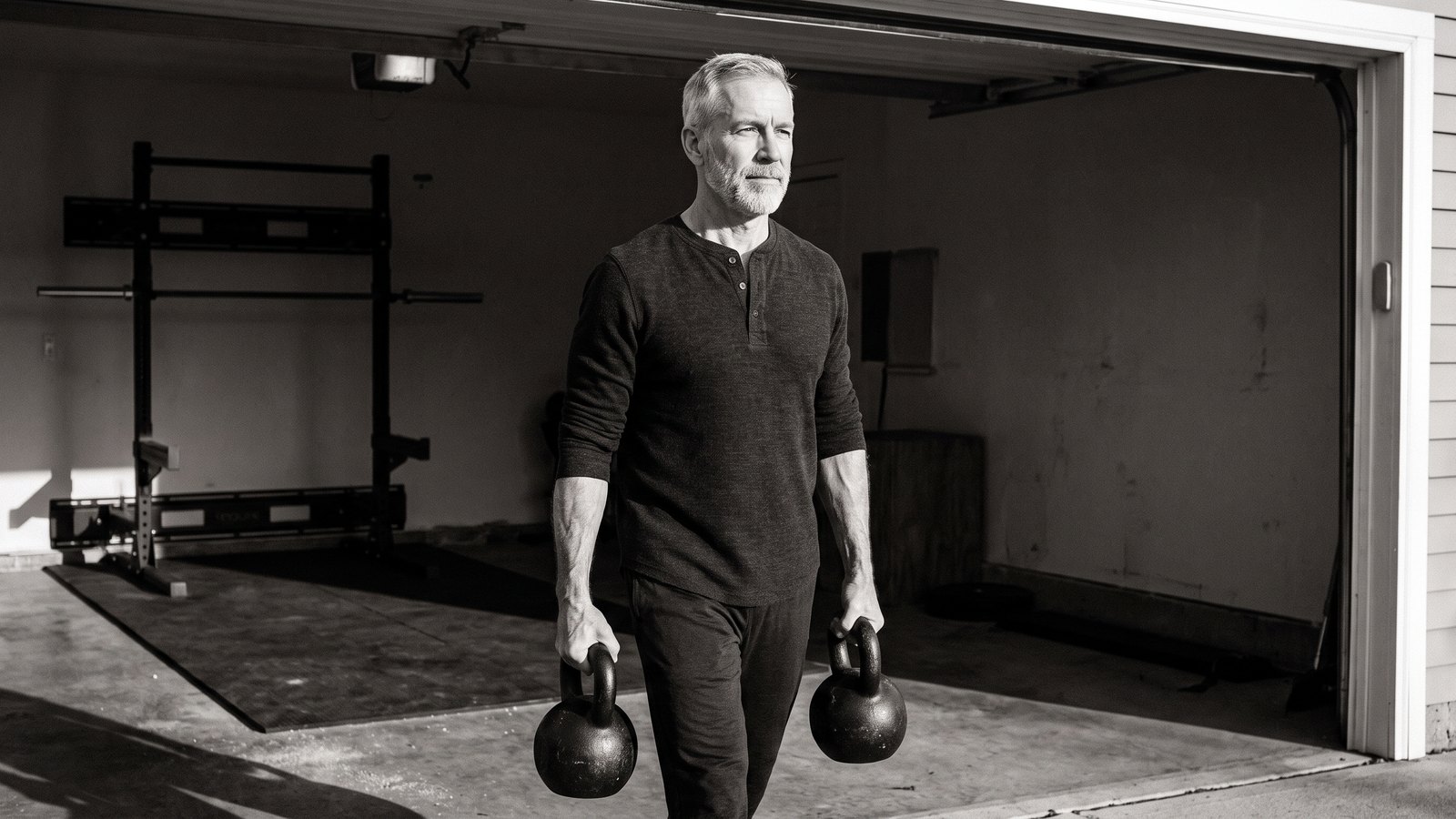
- Loaded carry. Pick up two heavy dumbbells and walk. Grip, core and conditioning in one.
Three to four sets of six to twelve reps, stopping a rep or two short of failure. Add weight when the top of the rep range gets easy.
Cardio (most days)
- Brisk or incline walking. The most underrated fat loss tool there is. Low injury risk, no recovery cost, easy to stack.
- Running. Big output per minute if your joints tolerate it.
- Rowing machine. Full body, easy on the knees.
- Cycling. Great for fitness and easy on joints, but see the note on HIIT below.
Is HIIT better than steady cardio for fat loss?
Not better. Faster. A meta-analysis of 13 trials in overweight and obese adults compared high-intensity interval training with moderate steady cardio. Both cut whole-body fat mass and waist size, and there was no significant difference between them on any body composition measure. HIIT got there with about 40 percent less training time (Wewege et al., 2017).
One detail worth knowing: in that analysis, running produced large effects on fat mass for both styles, while the cycling trials did not show fat loss. That does not mean bikes are useless. It likely means the cycling programs in those trials were too short or too light. But if your goal is fat loss and you only have 20 minutes, running or rowing intervals are the stronger bet.
A simple HIIT session: warm up five minutes, then eight rounds of 30 seconds hard and 90 seconds easy on a rower, bike or hill. Twice a week is plenty. The rest of your cardio should feel easy, which is where zone 2 training and why easy aerobic work pays off after 40 comes in.
Can exercise burn belly fat?
Yes, but not the way the ab-workout videos say. You cannot pick where fat comes off. In a randomized trial, 24 sedentary adults did seven abdominal exercises, two sets of ten reps, five days a week for six weeks. Their ab endurance improved. Their belly fat, waist size and body fat percentage did not change (Vispute et al., 2011).
What does shrink the belly is whole-body work. In a three month trial in 52 obese men, one group lost weight by exercising more every day without cutting calories, and another lost the same 7.5 kg by dieting alone. The exercise group lost 1.3 kg more total fat. Abdominal and visceral fat dropped in both. And a third group, who exercised but ate enough to keep their weight stable, still lost abdominal and visceral fat (Ross et al., 2000). The belly responds to total training, not to crunches. If you want to know why that deeper fat matters most, read why visceral fat matters more for men than the kind you can pinch.
How much exercise does a man need to lose weight?
More than the bare minimum. The American College of Sports Medicine reviewed the evidence and found that 150 to 250 minutes a week of moderate activity helps prevent weight gain and produces only modest weight loss on its own. Clinically meaningful weight loss was tied to more than 250 minutes a week. The same review found resistance training does not add much to weight loss on the scale, but may increase fat-free mass and fat loss (Donnelly et al., 2009).
That sounds like a lot until you break it down. 250 minutes is 36 minutes a day. A 30 minute walk after dinner plus two lifting sessions gets most men most of the way there. Daily steps count toward it, and the research on how many daily steps actually pay off is more encouraging than most men expect.
One thing to hold onto: exercise works best paired with eating a bit less. The trials that produced real fat loss either controlled food or pushed activity very high. Training alone on top of the same diet produces slower results, and the scale can hide real fat loss when you are adding muscle at the same time.
Weight loss exercises for men at home
No gym is not a reason to skip. A pair of adjustable dumbbells or a single kettlebell covers almost everything on the list above.
- Goblet squat with a dumbbell or kettlebell held at your chest.
- Romanian deadlift with two dumbbells.
- Push-ups, elevated on a bench if you need to, feet elevated when they get easy.
- One-arm dumbbell row braced on a chair.
- Kettlebell swing for 20 seconds on, 40 off, as your interval work.
- A brisk walk out the front door. Still the best cardio for most men.
Three rounds of the first four moves, then five minutes of swings, takes about 35 minutes.
Weight loss exercises for men over 40 and over 50
The same moves, with a different priority. After 40, you are losing muscle slowly every year you are not training for it, and a diet speeds that up. That makes lifting more important with age, not less. The NEJM trial above was run in adults in their late 60s and 70s, and lifting is what protected their muscle and bone while they lost weight (Villareal et al., 2017).
Practical changes past 40: warm up longer, favor goblet squats and trap-bar or Romanian deadlifts over heavy back squats if your back complains, keep most cardio easy, and take a lighter week every month or so. The rest of the over-50 picture, including protein and recovery, is in what actually works for weight loss in men over 50. If you have heart disease, joint problems or have not trained in years, talk to your doctor before starting intervals.
A simple weekly plan
- Monday: Lift. Squat, push-up or bench, row, carry.
- Tuesday: 30 to 45 minute brisk or incline walk.
- Wednesday: Intervals. 8 x 30 seconds hard on a rower or hill.
- Thursday: Lift. Deadlift, press, pull-up or row, carry.
- Friday: 30 to 45 minute walk.
- Saturday: Something long and easy. Hike, ride, long walk.
- Sunday: Rest, or an easy walk.
That is roughly 250 to 300 minutes of activity, two lifting days and one hard session. It is enough to lose fat and keep your muscle, and not so much that you burn out in three weeks. More on training and body composition sits in our muscle and fat loss coverage.
References
- Willis LH, Slentz CA, Bateman LA, et al. Effects of aerobic and/or resistance training on body mass and fat mass in overweight or obese adults. J Appl Physiol. 2012. https://pubmed.ncbi.nlm.nih.gov/23019316/
- Villareal DT, Aguirre L, Gurney AB, et al. Aerobic or resistance exercise, or both, in dieting obese older adults. N Engl J Med. 2017. https://pubmed.ncbi.nlm.nih.gov/28514618/
- Wewege M, van den Berg R, Ward RE, Keech A. The effects of high-intensity interval training vs. moderate-intensity continuous training on body composition in overweight and obese adults: a systematic review and meta-analysis. Obes Rev. 2017. https://pubmed.ncbi.nlm.nih.gov/28401638/
- Vispute SS, Smith JD, LeCheminant JD, Hurley KS. The effect of abdominal exercise on abdominal fat. J Strength Cond Res. 2011. https://pubmed.ncbi.nlm.nih.gov/21804427/
- Ross R, Dagnone D, Jones PJ, et al. Reduction in obesity and related comorbid conditions after diet-induced weight loss or exercise-induced weight loss in men. A randomized, controlled trial. Ann Intern Med. 2000. https://pubmed.ncbi.nlm.nih.gov/10896648/
- Donnelly JE, Blair SN, Jakicic JM, et al. American College of Sports Medicine Position Stand. Appropriate physical activity intervention strategies for weight loss and prevention of weight regain for adults. Med Sci Sports Exerc. 2009. https://pubmed.ncbi.nlm.nih.gov/19127177/
Common questions
What is the best exercise for a man to lose weight?
For pure weight and fat loss, aerobic exercise like brisk walking, running or rowing. In an eight month trial of 119 overweight adults, aerobic training cut body mass and fat mass more than resistance training, while lifting added more lean mass (Willis et al., 2012). The best plan does both: cardio for the burn, lifting to keep your muscle.
Is it better to lift weights or do cardio to lose belly fat?
Lifting weights and cardio both work on belly fat because both burn energy, but neither spot-reduces it. Six weeks of daily ab exercises did not change belly fat in a randomized trial (Vispute et al., 2011), while daily exercise in obese men cut abdominal and visceral fat even when their weight stayed the same (Ross et al., 2000). Whole-body training beats crunches.
Is HIIT better than cardio for losing weight?
HIIT is about equal to steady cardio for fat loss and takes less time. A meta-analysis of 13 trials found HIIT and steady cardio produced similar reductions in fat mass and waist size, with HIIT needing about 40 percent less training time (Wewege et al., 2017).
How many days a week should a man work out to lose weight?
A man should work out most days of the week to lose weight. The American College of Sports Medicine found that more than 250 minutes a week of moderate activity is tied to meaningful weight loss, while 150 to 250 minutes produces only modest loss on its own (Donnelly et al., 2009). Two lifting days plus walking or cardio on four or five days covers it.
Can you lose weight just by walking?
You can lose weight just by walking if you walk enough and eat a little less. Walking counts toward the 250 minute weekly target, it is easy to recover from, and it is the cardio most men can do every day. Add two short lifting sessions so the weight you lose is fat, not muscle.
What exercises should men over 50 do to lose weight?
The same big moves with more care: goblet squats, Romanian deadlifts, push-ups, rows, carries, and plenty of walking. In a trial of dieting adults in their late 60s and 70s, the aerobic-only group lost about 5 percent of its lean mass, against 2 to 3 percent for the groups that lifted (Villareal et al., 2017). Check with your doctor first if you have heart or joint problems.