Health
Sleep Apnea in Men: The Snoring You Keep Writing Off
Your wife elbows you at 3 a.m. You are wrecked by mid-afternoon. You blame work, age, or the mattress. There is a fair chance you stopped breathing a few hundred times last night.
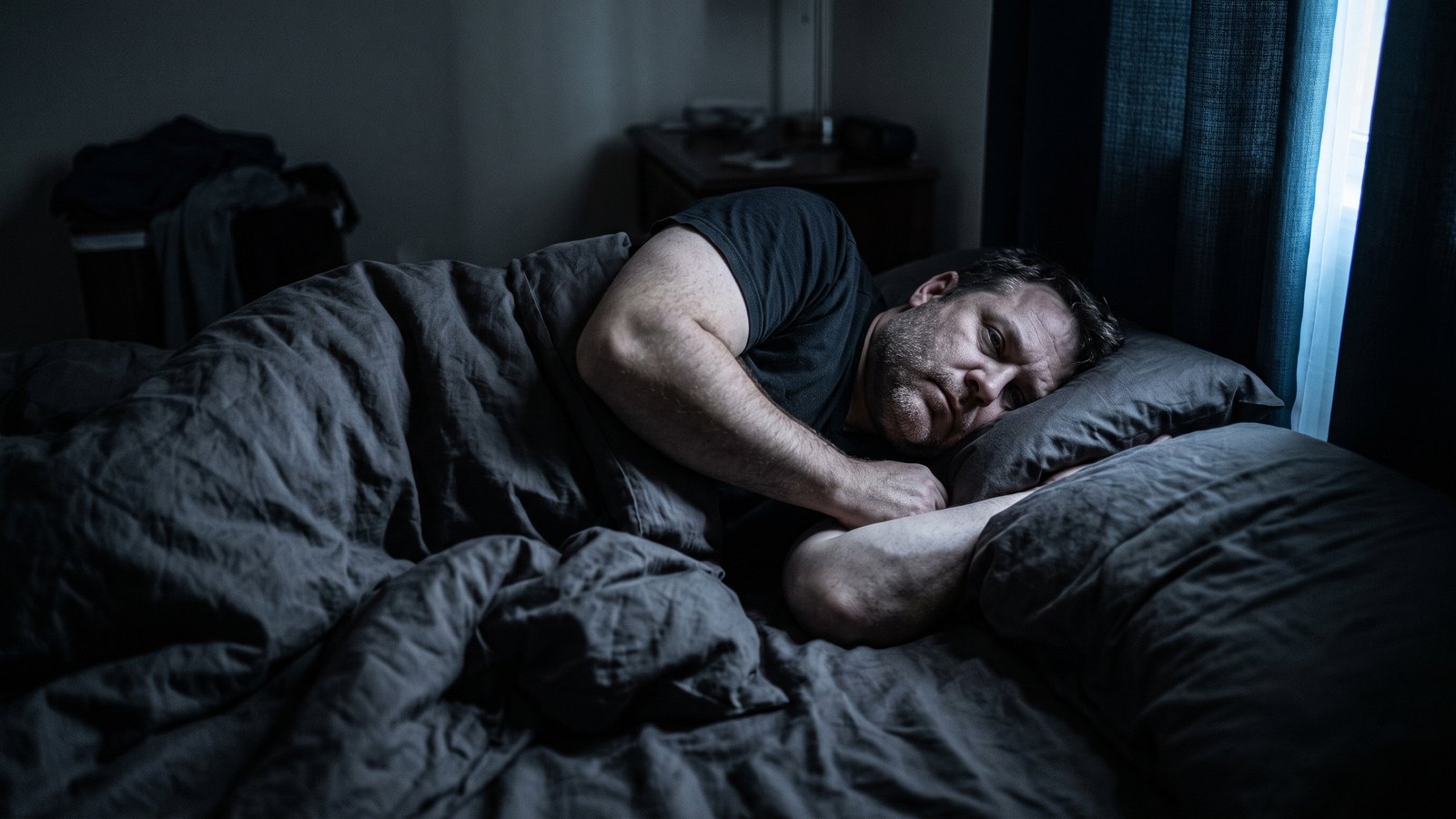
Snoring is a punchline. It shows up in sitcoms, it gets you exiled to the couch, and nobody treats it as a medical event. Meanwhile the guy doing the snoring is dragging through his afternoons, sitting on a blood pressure that will not come down, and has never once been tested.
Obstructive sleep apnea is one of the most common conditions in men, one of the least diagnosed, and one of the few where the fix is genuinely well studied. Here is what it is, the signs men talk themselves out of, and what the randomized evidence says treatment actually does. This is education, not medical advice.
What is actually happening while you sleep
Your throat muscles relax when you sleep. In some men they relax enough that the airway narrows or closes. Airflow drops or stops, oxygen falls, and your brain jolts you toward waking just enough to reopen the airway. You gasp, you snort, you roll over, and you do not remember any of it.
Then it happens again. In moderate to severe cases it happens 15 to 30 or more times an hour, all night. You were unconscious for eight hours and you got almost no restorative sleep out of it, including the deep sleep your testosterone depends on.
That is why the tired part is not laziness and not just age. You have been fighting for air all night.
It is not rare, and most cases are missed
Researchers pulled together prevalence data and estimated that 936 million adults aged 30 to 69 worldwide have mild to severe obstructive sleep apnea, and 425 million in that age band have the moderate to severe form. In some countries prevalence tops 50 percent (Benjafield et al., 2019).
Almost a billion people. The overwhelming majority of them have never had a sleep study.
Men carry more of it than women, which is why male sex is one of the eight items on the standard screening questionnaire. Being over 50, carrying a thick neck, and running a high BMI are three more.
The signs men write off
Here is what usually gets dismissed:
Loud snoring. Not the soft kind. The kind that carries through a wall, or gets you sent to the guest room.
Somebody watched you stop breathing. This is the one to take seriously. If your partner has ever said you went quiet, then gasped, that is not a quirk. Most men have this observed by someone else long before they ever mention it to a doctor.
Being tired no matter how long you were in bed. Eight hours, still wrecked at 2 p.m., falling asleep in front of the TV every night.
Blood pressure that will not budge. Sleep apnea shows up heavily in men whose hypertension resists treatment.
Waking to urinate, morning headaches, dry mouth, irritability, low drive. Individually easy to blame on age, or on the prostate that usually gets blamed for night waking. Together they form a pattern.
The standard screening tool is the STOP-Bang questionnaire, eight yes-or-no items covering snoring, tiredness, observed breathing pauses, blood pressure, BMI, age, neck size, and sex. In a meta-analysis of 17 studies and 9,206 patients, it caught 90 percent of any sleep apnea and 96 percent of severe cases in a sleep clinic setting. The score behaves like a dial: in that setting a score of 3 meant about a 25 percent chance of severe apnea, and each additional point pushed it up roughly 10 points, to about 75 percent at 7 or 8 (Nagappa et al., 2015).
It is a screen, not a diagnosis. Diagnosis takes a sleep study, and these days that is often a small device you wear at home rather than a night in a lab.
What untreated apnea does to your numbers
The blood pressure link is the clearest one, and you can see it in reverse. In a meta-analysis of six randomized controlled trials in patients with resistant hypertension and sleep apnea, treating the apnea with continuous positive airway pressure lowered 24-hour systolic pressure by about 5.4 mmHg and diastolic by about 3.9 mmHg (Lei et al., 2017).
Read that in the other direction. Untreated apnea was holding those men roughly 5 points higher, in a group already on multiple medications.
A separate randomized trial in men and women with resistant hypertension found effective CPAP cut night-time systolic pressure by 6.4 mmHg and heart rate by 6 beats per minute compared with sham CPAP over three months (Joyeux-Faure et al., 2018).
Those are drug-sized effects from a machine and a mask.
The honest part about CPAP and heart attacks
This is where the story gets more complicated, and you should hear it straight.
An individual participant meta-analysis pooled 4,186 people from three randomized trials, mostly men, all with existing cardiovascular disease and sleep apnea, followed for a mean of about 3.25 years. Comparing everyone assigned to CPAP against everyone assigned to usual care, there was no difference in major cardiac and cerebrovascular events. The hazard ratio was 1.01 (Sánchez-de-la-Torre et al., 2023).
Then look at why. Average CPAP use across the treated group was 3.1 hours a night. Analyze by actual adherence instead of assignment, and men who used it at least four hours a night had a 31 percent lower risk of a recurrent event, hazard ratio 0.69 (Sánchez-de-la-Torre et al., 2023).
The takeaway is not that CPAP does not work. It is that a machine sitting on your nightstand does nothing. Adherence is the whole ballgame, and that is where most men fail. If you get diagnosed and the first mask is uncomfortable, that is a fitting problem to solve with your clinic, not a reason to quit.
Weight loss moves it too
You are not stuck with only one option. In a four-center randomized study of 264 people with type 2 diabetes and sleep apnea, an intensive lifestyle program produced 10.8 kg of weight loss at one year versus 0.6 kg in the control group. The apnea-hypopnea index fell by about 9.7 events per hour relative to control, more than three times as many people had complete remission, and severe apnea was half as common in the intervention group. The men who lost 10 kg or more had the biggest improvements (Foster et al., 2009).
Ten kilos is about 24 pounds. That is a real target, and it happens to be the same target that fixes several other things on your chart.
Two caveats. First, that trial was in people with type 2 diabetes, so the result does not automatically transfer to every man. Second, weight loss reduced apnea, it did not reliably erase it. Losing the gut is worth doing on its own merits, but it is not a reason to skip the sleep study.
What to actually do
If your partner has watched you stop breathing, or you snore loudly and wake up unrefreshed, or your blood pressure will not come down on medication, bring it up with a doctor and ask specifically about a sleep study. Do not wait for the annual physical to circle back to it, and do not let it get filed under stress.
Before that appointment, it is worth knowing your own answers to the eight screening items, because they will likely be the first thing you get asked.
If you get diagnosed and start treatment, the number that matters is hours per night. Four or more is the threshold where the outcome data starts to look different (Sánchez-de-la-Torre et al., 2023). Get the mask right, whatever it takes.
The verdict
Snoring is the most ignored medical signal men have. Close to a billion adults have obstructive sleep apnea and most of them do not know it. It sits underneath high blood pressure, fatigue that no amount of coffee fixes, and worse cardiovascular outcomes in men who already have heart disease.
The screening takes two minutes, the test is often done in your own bed, and the treatment works when you actually use it. If somebody has told you that you stop breathing at night, stop laughing it off and get tested. More quiet signals like this one live in our health guides.
That is the verdict.
References
- Benjafield AV, Ayas NT, Eastwood PR, et al. Estimation of the global prevalence and burden of obstructive sleep apnoea: a literature-based analysis. Lancet Respir Med. 2019. https://pubmed.ncbi.nlm.nih.gov/31300334/
- Nagappa M, Liao P, Wong J, et al. Validation of the STOP-Bang Questionnaire as a Screening Tool for Obstructive Sleep Apnea among Different Populations: A Systematic Review and Meta-Analysis. PLoS One. 2015. https://pubmed.ncbi.nlm.nih.gov/26658438/
- Lei Q, Lv Y, Li K, et al. Effects of continuous positive airway pressure on blood pressure in patients with resistant hypertension and obstructive sleep apnea: a systematic review and meta-analysis of six randomized controlled trials. J Bras Pneumol. 2017. https://pubmed.ncbi.nlm.nih.gov/28767770/
- Joyeux-Faure M, Baguet JP, Barone-Rochette G, et al. Continuous Positive Airway Pressure Reduces Night-Time Blood Pressure and Heart Rate in Patients With Obstructive Sleep Apnea and Resistant Hypertension: The RHOOSAS Randomized Controlled Trial. Front Neurol. 2018. https://pubmed.ncbi.nlm.nih.gov/29867728/
- Sánchez-de-la-Torre M, Gracia-Lavedan E, Benitez ID, et al. Adherence to CPAP Treatment and the Risk of Recurrent Cardiovascular Events: A Meta-Analysis. JAMA. 2023. https://pubmed.ncbi.nlm.nih.gov/37787793/
- Foster GD, Borradaile KE, Sanders MH, et al. A randomized study on the effect of weight loss on obstructive sleep apnea among obese patients with type 2 diabetes: the Sleep AHEAD study. Arch Intern Med. 2009. https://pubmed.ncbi.nlm.nih.gov/19786682/
Common questions
How common is sleep apnea in men?
Sleep apnea is very common in men. A global analysis estimated 936 million adults aged 30 to 69 have mild to severe obstructive sleep apnea, and 425 million in that age band have the moderate to severe form, with prevalence above 50 percent in some countries (Benjafield, 2019). Men are affected more than women, which is why male sex is one of the eight items on the standard STOP-Bang screening questionnaire. Most cases have never been diagnosed.
What are the signs of sleep apnea I should not ignore?
Loud snoring, someone witnessing you stop breathing or gasp during sleep, waking up unrefreshed after a full night, heavy daytime sleepiness, blood pressure that will not come down on medication, morning headaches, dry mouth, and waking to urinate. The witnessed pauses are the strongest single signal. Any of these is worth raising with a doctor and asking specifically about a sleep study.
Does treating sleep apnea lower blood pressure?
In the randomized evidence, treating sleep apnea lowers blood pressure. A meta-analysis of six randomized trials in patients with resistant hypertension and sleep apnea found CPAP lowered 24-hour systolic pressure by about 5.4 mmHg and diastolic by about 3.9 mmHg (Lei, 2017). A separate randomized trial found effective CPAP cut night-time systolic pressure by 6.4 mmHg and heart rate by 6 beats per minute versus sham (Joyeux-Faure, 2018).
Does CPAP prevent heart attacks?
The answer depends on whether you use it. An individual participant meta-analysis of 4,186 people with existing cardiovascular disease found no difference in major cardiac events between those assigned CPAP and those assigned usual care, hazard ratio 1.01. But average use in the CPAP group was only 3.1 hours a night. When analyzed by actual adherence, using CPAP at least four hours a night was associated with a 31 percent lower risk of a recurrent event, hazard ratio 0.69 (Sánchez-de-la-Torre, 2023).
Can losing weight fix sleep apnea?
Losing weight helps sleep apnea substantially, and sometimes resolves it. In a randomized study of 264 people with type 2 diabetes, an intensive lifestyle program produced 10.8 kg of weight loss at one year and cut the apnea-hypopnea index by about 9.7 events per hour compared with controls. More than three times as many participants had complete remission, and those who lost 10 kg or more improved the most (Foster, 2009). It is not a substitute for getting tested.
Do I need an overnight stay in a sleep lab?
A sleep apnea diagnosis often does not need an overnight stay in a sleep lab. Home sleep apnea testing with a small portable device is widely used now, and many men are diagnosed without ever spending a night in a lab. A screening questionnaire like STOP-Bang comes first, but it only estimates probability. A sleep study is what actually makes the diagnosis (Nagappa, 2015). Your doctor decides which type of test fits your situation.