Health
How to Stop Stress Eating: A Guide for Men, With 7 Fixes That Work
It is not a willpower problem. It is short sleep, long gaps without protein and an evening with nothing in the way. Fix those.
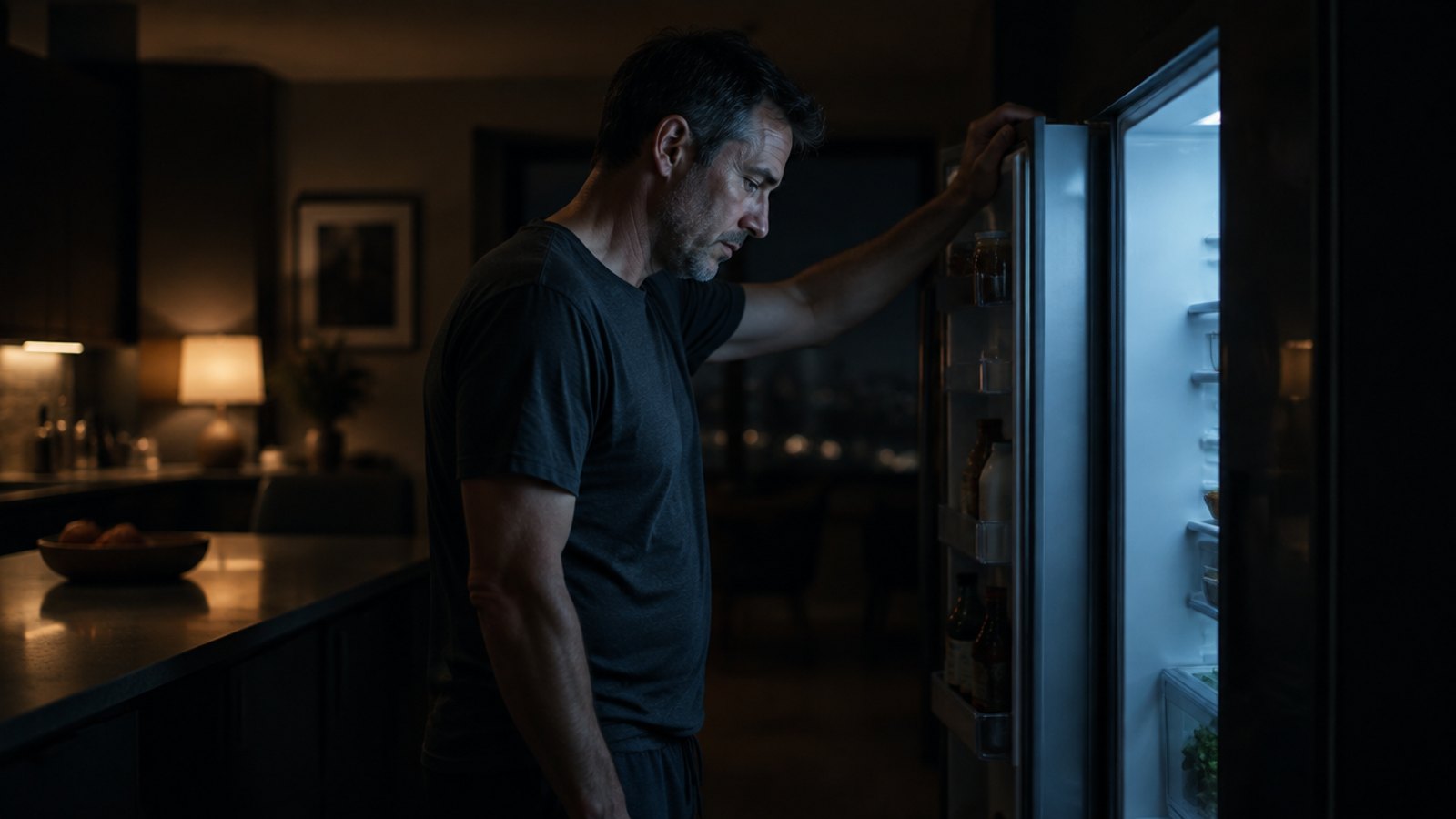
If you want to know how to stop stress eating, start here: it is not a willpower problem, and men do it far more than they admit. A bad day at work turns into a bag of chips at 9pm, and a rough month turns into ten pounds. The fix is not white-knuckling it. It is taking away the three things that make stress eating easy: short sleep, long gaps without protein, and an evening with nothing between the stress and the pantry. Put a pause, a plan and a few guardrails in place and most of it goes away.
Here is why stress pushes men toward food, what the research says actually helps, and a plan you can use tonight.
Why men stress eat
Stress changes what you want to eat more than how much. In a lab study, 68 men and women either prepared for a filmed speech or listened to neutral text, then ate a buffet lunch. Stress did not raise total intake across the group. But the people who already described themselves as emotional eaters ate more sweet, high-fat food and a more energy-dense meal when stressed (Oliver et al., 2000). Stress does not make everyone eat. It makes the people who already use food to cope reach for the richest thing in the room.
The body is set up for it. Stress hormones, cortisol included, are tied into the same system that regulates appetite, and palatable food appears to dampen the stress response for a while. That makes a cookie after a bad meeting feel like it works, which is exactly how the habit gets built (Adam and Epel, 2007). A later review lays out the full loop: stress wears down self-control, shortens sleep, cuts activity and pushes food choice toward calories, fat and sugar (Tomiyama, 2018). If you want the hormone side in more depth, we covered what cortisol actually does to a man's belly fat.
Is stress eating worse in men?
Men tend to say they do not emotionally eat. The weight data disagrees. A review of the stress and eating research found that in long-term studies, chronic life stress looked causally linked to weight gain, with a greater effect seen in men (Torres and Nowson, 2007). In a national US cohort of 1,355 adults followed for about nine years, heavier men gained more weight as job demands rose, as they had less say over their work, and as it got harder to pay the bills (Block et al., 2009).
That lines up with what most men describe. It rarely feels like "emotional eating." It feels like being tired, wired and hungry at the end of a long day. Same thing, different label. We made the same point about food noise and why men rarely call it that.
Stress eating vs real hunger: how to tell
A simple check before you open the fridge:
- Real hunger builds slowly, shows up three to five hours after a meal, and a plain meal would fix it.
- Stress hunger hits fast, usually right after a trigger (an email, a call, the kids finally asleep), and wants one specific thing, usually sweet, salty or crunchy.
- The test: would chicken and rice sound good right now? If yes, eat a real meal. If only the chips will do, it is stress.
How to stop stress eating: 7 fixes that work
1. Sleep seven hours before anything else
This is the biggest lever and the one men skip. When 12 healthy young men were cut to four hours in bed for two nights, their fullness hormone leptin fell 18 percent, their hunger hormone ghrelin rose 28 percent, hunger rose 24 percent, and appetite for calorie-dense, carb-heavy food rose 33 to 45 percent (Spiegel et al., 2004). A short night makes every stressor tomorrow more likely to end in the snack drawer. Sleep also happens to be when most of your testosterone gets made, so it pays twice.
2. Front-load protein
Long gaps and low protein turn a stressful afternoon into a starving evening. In 27 overweight and obese men aged around 47 on a 12 week diet, the higher-protein group felt fuller through the day and had lower late-night desire to eat and less preoccupation with thoughts of food than the normal-protein group (Leidy et al., 2011). Aim for 30 to 40 grams at breakfast and lunch. The rest of the appetite levers with real evidence behind them build on this one.
3. Build a pause between the trigger and the food
You cannot stop stress from happening. You can put ten minutes between it and eating. When the urge hits, set a timer, drink a glass of water, and do something else. Most stress cravings fade on their own inside that window. If you still want it after ten minutes, eat a planned portion on a plate, sitting down, not from the bag.
4. Walk it off, literally
A 15 minute brisk walk reduced chocolate urges in regular chocolate eaters compared with sitting quietly, and it also blunted the blood pressure jump when they were put through a stress task afterwards (Taylor and Oliver, 2008). It is a small study, but it matches what most men find: a walk after a bad day takes the edge off in a way the pantry only pretends to.
5. Try a short mindfulness habit
This one sounds soft, but it has data. A systematic review of 14 studies found mindfulness meditation effectively reduced binge eating and emotional eating in people who struggled with them. Its effect on weight was mixed (Katterman et al., 2014). Think of it as training the pause in fix 3. Five minutes of slow breathing, eyes closed, before dinner is enough to start.
6. Change what is within reach
Stress eating is fast eating, so it goes to whatever is closest. Keep the trigger foods out of the house or out of sight, and keep a default ready instead: Greek yogurt, a protein shake, fruit, jerky, or a bowl of popcorn you portion out. You will still eat. You will eat something that does less damage.
7. Watch the drink that comes with the snack
For a lot of men, stress eating and the evening beer travel together. Alcohol lowers the guard and adds its own calories, and the 9pm fridge raid does more damage than the clock does. Two alcohol-free weeknights often cut the snacking with it.
Stress eating at night
Most stress eating happens after dinner, when the day is done, willpower is spent and nobody is watching. Three things help most: a real dinner with protein and vegetables so you are not actually hungry, a set kitchen-closed time (for example, 8:30pm), and an evening routine that is not the couch plus a bag of chips. A walk, a shower, reading, anything that marks the day as over.
Stress eating and weight gain over 40
Past 40, the margin is smaller. You carry less muscle, sleep less, and job and family stress usually peak at the same time. That is why the Block cohort found the weight gain concentrated in men already carrying extra weight. The fixes are the same, they just matter more: sleep, protein, lifting, and a plan for the evening.
When stress eating is more than a habit
If you regularly eat large amounts in a short time, feel out of control while doing it, and feel ashamed afterwards, that can be binge eating disorder, and men have it too. It is common, treatable, and not something to fix with a blog post. Talk to your doctor or a therapist who works with eating behavior.
The verdict
Stress eating is a normal response to a stressful life, and men are not immune to it. The research points to the same fixes again and again: sleep enough, eat protein early, build a pause, move when the urge hits, and set up your evening so the easy choice is the right one. More on the stress side of men's health sits in our men's health guides.
References
- Oliver G, Wardle J, Gibson EL. Stress and food choice: a laboratory study. Psychosom Med. 2000. https://pubmed.ncbi.nlm.nih.gov/11139006/
- Adam TC, Epel ES. Stress, eating and the reward system. Physiol Behav. 2007. https://pubmed.ncbi.nlm.nih.gov/17543357/
- Tomiyama AJ. Stress and obesity. Annu Rev Psychol. 2018. https://pubmed.ncbi.nlm.nih.gov/29927688/
- Torres SJ, Nowson CA. Relationship between stress, eating behavior, and obesity. Nutrition. 2007. https://pubmed.ncbi.nlm.nih.gov/17869482/
- Block JP, He Y, Zaslavsky AM, Ding L, Ayanian JZ. Psychosocial stress and change in weight among US adults. Am J Epidemiol. 2009. https://pubmed.ncbi.nlm.nih.gov/19465744/
- Spiegel K, Tasali E, Penev P, Van Cauter E. Sleep curtailment in healthy young men is associated with decreased leptin levels, elevated ghrelin levels, and increased hunger and appetite. Ann Intern Med. 2004. https://pubmed.ncbi.nlm.nih.gov/15583226/
- Leidy HJ, Tang M, Armstrong CL, Martin CB, Campbell WW. The effects of consuming frequent, higher protein meals on appetite and satiety during weight loss in overweight/obese men. Obesity (Silver Spring). 2011. https://pubmed.ncbi.nlm.nih.gov/20847729/
- Taylor AH, Oliver AJ. Acute effects of brisk walking on urges to eat chocolate, affect, and responses to a stressor and chocolate cue. Appetite. 2008. https://pubmed.ncbi.nlm.nih.gov/18835411/
- Katterman SN, Kleinman BM, Hood MM, Nackers LM, Corsica JA. Mindfulness meditation as an intervention for binge eating, emotional eating, and weight loss: a systematic review. Eat Behav. 2014. https://pubmed.ncbi.nlm.nih.gov/24854804/
Common questions
Why do I eat when I am stressed?
Stress hormones are tied into the system that controls appetite, and rich food appears to calm the stress response for a while, so eating after a bad day feels like it works (Adam and Epel, 2007). In a lab study, stressed emotional eaters chose more sweet, high-fat food (Oliver et al., 2000). The relief is real but short, which is how the habit builds.
Does cortisol make you hungry?
Cortisol can push you toward calorie-dense food, especially when stress is chronic and sleep is short. Reviews link long-term stress to more eating of high-calorie, high-sugar foods and to weight gain (Tomiyama, 2018). A single stressful moment does not make everyone eat more, though.
How do I stop stress eating at night?
Eat a real dinner with protein, set a kitchen-closed time, and replace the couch-and-snack routine with something that ends the day, like a walk or a shower. Higher-protein diets lowered late-night desire to eat in overweight men (Leidy et al., 2011).
What should I eat when I am stress eating?
Something that is filling and hard to overeat: Greek yogurt, a protein shake, fruit, jerky, or a measured bowl of popcorn. Keep those within reach and the trigger foods out of sight.
Is stress eating a disorder?
Stress eating is usually not a disorder. Occasional stress eating is a common habit. If you often eat large amounts quickly, feel out of control and feel ashamed afterwards, that can be binge eating disorder, which is treatable. Talk to your doctor.
Does exercise help with stress eating?
Exercise does help with stress eating, and it does not take much. A 15 minute brisk walk reduced chocolate cravings and blunted the blood pressure response to a stress task compared with sitting (Taylor and Oliver, 2008).