Health
Food Noise: What It Is, and Why Men Rarely Call It That
The term came out of GLP-1 conversations, so most men have the experience without the word. It is a signaling problem, not a willpower problem, and sleep, protein, alcohol, and cues are the dials that actually move it.
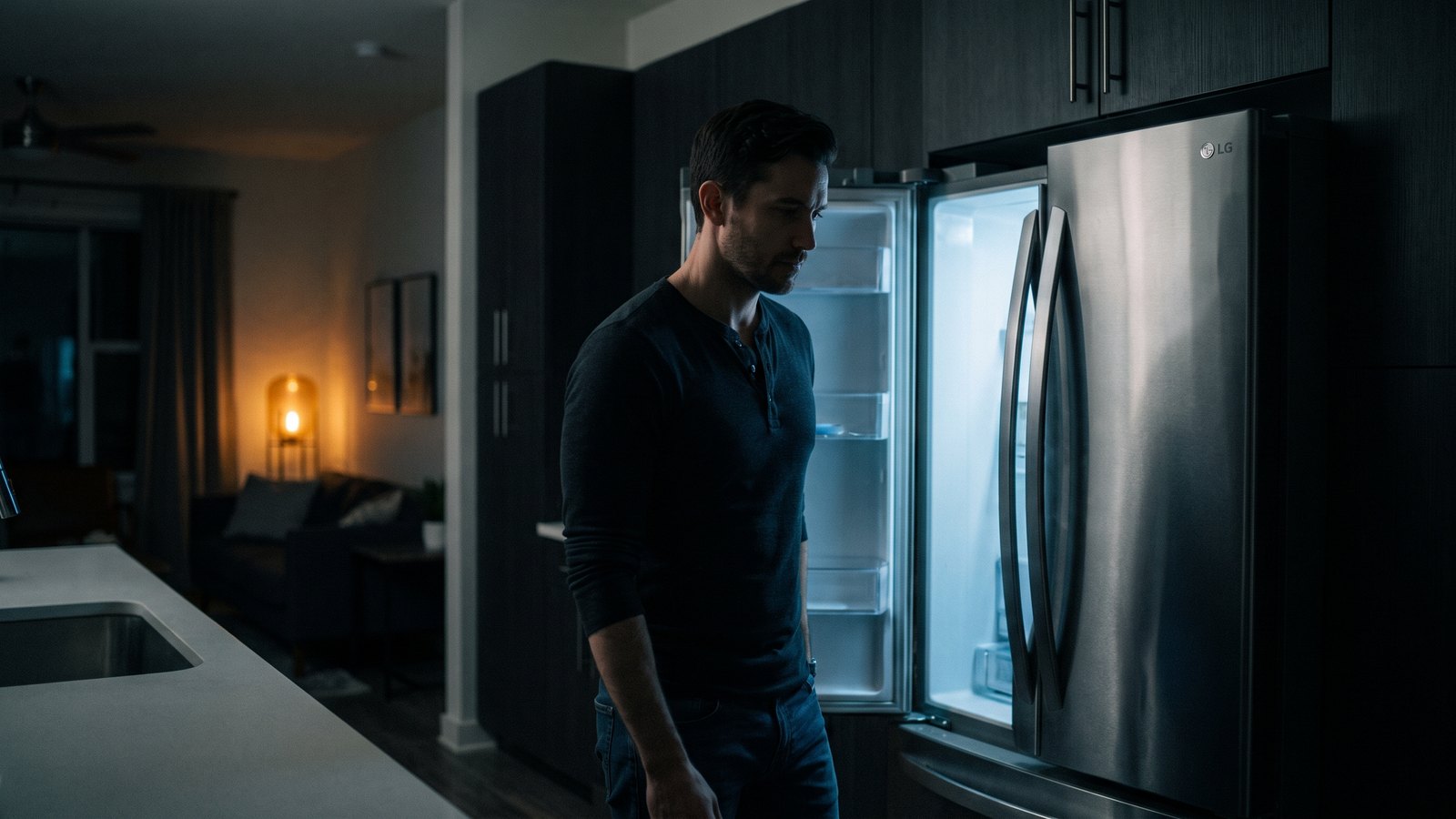
The phrase showed up about two years ago, mostly from people on GLP-1 medications describing what went away. They said the constant mental chatter about food finally stopped. No more planning lunch during a meeting. No more negotiating with the pantry at 9pm. Somebody called it food noise and the name stuck because it described something people had never had a word for.
Here is the part worth saying up front: this is not a female problem, and it is not a willpower problem. It is a signaling problem, and most of what turns the volume up is stuff a man can actually change. Sleep, protein, alcohol, and how often you park yourself in front of food you like. Those four are not glamorous and they are not marketing. They are the levers with evidence behind them.
What food noise actually means
A group of obesity researchers put a formal definition on it in 2025. Food noise is persistent thoughts about food that the person experiences as unwanted or unpleasant, and that can cause real social, mental, or physical problems. What separates it from normal food thoughts is intensity and intrusiveness. Ordinary hunger says eat something. Food noise keeps talking after you have eaten (Dhurandhar et al., 2025).
That distinction matters. Thinking about dinner on the drive home is not food noise. Running a background loop about what you already ate, what you should not have eaten, and what you are allowed to eat later, while trying to do your job, is closer to what people are describing. The researchers compared the pattern to rumination, and that is a good word for it.
There is now a measurement tool. Researchers built and tested the Food Noise Questionnaire in 400 adults. It is five items, it held together statistically as a single construct, and it repeated well when the same people took it a week later (Diktas et al., 2025). Five questions is not a diagnosis, but it does mean the thing can be measured instead of just described.
The honest caveat
Food noise is a young idea and it is worth knowing that. A 2026 commentary in Appetite went through the current definitions and measurement tools and made a fair point: nobody has yet shown that food noise is a distinct phenomenon rather than a new label on things researchers already study, like food cue reactivity, cravings, and food preoccupation. The mechanism evidence is thin, and the questionnaires overlap heavily with scales that already exist (Brewis et al., 2026).
That does not make the experience fake. It means the science is behind the vocabulary, which is normal for a term that came from patients rather than labs. Treat food noise as a useful description of something real, not as a diagnosis you have.
Why men rarely call it anything
Men get this and mostly do not name it. Part of that is vocabulary. The term entered the culture through weight-loss and GLP-1 conversations, which skew female, so a lot of guys have the experience without ever hearing the word attached to it.
There is some data underneath that too. A survey of 306 adults, 151 of them men, measured food appeal and desire to eat alongside mood and eating behaviors. Women reported more dietary restraint, more trait-based hunger, and more disinhibition than men did. But here is the part that matters: sex did not change the relationships. Hunger, cravings, and anxiety predicted desire to eat the same way in both groups (Legget et al., 2023).
Read that carefully. The wiring is the same. The reporting is not. Men are less likely to describe themselves as preoccupied with food, more likely to file the same experience under being hungry, stressed, or bored, and much less likely to bring it up. So the useful question is not whether you have food noise. It is what is turning yours up.
Turn one: you are not sleeping enough
This is the biggest and the most ignored. In a controlled crossover study, 12 healthy young men went through two days of short sleep and two days of extended sleep, with calories and activity held constant. On the short-sleep arm, ghrelin, the hormone that drives hunger, rose 28 percent. Leptin, which signals fullness, fell 18 percent. Self-reported hunger climbed 24 percent, and appetite specifically for calorie-dense, high-carbohydrate food went up 33 to 45 percent (Spiegel et al., 2004).
Two nights. Healthy young men. Same food, same training.
The brain imaging fills in why. When researchers scanned people after sleep deprivation, activity dropped in the frontal and insular regions that handle judgment about food, while amygdala activity went up. The people whose sleep loss hit hardest wanted the highest-calorie foods most (Greer et al., 2013). You do not become weaker when you are underslept. The part of you that evaluates gets quieter and the part that wants gets louder.
If you are chronically short on sleep, this is the first thing to fix, and it pays off everywhere else. Sleep loss is also the fastest way to tank your hormones, which is why cutting sleep to five hours drops testosterone within a week. And if you snore and still wake up tired, read the signs of sleep apnea men write off as snoring before you blame your discipline.
Turn two: you are under-eating, usually on protein
Men who are trying to lean out tend to solve it by eating less of everything. That works right up until the volume comes on.
A tightly controlled crossover study put 23 healthy women through two 16-day diets, one at roughly half normal protein intake and one at roughly double it, then scanned their brains while showing food cues. In the low-protein state, reward regions including the orbitofrontal cortex and striatum lit up more in response to food cues, preference for savory foods went up, and they ate more protein when given free access (Griffioen-Roose et al., 2014). That study was in women, so read it as mechanism rather than a men's result, but the mechanism is the point: run low on protein and your reward system starts hunting for it.
The practical read is well established. A review of the protein literature found that higher-protein meals produce greater fullness and higher satiety hormone responses, and that higher-protein energy-restricted diets outperform lower-protein ones for weight loss, fat loss, and holding onto lean mass (Leidy et al., 2015). If you are dieting, protein is the last thing that should be cut. Start with how much protein a man actually needs, and note that spreading it across the day beats loading most of it at dinner.
Turn three: alcohol, and not the amount you think
The appetizer effect is real and it has been measured cleanly. In a crossover trial, 24 healthy men drank either vodka and orange juice containing 20 grams of alcohol, about two standard drinks, or orange juice alone. Forty-five minutes later they ate an unrestricted lunch. After alcohol they ate 11 percent more, and the increase was specific: high-fat savory food. Alcohol raised both liking and wanting for savory food before the meal even started (Schrieks et al., 2015).
Two drinks. Not a bender. And the effect showed up in the food category most men will tell you they cannot stop eating once they start.
Alcohol also wrecks the sleep that would have kept the volume down, which stacks turn three on top of turn one. If you want the wider picture on what regular drinking does to a man's body composition and hormones, that is covered in what alcohol does to testosterone.
Turn four: the environment doing the talking
Reward signaling does not run on hunger alone. It runs on cues, and cues are learned. The sandwich shop you pass, the drawer at work, the specific hour you always eat something after the kids go down. None of that is a character flaw. It is a system that responds to repetition, and it will keep firing as long as you keep feeding the pattern.
This is where the GLP-1 conversation came from in the first place. Those drugs quiet the chatter partly by acting on the same appetite and reward pathways, which is why patients describe the silence so vividly. You do not need a prescription to move in the same direction, but you should be honest that the natural levers work slower and smaller. For what actually holds up outside a pharmacy, see which natural GLP-1 approaches have real evidence.
What to actually do this week
Pick the loudest one and fix that. In order of how often it is the culprit for men:
- Sleep first. Seven hours minimum, same wake time. Two short nights are enough to move ghrelin measurably.
- Protein at every meal. If you are in a deficit, this is not optional. Under-eating protein is a reliable way to make food louder.
- Count the drinks honestly. Two is enough to add roughly a tenth to your next meal, and it hits the savory stuff hardest.
- Break one cue. One route, one drawer, one hour. Not all of them. One.
- Check the stress load. If the noise is worst during hard weeks at work, that is a signal, not a coincidence. What chronic stress does to cortisol in men is the other half of this picture.
None of that silences food thoughts completely, and it should not. Wanting food is supposed to happen. The goal is turning a loop that runs all day back into a signal that shows up around mealtime and then leaves you alone.
If it does not quiet down, or the thoughts feel closer to compulsive than annoying, that is worth raising with a doctor rather than grinding at it alone. More on the fundamentals in our men's health coverage.
References
- Dhurandhar EJ, Maki KC, Dhurandhar NV, et al. Food noise: definition, measurement, and future research directions. Nutr Diabetes. 2025. https://pubmed.ncbi.nlm.nih.gov/40628707/
- Diktas HE, Cardel MI, Foster GD, et al. Development and validation of the Food Noise Questionnaire. Obesity (Silver Spring). 2025. https://pubmed.ncbi.nlm.nih.gov/39828656/
- Brewis A, Hayashi D, Gualano B, et al. Food noise: Conceptual, methodological, and ethical considerations. Appetite. 2026. https://pubmed.ncbi.nlm.nih.gov/42392316/
- Legget KT, Cornier MA, Sarabia L, et al. Sex Differences in Effects of Mood, Eating-Related Behaviors, and BMI on Food Appeal and Desire to Eat: A Cross-Sectional Survey Study. Nutrients. 2023. https://pubmed.ncbi.nlm.nih.gov/36771467/
- Spiegel K, Tasali E, Penev P, Van Cauter E. Brief communication: Sleep curtailment in healthy young men is associated with decreased leptin levels, elevated ghrelin levels, and increased hunger and appetite. Ann Intern Med. 2004. https://pubmed.ncbi.nlm.nih.gov/15583226/
- Greer SM, Goldstein AN, Walker MP. The impact of sleep deprivation on food desire in the human brain. Nat Commun. 2013. https://pubmed.ncbi.nlm.nih.gov/23922121/
- Griffioen-Roose S, Smeets PA, van den Heuvel E, et al. Human protein status modulates brain reward responses to food cues. Am J Clin Nutr. 2014. https://pubmed.ncbi.nlm.nih.gov/24847853/
- Leidy HJ, Clifton PM, Astrup A, et al. The role of protein in weight loss and maintenance. Am J Clin Nutr. 2015. https://pubmed.ncbi.nlm.nih.gov/25926512/
- Schrieks IC, Stafleu A, Griffioen-Roose S, et al. Moderate alcohol consumption stimulates food intake and food reward of savoury foods. Appetite. 2015. https://pubmed.ncbi.nlm.nih.gov/25636235/
Common questions
What is food noise?
Researchers defined it in 2025 as persistent thoughts about food that the person experiences as unwanted or unpleasant, and that can cause social, mental, or physical problems. What separates it from normal food thoughts is intensity and intrusiveness. It resembles rumination more than hunger, and it keeps going after you have eaten (Dhurandhar, 2025). There is now a five-item Food Noise Questionnaire, validated in 400 adults, that measures it (Diktas, 2025).
Do men get food noise?
Men do get food noise, they just rarely use the phrase. A survey of 306 adults including 151 men found women reported more dietary restraint, trait hunger, and disinhibition, but sex did not change the underlying relationships. Hunger, cravings, and anxiety predicted desire to eat the same way in men and women (Legget, 2023). The wiring is the same. Men are simply more likely to file it under being hungry, stressed, or bored.
Does poor sleep make food noise worse?
Sleep is probably the single biggest lever on food noise. Two nights of short sleep in 12 healthy young men, with calories and activity held constant, raised ghrelin 28 percent, dropped leptin 18 percent, and increased appetite for calorie-dense high-carbohydrate food by 33 to 45 percent (Spiegel, 2004). Brain imaging shows the same pattern: after sleep deprivation, the evaluative regions quiet down and the amygdala ramps up, and desire for high-calorie food climbs with it (Greer, 2013).
Does alcohol make you eat more?
Measurably, and at doses most men would call nothing. In a crossover trial, 24 healthy men who drank 20 grams of alcohol, about two standard drinks, ate 11 percent more at an unrestricted lunch 45 minutes later. The extra intake was specifically high-fat savory food, and alcohol raised both wanting and liking for savory food before the meal started (Schrieks, 2015).
Will eating more protein quiet food noise?
Eating more protein helps with food noise, particularly if you are dieting. A controlled crossover study found that a low-protein state increased reward-region brain responses to food cues and raised savory food preference, though that study was run in 23 women, so treat it as mechanism rather than a men's result (Griffioen-Roose, 2014). On the practical side, higher-protein meals produce greater fullness and higher satiety hormone responses, and higher-protein diets beat lower-protein ones for fat loss and holding lean mass in a deficit (Leidy, 2015).
Is food noise a real medical condition?
Food noise is not yet a real medical condition. A 2026 commentary in Appetite pointed out that nobody has shown food noise is distinct from things researchers already measure, like food cue reactivity, cravings, and food preoccupation, and that current questionnaires overlap heavily with existing scales (Brewis et al., 2026). The experience is real. The science is still catching up to the vocabulary. If the thoughts feel compulsive rather than annoying, that is worth raising with a doctor.