Supplements
Can Collagen Help Weight Loss for Men? What the Trials Found
It will not burn fat in a coffee mug. Paired with a barbell, it has a better track record in men than most people expect.
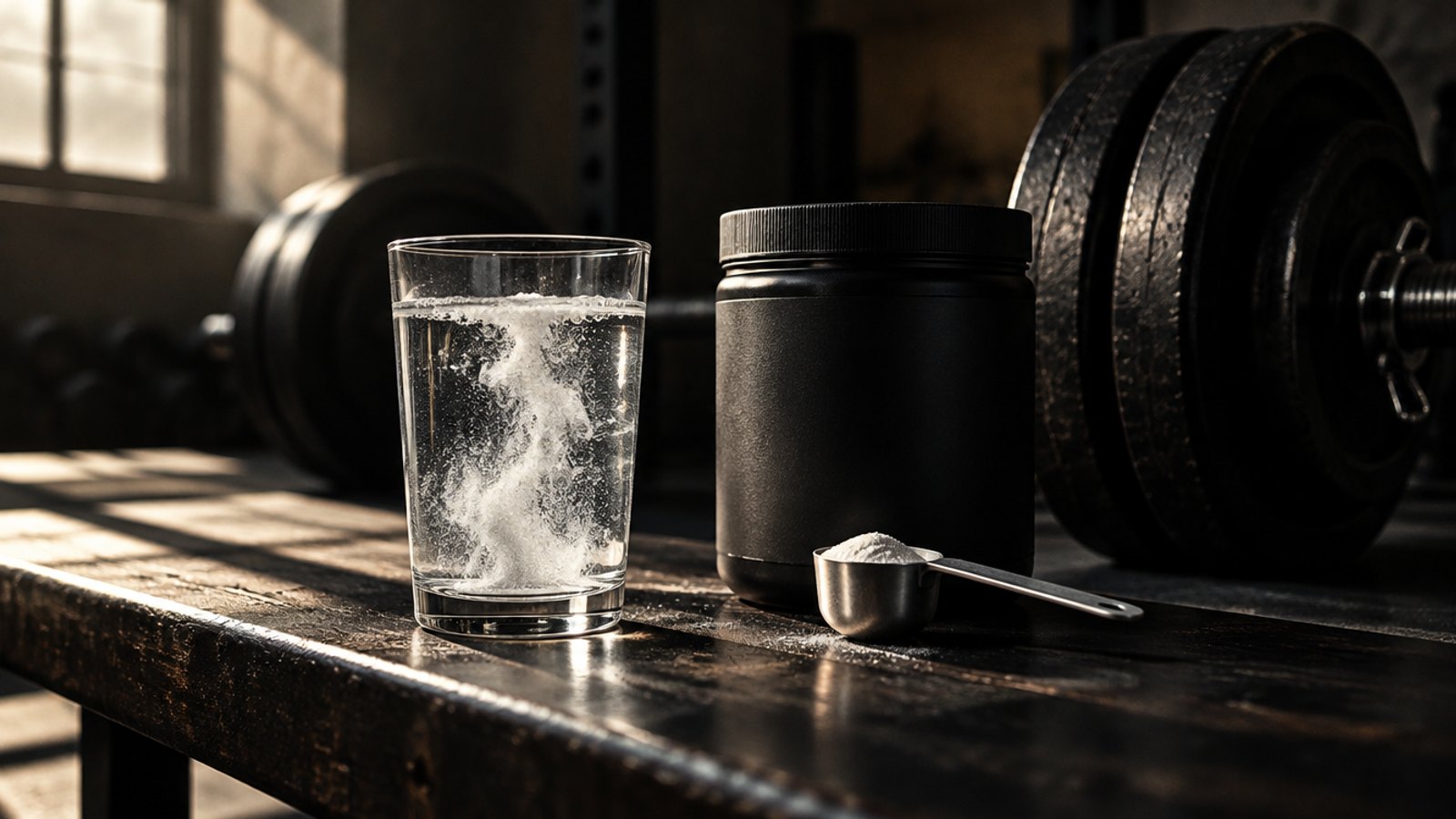
Can collagen help weight loss for men? Not on its own. Collagen does not burn fat, and no trial shows a man getting leaner just by stirring it into his coffee. Where it does help is alongside lifting: in three randomized trials in men who trained three times a week, 15 g of collagen peptides a day led to more lean mass than a placebo, and in two of them, more fat lost too. It is also protein, so it fills you up and counts toward your daily total.
That makes collagen a reasonable add-on for a man who already lifts and wants an easy 15 g of protein. It is not a fat burner, and it is not a replacement for whey, meat, eggs or dairy as your main protein. This is education, not medical advice.
Can collagen help weight loss for men? What the trials measured
Collagen helped men's body composition in trials that paired it with resistance training, and the gains came mostly as lean mass rather than a lower number on the scale. That distinction matters. Most men who say they want to lose weight really want to lose fat and keep their muscle, and the collagen trials speak to that goal better than to the scale.
The clearest trial is in older men. Fifty-three men averaging 72 years old, all with age-related muscle loss, lifted three times a week for 12 weeks and took either 15 g of collagen peptides or a placebo after training. Both groups improved. The collagen group gained more fat-free mass (4.2 kg vs 2.9 kg), lost more fat (5.4 kg vs 3.5 kg) and got stronger in the legs (Zdzieblik et al., 2015).
The same team repeated it in 97 untrained middle-aged men, this time with a third group on whey. After 12 weeks of training, the collagen group gained more fat-free mass than placebo (3.4 kg vs 1.8 kg) and lost more fat (5.3 kg vs 3.4 kg). The whey group landed in between (2.3 kg gained, 4.1 kg lost), and in the exploratory comparison collagen and whey did not differ significantly (Zdzieblik et al., 2021).
In 57 recreationally active young men, 15 g a day for 12 weeks of lifting raised fat-free mass more than placebo. Fat mass held steady in the collagen group and went up in the placebo group (Kirmse et al., 2019). A smaller trial of 25 young men found more lean mass with collagen but no difference in fat mass (Oertzen-Hagemann et al., 2019).
One honest note on all four: they tested a specific collagen peptide product, the groups are small, and several authors work with collagen research groups tied to the industry. The direction is consistent. The size of the effect deserves a grain of salt.
Does collagen help you lose fat without training?
Collagen without training has one small trial behind it, and it used a different product at a much lower dose. Ninety overweight adults, 17 of them men, averaging 41 years old, took 2,000 mg a day of collagen peptides from skate skin or a placebo for 12 weeks. Body fat mass dropped 1.2 kg in the collagen group and rose 0.3 kg in the placebo group (Tak et al., 2019).
That is a real result, but it is one study, mostly in women, with a fish-skin peptide you will not find in a typical tub. It does not tell you what a scoop of generic bovine collagen will do for a man who sits at a desk all day. The stronger case for collagen is the training trials above.
Does collagen help you lose belly fat?
No collagen trial in men has measured belly fat on its own. The trials above measured total fat mass with DXA scans or body composition scales, so they can say a man lost more fat overall, not where it came off. Belly fat tends to drop as total fat drops, which is why a calorie deficit plus lifting does more for your waist than any single supplement. The training side of that is in whether you can lose fat and build muscle at the same time past 40.
Is collagen good protein for weight loss?
Collagen is protein, but it is an incomplete one. It is missing tryptophan, an essential amino acid, so it scores as an incomplete protein on the standard quality test (Paul et al., 2019). That same analysis, written by authors with ties to collagen makers, calculated that collagen could still supply up to about a third of your daily protein without leaving you short on essential amino acids. So it works as part of your intake, not as all of it.
The quality gap shows up when muscle is under threat. In 31 older adults on a 500-calorie deficit who then cut their steps to under 750 a day, taking 30 g of whey or 30 g of collagen twice a day did not stop leg muscle loss in either group. When they went back to normal activity, only the whey group regained lean mass and saw muscle building rates recover (Oikawa et al., 2018). For a man in a deficit, whey or whole-food protein is the stronger base.
Your total still matters most. A pooled analysis of 49 trials found that the muscle benefit of extra protein flattened out at about 1.6 g per kg of body weight a day (Morton et al., 2018). Here is how much protein a lifting man actually needs and where it should come from.
Does collagen keep you full?
Gelatin, the cooked form of collagen, was one of the most filling proteins in a head-to-head breakfast study. Twenty-four healthy adults ate custard breakfasts made with different proteins. After a gelatin breakfast they ate about 20 percent less at lunch than after a casein or soy breakfast, and their hunger ratings tracked the difference (Veldhorst et al., 2009).
That is a single-meal lab study in young adults, so it does not prove collagen will cut your intake over months. It does fit with what men notice: protein at breakfast takes the edge off the late-morning hunger that sends you to the vending machine. For the other levers, see the appetite controls that hold up in trials for men.
Collagen vs whey protein for weight loss
Whey is the better all-round protein for weight loss in men, and collagen is the better add-on for joints. In the one trial that ran them side by side in men who lifted, collagen beat placebo on fat-free mass and fat loss while whey did not differ significantly from either one (Zdzieblik et al., 2021). In older adults in a deficit, whey was the only one that helped muscle recover afterward (Oikawa et al., 2018).
Put those together and the practical answer is simple. Use whey or food as your main protein, and add collagen if you want the extra grams or if your knees and elbows are part of the reason you are buying it. We rank the tubs in our pick for the best protein powder for men over 40, and the tendon research is in what the collagen trials found for tendons and sore joints.
How much collagen per day for weight loss?
The men's training trials all used 15 g of collagen peptides a day. That is the dose with results behind it for body composition, and it adds roughly 60 calories. The one fat-loss trial without training used 2,000 mg of a fish-skin peptide, which is not the same product and should not be read as a target for a regular scoop (Tak et al., 2019).
The trials gave collagen after training on workout days. Timing is a minor lever next to hitting your daily protein, so take it whenever you will actually remember.
Collagen for weight loss over 40, over 50 and over 60
Men over 60 have the strongest collagen data of any age group, because the best-known trial was run in men averaging 72. Those men gained 1.3 kg more fat-free mass and lost 1.9 kg more fat than the placebo group when collagen was added to three lifting sessions a week (Zdzieblik et al., 2015). The middle-aged trial adds support for men in their 40s and 50s who are new to lifting (Zdzieblik et al., 2021).
The catch for older men is the same one as above. Collagen is incomplete, and older muscle needs more high-quality protein to respond, so collagen should sit on top of a solid protein intake rather than stand in for it. More on that in how much protein to eat to build muscle at your bodyweight.
Does collagen make you gain weight?
Collagen was not linked to fat gain in any of the men's training trials. In those trials, body weight sometimes went up a little because the collagen groups added lean mass, which weighs something and is the weight you want (Oertzen-Hagemann et al., 2019). Fifteen grams adds about 60 calories, so it only shows up on the scale if it pushes you over your daily needs.
For more on what is worth taking and what is not, browse the supplements hub.
References
- Zdzieblik D, Oesser S, Baumstark MW, Gollhofer A, König D. Collagen peptide supplementation in combination with resistance training improves body composition and increases muscle strength in elderly sarcopenic men: a randomised controlled trial. Br J Nutr. 2015. https://pubmed.ncbi.nlm.nih.gov/26353786/
- Zdzieblik D, Jendricke P, Oesser S, Gollhofer A, König D. The Influence of Specific Bioactive Collagen Peptides on Body Composition and Muscle Strength in Middle-Aged, Untrained Men: A Randomized Controlled Trial. Int J Environ Res Public Health. 2021. https://pubmed.ncbi.nlm.nih.gov/33946565/
- Kirmse M, Oertzen-Hagemann V, de Marées M, Bloch W, Platen P. Prolonged Collagen Peptide Supplementation and Resistance Exercise Training Affects Body Composition in Recreationally Active Men. Nutrients. 2019. https://pubmed.ncbi.nlm.nih.gov/31126103/
- Oertzen-Hagemann V, Kirmse M, Eggers B, et al.. Effects of 12 Weeks of Hypertrophy Resistance Exercise Training Combined with Collagen Peptide Supplementation on the Skeletal Muscle Proteome in Recreationally Active Men. Nutrients. 2019. https://pubmed.ncbi.nlm.nih.gov/31091754/
- Tak YJ, Kim YJ, Lee JG, et al.. Effect of Oral Ingestion of Low-Molecular Collagen Peptides Derived from Skate (Raja Kenojei) Skin on Body Fat in Overweight Adults: A Randomized, Double-Blind, Placebo-Controlled Trial. Mar Drugs. 2019. https://pubmed.ncbi.nlm.nih.gov/30866485/
- Paul C, Leser S, Oesser S. Significant Amounts of Functional Collagen Peptides Can Be Incorporated in the Diet While Maintaining Indispensable Amino Acid Balance. Nutrients. 2019. https://pubmed.ncbi.nlm.nih.gov/31096622/
- Oikawa SY, McGlory C, D'Souza LK, et al.. A randomized controlled trial of the impact of protein supplementation on leg lean mass and integrated muscle protein synthesis during inactivity and energy restriction in older persons. Am J Clin Nutr. 2018. https://pubmed.ncbi.nlm.nih.gov/30289425/
- Morton RW, Murphy KT, McKellar SR, et al.. A systematic review, meta-analysis and meta-regression of the effect of protein supplementation on resistance training-induced gains in muscle mass and strength in healthy adults. Br J Sports Med. 2018. https://pubmed.ncbi.nlm.nih.gov/28698222/
- Veldhorst MA, Nieuwenhuizen AG, Hochstenbach-Waelen A, et al.. A breakfast with alpha-lactalbumin, gelatin, or gelatin + TRP lowers energy intake at lunch compared with a breakfast with casein, soy, whey, or whey-GMP. Clin Nutr. 2009. https://pubmed.ncbi.nlm.nih.gov/19185957/
Common questions
Does collagen help you lose weight?
Collagen does not cause weight loss by itself. In men who lifted three times a week, 15 g a day led to more lean mass than a placebo, and in two trials more fat lost as well (Zdzieblik et al., 2015; Zdzieblik et al., 2021). Its value is as a protein add-on to training and a calorie deficit.
How much collagen should a man take a day for weight loss?
Fifteen grams a day of collagen peptides is the dose used in every men's training trial that improved body composition. That adds about 60 calories. Collagen should sit on top of a full day's protein from food or whey, not replace it.
Is collagen better than whey protein for weight loss?
Whey is the stronger main protein for men losing weight because it is complete and helped older adults regain muscle after a deficit when collagen did not (Oikawa et al., 2018). In the one men's trial with both, collagen and whey did not differ significantly on fat-free mass or fat loss (Zdzieblik et al., 2021). Use whey as the base and collagen as an add-on.
Can collagen reduce belly fat in men?
No collagen trial in men has measured belly fat on its own. The training trials found more total fat lost with collagen, measured by DXA scan, and belly fat usually falls as total fat falls. A calorie deficit and lifting remain the main levers for a smaller waist.
Does collagen make you gain weight?
Collagen was not linked to fat gain in the men's training trials. In those trials some men gained a little body weight on collagen because they added lean mass (Oertzen-Hagemann et al., 2019). At about 60 calories per 15 g, it only adds fat if it pushes you over your daily calorie needs.
When is the best time to take collagen for weight loss?
The best time to take collagen for weight loss is whenever you will take it consistently. The men's trials gave it after training sessions, but hitting your total daily protein matters far more than the clock. A morning dose can also help with fullness, since gelatin cut lunch intake by about 20 percent in a breakfast study (Veldhorst et al., 2009).