Supplements
Creatine Supplement for Weight Loss: What It Really Does for Men
It is not a fat burner. It is something more useful when you are cutting.
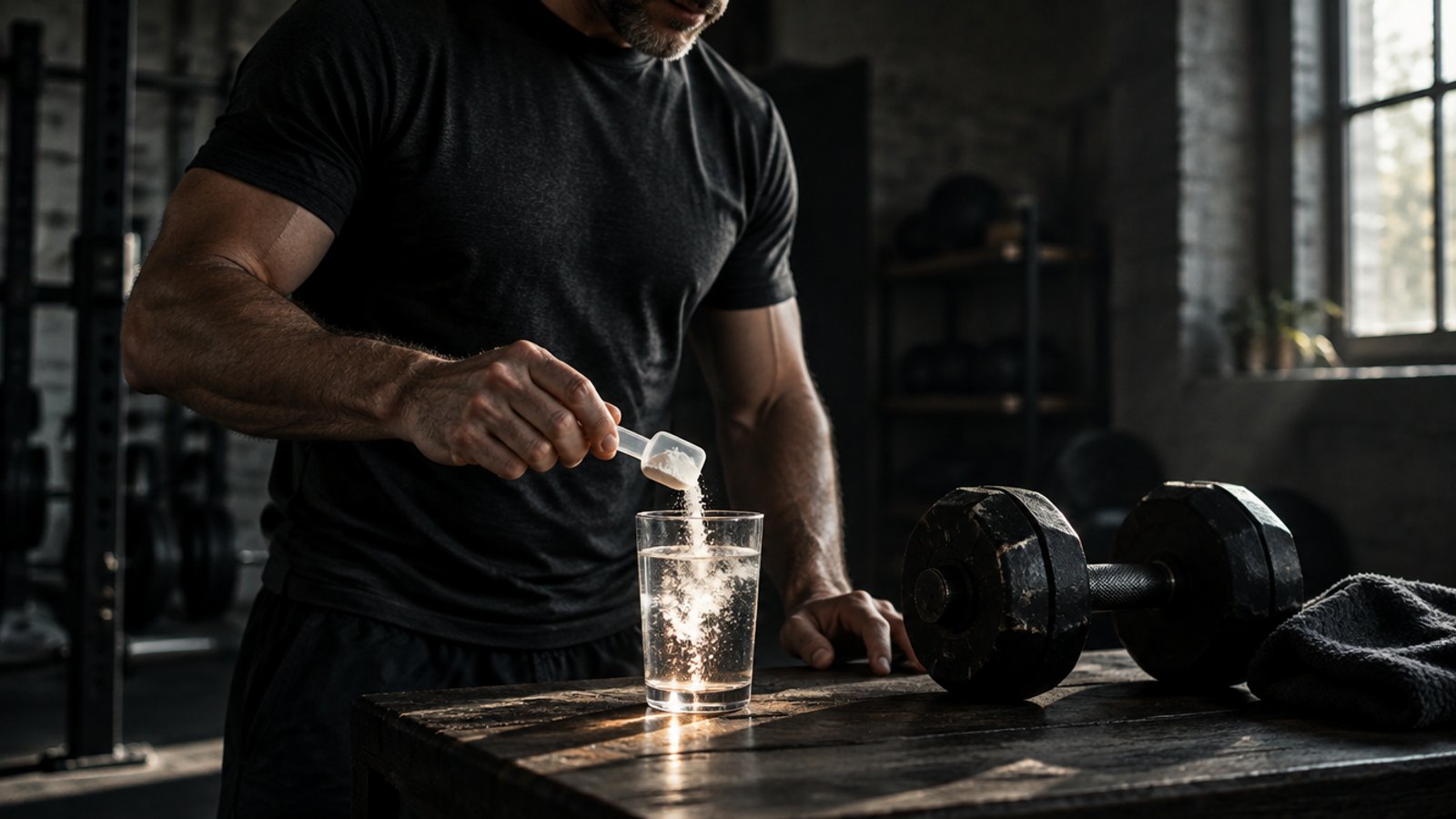
Can a creatine supplement for weight loss actually help a man lose fat? Here is the straight answer up front: creatine does not burn fat on its own, and it will usually push the scale up a couple of pounds in the first week. But for a man who lifts while he cuts, it is one of the best supported supplements there is for keeping muscle and strength, and the trials show a small extra drop in body fat percentage on top of training alone. It is a body composition tool, not a fat burner.
Here is what the research shows, what to expect on the scale, and how to use it during a cut.
Does creatine help with weight loss?
Not directly, if "weight loss" means a lower number on the scale. The largest recent review pooled 143 randomized trials and found creatine raised body mass by about 0.9 kg on average, raised fat-free mass by about 0.8 kg, and lowered body fat percentage by about 0.3 points (Pashayee-Khamene et al., 2024). The effects were stronger when people also did resistance training.
So the scale goes up a little, mostly from muscle and the water stored inside it, while the share of your body that is fat goes down a little. If your goal is to look leaner and keep your strength while you diet, that is a good trade. If your only goal is a smaller number on the scale this month, creatine is the wrong tool.
Does creatine burn fat?
No study shows creatine melting fat by itself. What it does is let you train a little harder, and over weeks that adds up to more muscle. The fat effect is a side effect of that.
A 2024 meta-analysis of 12 trials in adults under 50 is the most encouraging result. Compared with lifting alone, lifting plus creatine added about 1.1 kg of lean mass and cut about 0.7 kg more fat mass, with body fat percentage down about 0.9 points. The authors estimated that 7 grams a day, or about 0.3 g per kg of body weight, is likely to deliver roughly that result (Desai et al., 2024).
Not every review agrees on the fat mass part. Another meta-analysis of 12 trials in adults under 50 found a small drop in body fat percentage of about 1.2 points, but no real change in kilograms of fat (Candow et al., 2023). The biggest analysis to date, 63 trials and almost 1,500 people, landed in the same place: more strength, more lean mass, a slightly lower body fat percentage, and no significant change in fat mass itself (Wang et al., 2026).
The honest read: expect more muscle and a modestly leaner ratio, not a fat loss supplement. That still matters, because the muscle is what makes you look and perform better at the end of a diet.
Why creatine matters more when you are cutting
When you eat less to lose fat, your body is willing to give up muscle along with it. Lifting heavy and eating enough protein are the two biggest levers to stop that, and both are covered in the training plan the weight loss trials actually support. Creatine fits on top of them. It helps you hold your strength in the gym when calories are low, which keeps the signal to your muscles strong.
In 61 trials pooled in 2025, creatine with resistance training added about 1.4 kg of fat-free mass compared with placebo, in both beginners and experienced lifters (Ashtary-Larky et al., 2025). Holding onto that tissue during a cut is what separates a lean finish from a "skinny but soft" one. If you want the full picture of losing fat and adding muscle at the same time, see what the recomposition research says works after 40.
Creatine for weight loss over 40 and over 50
This is where creatine earns its spot. Men lose muscle steadily with age, and losing weight without lifting speeds that up.
A meta-analysis of older adults, average age about 64, found creatine plus resistance training raised fat-free mass and improved chest press, leg press and a chair stand test more than training alone (Devries and Phillips, 2014). A separate analysis of 19 studies in adults 50 and older found a larger drop in body fat percentage with creatine, about 0.55 points, and about 0.5 kg more fat lost, though that last number was not statistically certain (Forbes et al., 2019).
For a man past 40 who is trying to lose the gut without losing his strength, that is a useful edge. Pair it with lifting, enough protein and decent sleep.
Why the scale goes up when you start creatine
Creatine pulls water into your muscle cells. That is how it works, and it is why many men see the scale jump 1 to 2 kg in the first week or two, especially if they start with a loading phase.
This is water inside the muscle, not fat and not the puffy look people blame on it. A research team that reviewed the common creatine myths concluded that creatine does not increase fat mass, and that the early weight gain is mostly water (Antonio et al., 2021).
The practical fix: if you are tracking weight during a cut, start creatine, give it two weeks, and treat that new number as your baseline. Judge progress by the trend after that, plus your waist measurement and how your clothes fit.
How much creatine should you take to lose weight?
The standard dose is 3 to 5 grams of creatine monohydrate a day, every day, including rest days. Some trials used a loading phase of about 20 grams a day for 5 to 7 days, but it is not required. Skipping it just means your muscles take about three to four weeks to fill up instead of one (Kreider et al., 2017).
Heavier men can go toward the top of that range. The 2024 meta-analysis that showed the best fat result used about 7 grams a day or 0.3 g per kg (Desai et al., 2024). Timing matters far less than taking it daily. Mix it with water, coffee or your protein shake.
Plain creatine monohydrate is the form with the evidence. Fancier forms cost more and have not beaten it, as we cover in our breakdown of which creatine form actually wins.
Is creatine safe while dieting?
For healthy men, yes. The International Society of Sports Nutrition reviewed the safety research and concluded that short and long term use, up to 30 grams a day for five years in some studies, is safe and well tolerated in healthy people (Kreider et al., 2017). The same expert reviews found no good evidence that normal doses harm healthy kidneys, cause hair loss or cause dehydration and cramping (Antonio et al., 2021).
Two practical notes. Creatine can nudge up creatinine on a blood test, because creatinine is what creatine breaks down into, so tell your doctor you take it before bloodwork. And if you have kidney disease or take medication that affects your kidneys, talk to your doctor first.
How to use creatine during a cut: a simple plan
- Take 3 to 5 grams of creatine monohydrate daily. Heavier men can use up to about 7 grams.
- Lift two to four times a week. Creatine without training does very little for body composition.
- Hit your protein. Aim for roughly 1.6 g per kg of body weight or more while dieting. The numbers are in our protein by bodyweight guide.
- Reset your baseline after two weeks. Expect the early water gain and track the trend after it.
- Measure your waist, not just your weight. That is where the body composition change shows up.
For more evidence-graded picks, browse our supplements hub, or start with the full guide to creatine for men.
The verdict
A creatine supplement for weight loss works if you measure the right thing. It will not burn fat or shrink the scale, and the scale will likely go up a bit at first. What it does, reliably, is help a lifting man keep and build muscle while he loses fat, which leaves him leaner and stronger at the end. For about the cost of a coffee a week, that is one of the best returns in the supplement aisle.
This article is for education and is not medical advice. If you have kidney disease or take prescription medication, talk to your doctor before starting creatine.
References
- Pashayee-Khamene F, Heidari Z, Asbaghi O, et al. Creatine supplementation protocols with or without training interventions on body composition: a GRADE-assessed systematic review and dose-response meta-analysis. J Int Soc Sports Nutr. 2024. https://pubmed.ncbi.nlm.nih.gov/39042054/
- Desai I, Wewege MA, Jones MD, et al. The effect of creatine supplementation on resistance training-based changes to body composition: a systematic review and meta-analysis. J Strength Cond Res. 2024. https://pubmed.ncbi.nlm.nih.gov/39074168/
- Candow DG, Prokopidis K, Forbes SC, et al. Resistance exercise and creatine supplementation on fat mass in adults under 50 years of age: a systematic review and meta-analysis. Nutrients. 2023. https://pubmed.ncbi.nlm.nih.gov/37892421/
- Wang H, Wang H, Xin X, Yi Z. Resistance training combined with creatine supplementation: a three-level meta-analysis of multidimensional outcomes from strength enhancement to body composition remodeling. J Int Soc Sports Nutr. 2026. https://pubmed.ncbi.nlm.nih.gov/42765482/
- Ashtary-Larky D, Mohammadi S, Hajizadeh L, et al. Creatine supplementation and resistance training: a comparison between novice and experienced lifters. J Int Soc Sports Nutr. 2025. https://pubmed.ncbi.nlm.nih.gov/41433021/
- Devries MC, Phillips SM. Creatine supplementation during resistance training in older adults: a meta-analysis. Med Sci Sports Exerc. 2014. https://pubmed.ncbi.nlm.nih.gov/24576864/
- Forbes SC, Candow DG, Krentz JR, Roberts MD, Young KC. Changes in fat mass following creatine supplementation and resistance training in adults 50 years of age and older: a meta-analysis. J Funct Morphol Kinesiol. 2019. https://pubmed.ncbi.nlm.nih.gov/33467377/
- Antonio J, Candow DG, Forbes SC, et al. Common questions and misconceptions about creatine supplementation: what does the scientific evidence really show? J Int Soc Sports Nutr. 2021. https://pubmed.ncbi.nlm.nih.gov/33557850/
- Kreider RB, Kalman DS, Antonio J, et al. International Society of Sports Nutrition position stand: safety and efficacy of creatine supplementation in exercise, sport, and medicine. J Int Soc Sports Nutr. 2017. https://pubmed.ncbi.nlm.nih.gov/28615996/
Common questions
Does creatine make you gain weight?
Creatine usually makes you gain a little weight at first. Creatine pulls water into your muscles, so many men see the scale rise 1 to 2 kg in the first week or two. That is water inside the muscle, not fat. Over months, any further gain tends to be lean mass if you are training.
Should I take creatine while cutting?
If you lift, you should take creatine while cutting. Creatine helps you hold strength when calories are low, and trials show it adds lean mass and slightly lowers body fat percentage compared with training alone. Reset your weight baseline after the first two weeks so the early water gain does not throw off your tracking.
Does creatine burn belly fat?
No supplement targets belly fat. Creatine does not burn fat directly. Combined with lifting it can lower body fat percentage a little, mostly by helping you keep and add muscle while you diet.
How much creatine should I take for weight loss?
Take 3 to 5 grams of creatine monohydrate a day, every day. Heavier men can go up to about 7 grams, the dose linked to the best body composition result in a 2024 meta-analysis. A loading phase is optional.
Is creatine safe for men over 40?
Creatine is safe for healthy men over 40. Expert reviews found it safe and well tolerated at normal doses, and older adults who combine it with lifting gain more muscle and strength than lifting alone. Tell your doctor you take it before bloodwork, since it can raise creatinine, and check with them first if you have kidney disease.