Supplements
Best Pre Workout for Weight Loss for Men: 5 Options Compared
Most of what you pay for in a fat-loss tub is one cheap ingredient. Here is the dose, the timing, and what to use if you train at night.
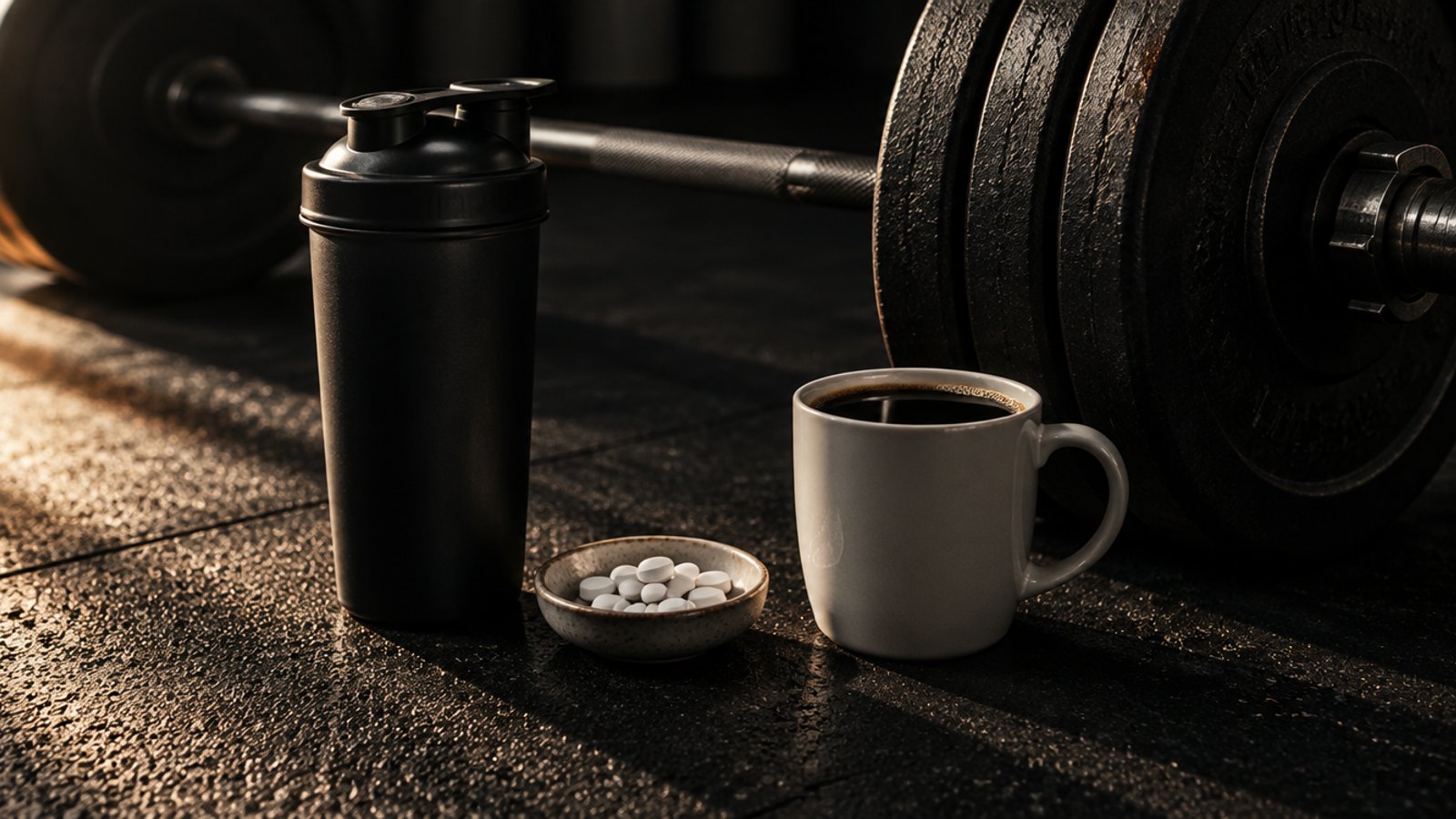
The best pre workout for weight loss for men is plain caffeine: about 2 to 3 mg per kilogram of body weight, which is roughly 200 mg for most men, taken 30 to 60 minutes before you train. Caffeine is the one pre-workout ingredient with solid human evidence for a harder session and more fat burned during exercise, and it is the main active ingredient in almost every tub sold for weight loss. If you like a scoop, the runner-up is a simple pre-workout that prints every dose. Skip the "shred" formulas with synephrine or yohimbine, and if you train at night, go stimulant-free.
One honest point first. No pre-workout, including caffeine, has been shown to take fat off by itself. In the training trials below, men and women who took a multi-ingredient pre-workout for six to eight weeks lost no more fat than the placebo groups. What a good pre-workout can do is help you train harder and burn a bit more fat while you do it, and the training is what moves your body composition. This is education, not medical advice. If you treat high blood pressure or a heart condition, talk to your prescriber before adding a stimulant.
Best pre workout for weight loss for men: the short version
Plain caffeine wins this comparison because it has the most evidence, the lowest cost, and a dose you control.
| Option | Stimulant | Dose printed | Evidence for training and fat burning | Evening use | Verdict |
|---|---|---|---|---|---|
| Plain caffeine (tablet or coffee) | Yes | Yes, you set it | Strongest: better strength and power, more fat burned during exercise | No | Winner |
| Fully dosed pre-workout tub | Usually | Yes, on good brands | Mostly from its caffeine; small extras from beta-alanine | No | Runner-up if you want a scoop |
| Stimulant-free pre-workout | No | Varies | Small performance effects, nothing for fat loss | Yes | Best for night training |
| "Shred" or thermogenic pre-workout | Yes, stacked | Often hidden in blends | Extras added nothing beyond the base formula in trials | No | Skip |
| Proprietary blend tubs | Yes | No | Cannot be judged | No | Skip |
How we compared pre-workouts for weight loss
We ranked every pre-workout option on six criteria that matter when the goal is losing fat while keeping muscle.
- Dose disclosed. Every ingredient listed with its amount, no proprietary blend.
- Stimulant or not, and how much. Total caffeine per scoop, counted with your coffee.
- Human evidence. Trials at or near the dose on the label, for training performance and for fat burned during exercise.
- Tolerability. Jitters, a racing heart and a sour stomach end most pre-workout habits.
- Evening use. Whether it wrecks your sleep if you lift after work, because short sleep makes the next day's diet harder.
- Cost per serving. A tub usually runs one to two dollars a scoop. A caffeine tablet costs a few cents.
The label problem is real. An analysis of the top 100 selling pre-workouts found they averaged 18 ingredients each, and 44 percent of all ingredients sat inside proprietary blends with no amount listed. The average scoop carried 254 mg of caffeine, and the average beta-alanine dose was below the amount shown to work (Jagim et al., 2019). In plain terms, most of what you pay for is the caffeine.
1. Plain caffeine: the best pre workout for weight loss for men
Plain caffeine is the best pre-workout for weight loss because it improves the session and raises fat burning during exercise, at a dose you can set to the milligram.
Training. A meta-analysis of ten strength studies and ten power studies found caffeine improved maximal strength and muscle power against placebo, with the clearest gain in upper body strength (Grgic et al., 2018). The effects were small, the kind of gain that adds up over months of training. The International Society of Sports Nutrition puts the reliable range at 3 to 6 mg per kilogram of body weight, with a minimum effective dose that may be as low as 2 mg per kilogram, usually taken about 60 minutes before exercise. It also notes that very high doses around 9 mg per kilogram bring more side effects without more benefit (Guest et al., 2021).
Fat burned during exercise. A meta-analysis of 19 crossover studies found caffeine taken before exercise after an overnight fast raised the rate of fat burning during submaximal exercise, with doses above about 3 mg per kilogram needed for a clear effect (Collado-Mateo et al., 2020). A follow-up meta-analysis of 18 trials, 185 of the 228 participants men, found the same in people who had eaten within five hours. That effect showed up at doses under 6 mg per kilogram and not above, and it was larger in people who did not already use caffeine every day (Fernández-Sánchez et al., 2024). So more is not better, and a moderate dose before a walk, a ride or a lifting session is the sweet spot.
The scale. Across 13 randomized trials with 606 people, higher caffeine intake went with more weight and fat mass lost, though the trials differed a lot from one another (Tabrizi et al., 2019). Treat that as a direction, not a number to bank on.
How to use it. A man who weighs 200 pounds (about 90 kg) lands near 180 to 270 mg at 2 to 3 mg per kilogram. Start at the low end. A strong cup of coffee is roughly 100 mg, so count what you already drink, and keep your daily total under the roughly 400 mg the FDA cites as not generally linked to negative effects in healthy adults. We cover timing in more detail in how much caffeine to take before training and how late is too late.
Downsides. It is a stimulant, so it can raise heart rate and blood pressure for a few hours, and it costs sleep if you take it late. More on that below.
Verdict. The winner. A 200 mg tablet, or two cups of coffee, does what most tubs do for a fraction of the price.
2. A fully dosed pre-workout tub: the runner-up
A fully dosed pre-workout with every amount printed is the runner-up, because its caffeine works and its other ingredients add a little for lifters.
The usual extras are beta-alanine, citrulline and sometimes creatine. Beta-alanine has the best record of the three: a meta-analysis of 40 placebo-controlled studies with 1,461 people found a small overall benefit, strongest in hard efforts lasting half a minute to 10 minutes, like high-rep sets and intervals (Saunders et al., 2017). It takes weeks of daily use to build up, and the tingling it causes is harmless. Citrulline did not improve strength in a meta-analysis of resistance-trained adults (Aguiar and Casonatto, 2021).
In a crossover trial in 12 trained men, a multi-ingredient pre-workout added a bit under one extra rep on the last set of bench press and lifted energy and alertness ratings, but the authors called the performance gains small (Jagim et al., 2016). Over longer stretches, the results for body composition are flat. Eighty resistance-trained men took a pre-workout or placebo for eight weeks of training, and body composition did not differ between groups (Jung et al., 2017). A six-week trial in men and women found the same for fat mass, lean mass and strength (Kedia et al., 2014).
Brands such as Legion Pulse and Transparent Labs publish full labels with no proprietary blend, which is the minimum to ask for. Check the caffeine line before anything else.
Verdict. Fine if you like a scoop and the taste keeps you consistent. Pay for the label, not the promises.
3. Stimulant-free pre-workout: the best pick for night training
A stimulant-free pre-workout is the best choice for men who lift in the evening, because caffeine taken late cuts into sleep.
A meta-analysis of 24 studies found caffeine cut total sleep time by about 45 minutes and reduced deep sleep. To avoid losing sleep, the authors worked out that a standard pre-workout serving of about 217 mg of caffeine should be taken at least 13 hours before bed (Gardiner et al., 2023). In a home sleep study, 400 mg taken six hours before bed still disrupted sleep (Drake et al., 2013). For a man who trains at 6 p.m. and sleeps at 10:30, a stimulant pre-workout is a bad trade. Short sleep also pulls testosterone down within a week, which we covered in what the sleep-restriction studies did to testosterone.
Stimulant-free formulas lean on beta-alanine, citrulline and sometimes creatine. Expect a small effect on hard sets and nothing for fat loss directly.
Verdict. The right tub if you train after work. Or skip the tub entirely and put the money into creatine, which helps you keep muscle while you diet, as we showed in what creatine does and does not do during weight loss.
4. "Shred" and thermogenic pre-workouts: skip them
Pre-workouts marketed for fat loss with added thermogenics are not worth the premium, because the extras did not add anything in the trials.
These formulas stack caffeine with ingredients like synephrine (bitter orange), yohimbine, green tea extract or L-carnitine. In the eight-week trial above, adding 20 mg of synephrine to the pre-workout gave no extra benefit over the same pre-workout without it (Jung et al., 2017). Green tea preparations produced a weight difference of 0.04 kg against control in six trials run outside Japan, which is no difference (Jurgens et al., 2012). We went through each of these ingredients one by one in our ranking of fat burner ingredients for men over 40.
Verdict. Skip. You pay more for more stimulant load and the same result as plain caffeine.
5. Proprietary blend tubs: skip them
A pre-workout that hides its doses inside a proprietary blend cannot be judged, so it should not be bought.
If the label lists one total weight for a group of ingredients, you do not know how much caffeine you are getting or whether anything else is at a dose that does something. With nearly half of all pre-workout ingredients hidden this way (Jagim et al., 2019), this rules out a large part of the shelf.
Verdict. Skip. Buy a tub that prints every number, or buy caffeine by itself.
Does pre-workout help you lose weight?
Pre-workout helps weight loss only through better training; it does not burn meaningful fat on its own. Four randomized training trials gave people a multi-ingredient pre-workout (one paired it with a post-workout shake) for six to eight weeks, and none found more fat lost than placebo (Kedia et al., 2014; Jung et al., 2017; Nelson et al., 2019; Cabre et al., 2022). What caffeine does is raise fat burning during the session and help you push a little harder. Lifting is what protects muscle while the fat comes off, and we laid out the plan in how much fat lifting alone takes off and how to set up the week.
Best pre workout for weight loss for men over 40
The best pre-workout for weight loss for men over 40 is the same plain caffeine, started at the low end, around 100 to 200 mg. Blood pressure is the reason to start low. In one safety test, a single dose of a pre-workout blend raised systolic blood pressure by 3 to 5 mmHg in young adults (Kedia et al., 2014), and high blood pressure gets more common with every decade after 40. If you do not know your numbers, check them before you add a stimulant.
Best pre workout for weight loss for men over 50
The best pre-workout for weight loss for men over 50 is a low caffeine dose in the morning, or a stimulant-free formula if your blood pressure runs high or you train late. Past 50, keeping muscle matters more than speeding up the scale, so creatine and enough protein earn more of your money than any scoop.
Best stimulant-free pre workout for weight loss
The best stimulant-free pre-workout for weight loss is one that prints a full dose of beta-alanine (3 to 6 g a day is the usual research range), with creatine if it includes any. Neither burns fat directly. Beta-alanine supports hard sets and intervals (Saunders et al., 2017), and creatine supports muscle, which is what you want to keep while dieting.
When to take pre-workout for fat loss
Take caffeine or a pre-workout 30 to 60 minutes before training, and only when the session is early enough to protect your sleep. The ISSN notes 60 minutes before exercise as the most common timing (Guest et al., 2021). Fasted morning sessions are where caffeine's boost to fat burning showed up most clearly (Collado-Mateo et al., 2020), but it also showed up after a meal (Fernández-Sánchez et al., 2024), so train at the time you can stick to.
The verdict
Plain caffeine is the best pre workout for weight loss for men. Take about 2 to 3 mg per kilogram, roughly 200 mg for most men, 30 to 60 minutes before training, and keep it well away from bedtime. A fully dosed tub with every amount printed is the runner-up if you like a scoop. Go stimulant-free if you lift at night, and skip the "shred" formulas and proprietary blends. Then let the training, a modest deficit and enough protein do the real work. For more breakdowns of what is worth buying, see our supplements hub.
References
- Jagim AR, Harty PS, Camic CL. Common Ingredient Profiles of Multi-Ingredient Pre-Workout Supplements. Nutrients. 2019. https://pubmed.ncbi.nlm.nih.gov/30678328/
- Grgic J, Trexler ET, Lazinica B, Pedisic Z. Effects of caffeine intake on muscle strength and power: a systematic review and meta-analysis. J Int Soc Sports Nutr. 2018. https://pubmed.ncbi.nlm.nih.gov/29527137/
- Guest NS, VanDusseldorp TA, Nelson MT, et al. International society of sports nutrition position stand: caffeine and exercise performance. J Int Soc Sports Nutr. 2021. https://pubmed.ncbi.nlm.nih.gov/33388079/
- Collado-Mateo D, Lavín-Pérez AM, Merellano-Navarro E, Del Coso J. Effect of Acute Caffeine Intake on the Fat Oxidation Rate during Exercise: A Systematic Review and Meta-Analysis. Nutrients. 2020. https://pubmed.ncbi.nlm.nih.gov/33255240/
- Fernández-Sánchez J, Trujillo-Colmena D, Rodríguez-Castaño A, et al. Effect of Acute Caffeine Intake on Fat Oxidation Rate during Fed-State Exercise: A Systematic Review and Meta-Analysis. Nutrients. 2024. https://pubmed.ncbi.nlm.nih.gov/38257100/
- Tabrizi R, Saneei P, Lankarani KB, et al. The effects of caffeine intake on weight loss: a systematic review and dos-response meta-analysis of randomized controlled trials. Crit Rev Food Sci Nutr. 2019. https://pubmed.ncbi.nlm.nih.gov/30335479/
- Saunders B, Elliott-Sale K, Artioli GG, et al. β-alanine supplementation to improve exercise capacity and performance: a systematic review and meta-analysis. Br J Sports Med. 2017. https://pubmed.ncbi.nlm.nih.gov/27797728/
- Aguiar AF, Casonatto J. Effects of Citrulline Malate Supplementation on Muscle Strength in Resistance-Trained Adults: A Systematic Review and Meta-Analysis of Randomized Controlled Trials. J Diet Suppl. 2021. https://pubmed.ncbi.nlm.nih.gov/34176406/
- Jagim AR, Jones MT, Wright GA, et al. The acute effects of multi-ingredient pre-workout ingestion on strength performance, lower body power, and anaerobic capacity. J Int Soc Sports Nutr. 2016. https://pubmed.ncbi.nlm.nih.gov/26962303/
- Jung YP, Earnest CP, Koozehchian M, et al. Effects of ingesting a pre-workout dietary supplement with and without synephrine for 8 weeks on training adaptations in resistance-trained males. J Int Soc Sports Nutr. 2017. https://pubmed.ncbi.nlm.nih.gov/28096757/
- Kedia AW, Hofheins JE, Habowski SM, et al. Effects of a pre-workout supplement on lean mass, muscular performance, subjective workout experience and biomarkers of safety. Int J Med Sci. 2014. https://pubmed.ncbi.nlm.nih.gov/24465156/
- Nelson A, Camic CL, Foster C, et al. Supplementation with a Multi-ingredient Pre-workout Supplement does not Augment Resistance Training Adaptations in Females. Int J Exerc Sci. 2019. https://pubmed.ncbi.nlm.nih.gov/30761195/
- Cabre HE, Gordon AN, Patterson ND, Smith-Ryan AE. Evaluation of pre-workout and recovery formulations on body composition and performance after a 6-week high-intensity training program. Front Nutr. 2022. https://pubmed.ncbi.nlm.nih.gov/36407519/
- Gardiner C, Weakley J, Burke LM, et al. The effect of caffeine on subsequent sleep: A systematic review and meta-analysis. Sleep Med Rev. 2023. https://pubmed.ncbi.nlm.nih.gov/36870101/
- Drake C, Roehrs T, Shambroom J, Roth T. Caffeine effects on sleep taken 0, 3, or 6 hours before going to bed. J Clin Sleep Med. 2013. https://pubmed.ncbi.nlm.nih.gov/24235903/
- Jurgens TM, Whelan AM, Killian L, et al. Green tea for weight loss and weight maintenance in overweight or obese adults. Cochrane Database Syst Rev. 2012. https://pubmed.ncbi.nlm.nih.gov/23235664/
Common questions
What is the best pre workout for weight loss for men?
The best pre workout for weight loss for men is plain caffeine, about 2 to 3 mg per kilogram of body weight, or roughly 200 mg for most men, taken 30 to 60 minutes before training. Caffeine improved strength and power in a meta-analysis (Grgic et al., 2018) and raised fat burning during exercise (Collado-Mateo et al., 2020). A fully dosed tub with every amount printed is the runner-up.
Does pre-workout help you lose weight?
Pre-workout helps weight loss only by helping you train harder; it does not burn meaningful fat by itself. In training trials lasting six to eight weeks, people taking a multi-ingredient pre-workout lost no more fat than people taking a placebo (Jung et al., 2017; Kedia et al., 2014). The training, the calorie deficit and protein do the real work.
Is pre-workout safe for men over 40?
Pre-workout is generally fine for healthy men over 40 at a moderate caffeine dose, but blood pressure is the thing to watch. A single dose of a pre-workout blend raised systolic blood pressure by 3 to 5 mmHg in one safety test (Kedia et al., 2014). Start at 100 to 200 mg of caffeine, and talk to your prescriber first if you treat high blood pressure or a heart condition.
Should I take pre-workout if I work out at night?
A stimulant pre-workout is a poor choice for night training because caffeine cuts sleep. A meta-analysis worked out that a typical pre-workout serving of about 217 mg of caffeine should be taken at least 13 hours before bed to avoid losing sleep (Gardiner et al., 2023). Evening lifters do better with a stimulant-free formula or creatine.
Is coffee as good as pre-workout for fat loss?
Coffee works about as well as a caffeine pre-workout for fat loss, because caffeine is the ingredient doing most of the work in both. Two strong cups give roughly 200 mg. The trade-off is that the caffeine in coffee varies cup to cup, so a tablet makes the dose easier to control.
Can pre-workout make you gain weight?
Pre-workout does not make you gain fat, but formulas with creatine can nudge the scale up because creatine pulls water into muscle. That is water and muscle, not fat. Judge your progress by your waist and the mirror as well as the scale.