Muscle and fat loss
Weight Training for Weight Loss for Men: What Lifting Does, Plus a 3-Day Plan
Lifting will not move the scale as fast as cardio. It decides whether the weight you lose is fat or muscle. Here is what the trials found and a three-day plan.
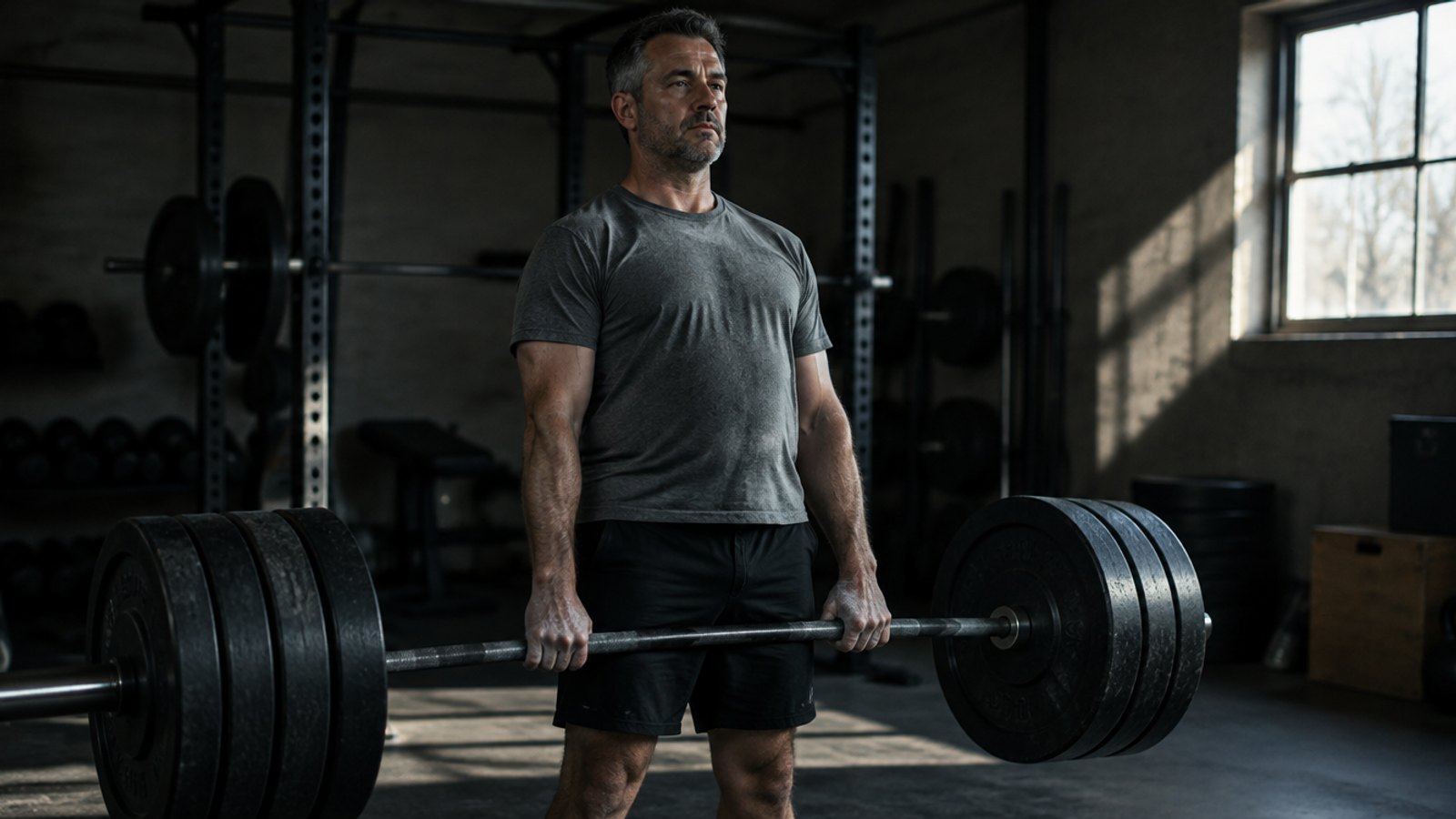
Weight training for weight loss for men works, but not the way most men expect. Lifting on its own takes off a modest amount of fat, about a pound or two over a few months. Its real job shows up when you are also eating less. In a calorie deficit, lifting is what makes sure the weight you lose is fat and not muscle. Pair three lifting sessions a week with a sensible deficit and enough protein, and you end up lighter, stronger and visibly leaner than the man who only dieted or only ran.
This is education, not medical advice.
Does weight training help men lose weight?
Yes, with one honest caveat about the word weight. Lifting changes what you are made of more than what you weigh. In a meta-analysis of 54 randomized trials in healthy adults, full-body resistance training with no diet change cut body fat percentage by about 1.5 points and fat mass by about 0.55 kg compared with doing nothing. It also reduced visceral fat, the deep belly fat that matters most for a man's health. Men and women responded the same (Wewege et al., 2022).
That is a real result, and it is a small one on the scale. The bigger numbers come when lifting is paired with eating less. A second meta-analysis pooled 114 trials and 4,184 people with overweight or obesity. Resistance training plus calorie restriction cut body fat by 3.8 percentage points and fat mass by 5.3 kg, the best result of any combination tested, and lean mass held steady while it happened (Lopez et al., 2022).
So the straight answer is this. The deficit takes the weight off. The lifting decides what kind of weight comes off.
Weight training vs cardio for weight loss
If the only number you care about is the scale, cardio wins. In the STRRIDE trial, 119 sedentary, overweight adults did eight months of aerobic training, resistance training, or both. The aerobic and combined groups lost more body mass and more fat mass than the lifting-only group. The lifting groups were the only ones that added lean mass (Willis et al., 2012).
The reason is simple. You can jog or walk for 40 minutes without stopping. A lifting session spends half its time resting between sets, so it burns fewer calories per hour. An overview of 12 systematic reviews covering 149 studies landed in the same place: exercise takes off roughly 1.5 to 3.5 kg, and resistance training's specific contribution is that it reduces the lean mass you lose along the way, by about 0.8 kg (Bellicha et al., 2021).
That is why the best plan uses both. Cardio for the calorie burn, lifting to protect the muscle. We lay out the cardio side, including walking, intervals and home options, in the full list of weight loss exercises for men and what the head-to-head trials found.
Why lifting matters most when you are eating less
When you diet without lifting, a good share of what you lose is muscle. That is the weight you want to keep. It is what makes you look like you have lost fat instead of just getting smaller, and it is what keeps you strong at 60.
Three sets of trials show how much lifting changes this.
- The NEJM trial. 160 older adults with obesity dieted for six months and did aerobic training, resistance training, or both. Every exercise group lost about 9 percent of body weight. The aerobic group lost about 5 percent of its lean mass. The resistance group lost about 2 percent (Villareal et al., 2017).
- The 18-month trial. 249 older men and women dieted alone, dieted and did cardio, or dieted and lifted. Diet plus lifting took off the most fat, 7.8 kg, and the least lean mass, 0.8 kg. Diet plus cardio cost twice as much lean mass (Beavers et al., 2017).
- The pooled analysis. Across six randomized trials in older adults with obesity, lifting three times a week prevented about 93 percent of the muscle loss that calorie restriction caused, with the same fat loss as dieting alone (Sardeli et al., 2018).
Same weight lost, very different body at the end. Protein, pace and sleep decide the rest, and they are laid out in the four habits that keep weight loss coming from fat instead of muscle. This is also the idea behind losing fat while holding or adding muscle after 40, and who it works for.
Does lifting weights boost your metabolism?
A little. A meta-analysis of 18 studies found resistance training raised resting metabolic rate by about 96 calories a day compared with controls, while aerobic training showed no clear effect (MacKenzie-Shalders et al., 2020). The authors flagged a high risk of bias in the underlying studies, so treat that number as a rough guide.
Ninety-six calories is about one banana. It will not melt fat on its own. What it does is push back against the slowdown that comes with dieting, which is one of the reasons a weight loss plateau shows up for most men a few months in. Holding on to muscle is one of the few things that works against it.
How many days a week should a man lift to lose weight?
Two is the floor. Three is the sweet spot for most men.
When researchers pooled the trials comparing training frequencies, working each muscle group twice a week built more muscle than once a week (Schoenfeld et al., 2016). A separate analysis found a graded dose-response for volume: more weekly sets per muscle produced more growth, with the best results at ten or more sets per muscle per week (Schoenfeld, Ogborn and Krieger, 2017). Three full-body sessions get you there without living in the gym. The trials that protected muscle during a diet used three sessions a week too (Sardeli et al., 2018).
More than four hard sessions a week is rarely worth it in a deficit. You recover slower when you are eating less. If your lifts are going backward and you feel flat, a planned easy week is usually the fix, and here is how to tell fatigue from being out of shape.
Heavy weights or light weights for fat loss?
The old gym rule says heavy weights for size and light weights with high reps for "toning" and fat loss. The trials do not back it. In a meta-analysis of 21 studies, muscle growth was similar with light loads and heavy loads as long as the sets were taken close to failure. Heavy loads were better for building maximum strength (Schoenfeld, Grgic et al., 2017).
For a man who is cutting, that points to a middle path. Use loads you can lift for 6 to 12 reps, stop one or two reps short of failure, and keep the weight on the bar as high as you can while the scale drops. Holding your strength while you lose weight is the best sign that the weight coming off is fat. Do not switch to light, fast circuits just because you are dieting. That removes the signal that tells your body to keep the muscle.
A weight lifting workout for weight loss: the 3-day plan
Three full-body sessions a week, with a day between them. Each takes about 45 minutes.
Day A
- Squat or goblet squat: 3 sets of 6 to 10
- Bench press or push-up: 3 sets of 6 to 12
- Barbell or dumbbell row: 3 sets of 8 to 12
- Farmer's carry: 3 trips of 30 to 40 yards
Day B
- Deadlift or Romanian deadlift: 3 sets of 5 to 8
- Overhead press: 3 sets of 6 to 10
- Pull-up or lat pulldown: 3 sets of 6 to 12
- Split squat: 2 sets of 8 to 12 per leg
Day C
- Leg press or front squat: 3 sets of 8 to 12
- Incline dumbbell press: 3 sets of 8 to 12
- Seated cable row: 3 sets of 8 to 12
- Hip thrust or back extension: 2 sets of 10 to 15
Rest 90 seconds to two minutes between sets. When you hit the top of the rep range on every set, add the smallest plate you can next time. On the days between, walk. Thirty to 45 minutes of brisk walking adds the calorie burn that lifting lacks without eating into your recovery.
How much protein do you need with it?
Lifting sends the signal to keep muscle. Protein is the material. In a four-week trial, 40 young men ate about 40 percent under their needs and trained hard six days a week. The group eating 2.4 g of protein per kg of body weight gained 1.2 kg of lean mass and lost 4.8 kg of fat. The group at 1.2 g per kg held its lean mass and lost 3.5 kg of fat (Longland et al., 2016).
That was an extreme setup in young men, and you do not need to copy it. The useful lesson is the direction: in a deficit, more protein means more of the loss is fat. A target of 1.6 to 2.2 g per kg a day covers most men. Our protein-by-bodyweight table gives the daily number for your weight.
Weight training for weight loss for men over 40 and over 50
This is where lifting earns the most. Men lose muscle with age even without dieting, so a diet with no lifting costs an older man more than it costs a 25-year-old. The strongest trials in this article were run in people in their sixties and seventies, and they are the ones where lifting cut muscle loss by half or more (Villareal et al., 2017; Beavers et al., 2017). In the Lopez meta-analysis, the results held across age groups.
A few changes help after 40. Warm up longer. Favor the joint-friendly version of each lift: goblet squats, Romanian deadlifts, dumbbell presses, a trap bar if your gym has one. Stay in the 8 to 12 rep range on most lifts. Progress slower and do not skip the walking. The rest of the plan is the same. For the food side, see what changes about weight loss for men over 40.
Why the scale may not move at first
New lifters often gain a little muscle while they lose fat. In the Lopez analysis, resistance training alone added about 0.8 kg of lean mass. Add the water your muscles hold when you start training, and the scale can sit still for three or four weeks while your waist shrinks.
Track two things besides weight: your waist at the navel, and your numbers in the gym. If your waist is coming down and your lifts are holding or climbing, it is working.
The verdict
Weight training for weight loss for men is not the fastest way to move the scale. Cardio and a calorie deficit do more of that. Lifting is what makes the loss worth having. It trims a modest amount of fat on its own, it keeps nearly all of your muscle when you diet, and it gives a small lift to your resting burn. Its downside is that it burns fewer calories per hour than cardio and will not outwork a bad diet. Lift three days a week, walk on the others, eat in a modest deficit with plenty of protein, and judge it by your waist and your strength, not just your weight. For more on this, browse our muscle and fat loss coverage.
This article is for general education and is not medical advice. If you have a heart condition, high blood pressure, or a joint or back injury, talk to your doctor before starting a lifting program.
References
- Wewege MA, Desai I, Honey C, et al. The effect of resistance training in healthy adults on body fat percentage, fat mass and visceral fat: a systematic review and meta-analysis. Sports Med. 2022. https://pubmed.ncbi.nlm.nih.gov/34536199/
- Lopez P, Taaffe DR, Galvão DA, et al. Resistance training effectiveness on body composition and body weight outcomes in individuals with overweight and obesity across the lifespan: a systematic review and meta-analysis. Obes Rev. 2022. https://pubmed.ncbi.nlm.nih.gov/35191588/
- Willis LH, Slentz CA, Bateman LA, et al. Effects of aerobic and/or resistance training on body mass and fat mass in overweight or obese adults. J Appl Physiol. 2012. https://pubmed.ncbi.nlm.nih.gov/23019316/
- Bellicha A, van Baak MA, Battista F, et al. Effect of exercise training on weight loss, body composition changes, and weight maintenance in adults with overweight or obesity: an overview of 12 systematic reviews and 149 studies. Obes Rev. 2021. https://pubmed.ncbi.nlm.nih.gov/33955140/
- Villareal DT, Aguirre L, Gurney AB, et al. Aerobic or resistance exercise, or both, in dieting obese older adults. N Engl J Med. 2017. https://pubmed.ncbi.nlm.nih.gov/28514618/
- Beavers KM, Ambrosius WT, Rejeski WJ, et al. Effect of exercise type during intentional weight loss on body composition in older adults with obesity. Obesity (Silver Spring). 2017. https://pubmed.ncbi.nlm.nih.gov/29086504/
- Sardeli AV, Komatsu TR, Mori MA, Gáspari AF, Chacon-Mikahil MPT. Resistance training prevents muscle loss induced by caloric restriction in obese elderly individuals: a systematic review and meta-analysis. Nutrients. 2018. https://pubmed.ncbi.nlm.nih.gov/29596307/
- MacKenzie-Shalders K, Kelly JT, So D, Coffey VG, Byrne NM. The effect of exercise interventions on resting metabolic rate: a systematic review and meta-analysis. J Sports Sci. 2020. https://pubmed.ncbi.nlm.nih.gov/32397898/
- Schoenfeld BJ, Ogborn D, Krieger JW. Effects of resistance training frequency on measures of muscle hypertrophy: a systematic review and meta-analysis. Sports Med. 2016. https://pubmed.ncbi.nlm.nih.gov/27102172/
- Schoenfeld BJ, Ogborn D, Krieger JW. Dose-response relationship between weekly resistance training volume and increases in muscle mass: a systematic review and meta-analysis. J Sports Sci. 2017. https://pubmed.ncbi.nlm.nih.gov/27433992/
- Schoenfeld BJ, Grgic J, Ogborn D, Krieger JW. Strength and hypertrophy adaptations between low- vs. high-load resistance training: a systematic review and meta-analysis. J Strength Cond Res. 2017. https://pubmed.ncbi.nlm.nih.gov/28834797/
- Longland TM, Oikawa SY, Mitchell CJ, Devries MC, Phillips SM. Higher compared with lower dietary protein during an energy deficit combined with intense exercise promotes greater lean mass gain and fat mass loss: a randomized trial. Am J Clin Nutr. 2016. https://pubmed.ncbi.nlm.nih.gov/26817506/
Common questions
Does weight training help men lose weight?
Weight training helps men lose weight, mostly by changing what the weight loss is made of. On its own, lifting cut body fat by about 1.5 percentage points in a meta-analysis of 54 trials. Paired with a calorie deficit, it produced the largest fat loss of any combination tested while lean mass held steady.
Is it better to do cardio or weights to lose weight?
Cardio burns more calories per hour and moves the scale faster. Weights protect your muscle while you lose. In trials of dieting adults, the lifting groups lost about the same weight and kept far more lean mass. Most men do best with both.
How many days a week should a man lift weights to lose weight?
Two is the minimum and three is a good target. Training each muscle group twice a week built more muscle than once a week in pooled trials, and the studies that protected muscle during a diet used three sessions a week.
Should I lift heavy or light to lose fat?
Heavy and light loads both build muscle if the sets are taken close to failure. Heavier loads build more maximum strength. While cutting, stay in the 6 to 12 rep range and keep the weight on the bar as high as you can.
Can you lose belly fat by lifting weights?
Lifting reduced visceral fat, the deep belly fat, in a meta-analysis of randomized trials. You cannot pick where fat comes off, but overall fat loss from lifting, cardio and a deficit includes the belly.
Why am I lifting weights but not losing weight?
New lifters often add a little muscle and hold more water in the muscle while losing fat, so the scale can stall for a few weeks. Measure your waist and track your lifts. If the scale has not moved after a month, the calorie deficit is the part to check.