Supplements
Caffeine and Training: Dose, Timing, and the Sleep Tax
Three to six milligrams per kilogram, about an hour out. That part is settled. The part most men get wrong is how late they are still drinking it.
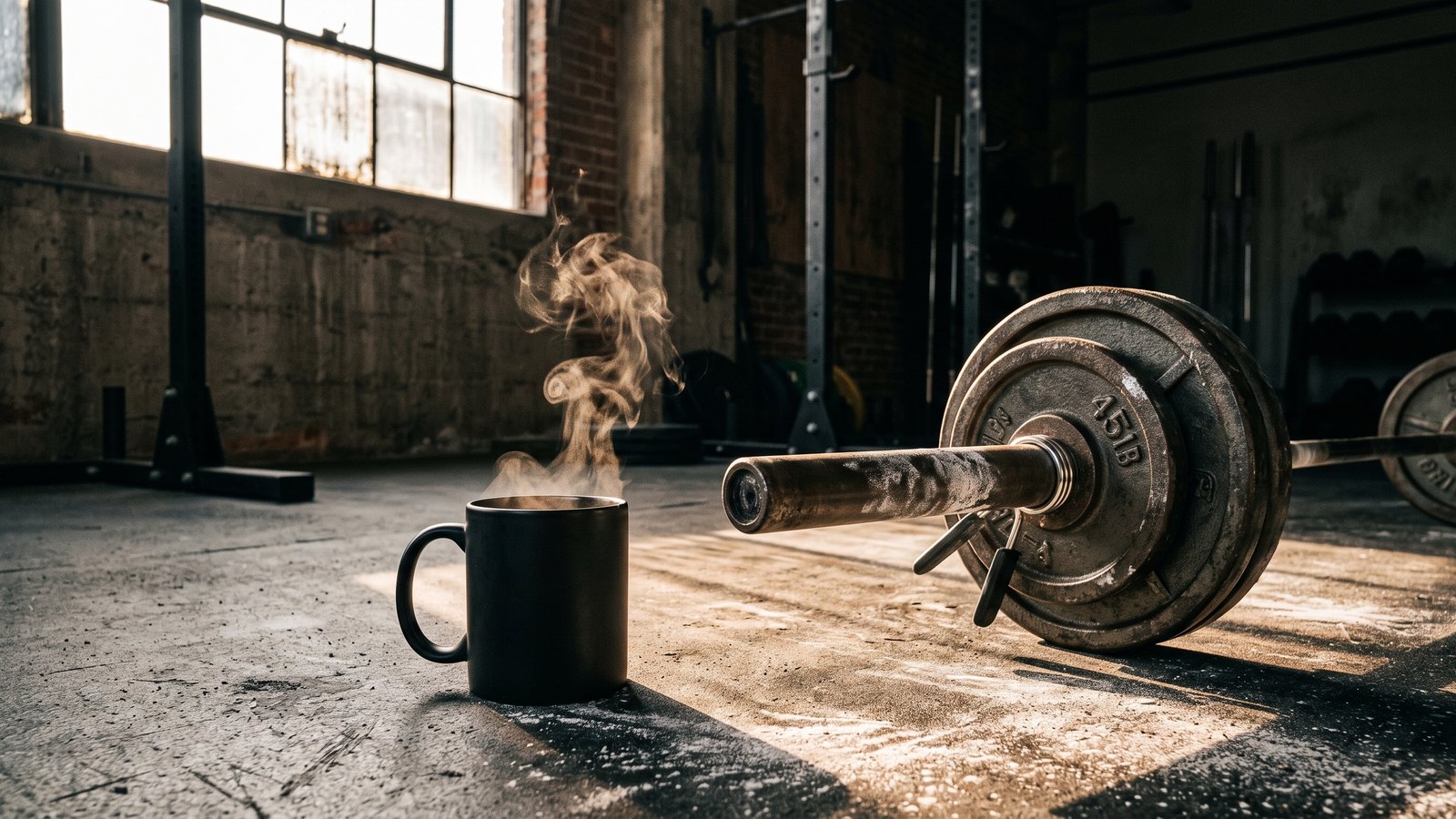
Caffeine is the rare supplement that actually does what the label implies, right up there with creatine. It is cheap, it is legal, it has been tested to death, and it works. That is not the interesting question anymore.
The interesting question is how much, when, and what it costs you eight hours later. Because the same drug that adds a few percent to your lifts is also capable of taking 45 minutes off your sleep, and sleep is where the training actually turns into results.
What caffeine actually does for performance
Start with the size of the evidence base, because it is unusual. Researchers ran an umbrella review, meaning a review of reviews, pulling together 11 systematic reviews containing 21 separate meta-analyses. Caffeine came out ergogenic for aerobic endurance, muscle strength, muscle endurance, power, jumping, and speed. The quality of that evidence was rated moderate overall, with some outcomes resting on weaker ground, and the effect was generally larger for aerobic work than anaerobic work (Grgic et al., 2020).
Two honest caveats from the authors themselves. Not every analysis gave a definite direction once prediction intervals were considered, and most of the underlying studies were run on young men. That last point cuts in your favor if you are a man reading a men's health site, and it is worth knowing the research is thinner elsewhere.
Now the size of the effect, because this is where expectations get out of hand. A meta-analysis of 10 good-quality studies on isokinetic strength found caffeine improved strength with a standardized effect of 0.16, which worked out to about 5.3 percent. The benefit was clear for knee extensors, roughly 6.1 percent, and did not reach significance for smaller muscle groups (Grgic and Pickering, 2019).
Five percent. That is the real number. It is meaningful over a training block, and it is not the transformation a pre-workout label sells you. Caffeine makes a good session slightly better. It does not rescue a bad one.
The dose, settled
The International Society of Sports Nutrition reviewed the literature and put out a position stand that reads like a straight answer, which is rare in this field (Guest et al., 2021).
Caffeine consistently improves performance at 3 to 6 mg per kilogram of body mass. The minimum effective dose is not firmly established but may be as low as 2 mg/kg. Very high doses, around 9 mg/kg, come with a high rate of side effects and do not appear to be necessary for the benefit.
Run those numbers on yourself. At 180 pounds, about 82 kilograms, the effective range is roughly 245 to 490 mg. A standard cup of coffee runs around 100 mg. So one strong coffee lands you at the low end of the useful range, two to three puts you in the middle, and the 400 mg scoop of pre-workout is already near the top of it before you have counted the coffee you had at 7 a.m.
Timing is simpler than the supplement aisle suggests. The most commonly used approach is 60 minutes before exercise, though optimal timing depends on the form, and caffeine gum needs less lead time than capsules. Caffeine works in both trained and untrained people, and aerobic endurance is the category with the most consistent moderate-to-large benefit (Guest et al., 2021).
The part that quietly cancels it out
Here is what does not make it onto the tub.
A systematic review and meta-analysis of 24 studies measured what caffeine does to the night that follows. Total sleep time dropped by 45 minutes. Sleep efficiency fell by 7 percent. It took 9 minutes longer to fall asleep and men spent 12 more minutes awake after falling asleep. Light sleep went up. Deep sleep, the stage that matters most for recovery, dropped by 11.4 minutes (Gardiner et al., 2023).
Then the researchers did the genuinely useful thing and worked out the cutoffs. To avoid losing total sleep time, a standard coffee at 107 mg should be your last one at least 8.8 hours before bed. A standard serve of pre-workout at 217.5 mg needs at least 13.2 hours.
Read that again, because it is stricter than almost anyone practices. If you go to bed at 11, your last coffee is around 2 p.m. and your last pre-workout is around 10 in the morning. A 6 p.m. session with a scoop of pre-workout is a sleep problem wearing a training outfit.
An earlier controlled study makes the same point in a way that is hard to argue with. Researchers gave people 400 mg of caffeine at bedtime, 3 hours before bed, and 6 hours before bed. All three disrupted sleep compared with placebo, including the dose taken a full 6 hours out, and the authors concluded that stopping caffeine at least 6 hours before bed has real empirical support (Drake et al., 2013).
Now put the two halves together. Caffeine buys you about 5 percent on your lifts. Short sleep costs you recovery, appetite control, and testosterone. Taking a big dose at 6 p.m. to add 5 percent to a session, then losing 45 minutes of sleep and a chunk of deep sleep, is not a trade a serious man makes on purpose. Most men are just making it by accident.
How to use it well
Dose by bodyweight, not by scoop. Aim for 3 to 6 mg per kilogram. Weigh yourself, do the multiplication once, and stop guessing.
Take it about an hour out. That is the timing most of the research used.
Count everything. Coffee, pre-workout, energy drinks, and the caffeine hiding in some fat burners all go in the same total. Men routinely double their intended dose this way.
Set a hard cutoff. Work backward from your bedtime, because a wired stress system at night is exactly what you are trying to avoid. Around 9 hours for coffee, closer to 13 for a full pre-workout serve. If you train in the evening, train without it or use a much smaller dose.
Save the big doses for when they matter. If you use caffeine every single session, it becomes your baseline rather than a tool. Keep the higher end for hard sessions, tests, and competition.
More is not better. Around 9 mg/kg brings side effects without extra performance. There is no prize for the jitters.
The verdict
Caffeine is the most reliable legal performance aid you can buy, and it is one of the few supplements where the research gives you a straight dose and a straight timing window. Take 3 to 6 mg per kilogram about an hour before you train and you will get a small, real edge, biggest on endurance work and worth roughly 5 percent on strength.
The mistake is not the dose. It is the clock. Caffeine sits in your system far longer than the buzz lasts, and the sleep it takes is worth more than the 5 percent it gives. Use it early, count all of it, and stop pretending an evening pre-workout is free. The rest of our supplement reviews run the same honest math.
This article is for general education and is not medical advice. Caffeine affects heart rate, blood pressure, and anxiety, and individual tolerance varies widely for genetic reasons. If you have a heart condition, high blood pressure, an anxiety disorder, or you take prescription medication, talk to your prescriber before using high doses or pre-workout supplements.
References
- Guest NS, VanDusseldorp TA, Nelson MT, et al. International society of sports nutrition position stand: caffeine and exercise performance. J Int Soc Sports Nutr. 2021. https://pubmed.ncbi.nlm.nih.gov/33388079/
- Grgic J, Grgic I, Pickering C, Schoenfeld BJ, Bishop DJ, Pedisic Z. Wake up and smell the coffee: caffeine supplementation and exercise performance, an umbrella review of 21 published meta-analyses. Br J Sports Med. 2020. https://pubmed.ncbi.nlm.nih.gov/30926628/
- Grgic J, Pickering C. The effects of caffeine ingestion on isokinetic muscular strength: A meta-analysis. J Sci Med Sport. 2019. https://pubmed.ncbi.nlm.nih.gov/30217692/
- Gardiner C, Weakley J, Burke LM, et al. The effect of caffeine on subsequent sleep: A systematic review and meta-analysis. Sleep Med Rev. 2023. https://pubmed.ncbi.nlm.nih.gov/36870101/
- Drake C, Roehrs T, Shambroom J, Roth T. Caffeine effects on sleep taken 0, 3, or 6 hours before going to bed. J Clin Sleep Med. 2013. https://pubmed.ncbi.nlm.nih.gov/24235903/
Common questions
How much caffeine should I take before a workout?
The position stand from the International Society of Sports Nutrition puts the effective range at 3 to 6 mg per kilogram of body mass. For a 180-pound man that is roughly 245 to 490 mg. The minimum useful dose may be as low as 2 mg/kg. Doses around 9 mg/kg bring a high rate of side effects without extra benefit.
How much does caffeine actually improve strength?
Caffeine improves strength less than the marketing implies. A meta-analysis of isokinetic strength studies found an improvement of about 5.3 percent overall, with roughly 6.1 percent for the knee extensors and no significant effect for smaller muscle groups. It is a real edge, not a transformation, and the benefit tends to be larger for endurance work than for lifting.
How late is too late for caffeine?
The caffeine cutoff is earlier in the day than most men think. A meta-analysis of 24 studies calculated that a standard 107 mg coffee should be your last one at least 8.8 hours before bed, and a standard 217.5 mg serve of pre-workout at least 13.2 hours before bed, if you want to protect total sleep time. A separate controlled study found 400 mg still disrupted sleep when taken a full 6 hours before bedtime.
Does caffeine work if I drink coffee every day?
Caffeine has been shown to improve performance in both trained and untrained people, but habitual intake is one of the factors researchers point to when explaining why response varies so much between individuals. Genetics play a role too. If you use a big dose before every session it becomes your normal rather than a tool, so save the higher end for hard sessions and testing days.
Is pre-workout better than coffee?
Pre-workout is not inherently better than coffee. Pre-workout and energy drinks containing caffeine do improve aerobic and anaerobic performance, but the active ingredient doing most of the heavy lifting is the caffeine. The practical difference is dose and timing. A standard pre-workout serve is roughly double a coffee, which is why its sleep cutoff sits so much earlier in the day.