Muscle & Fat Loss
Sleep and Weight Loss for Men: How Much Does Sleep Really Matter?
Same diet, less sleep, less fat lost and more muscle gone. The cheapest fat-loss lever most dieting men are not pulling.
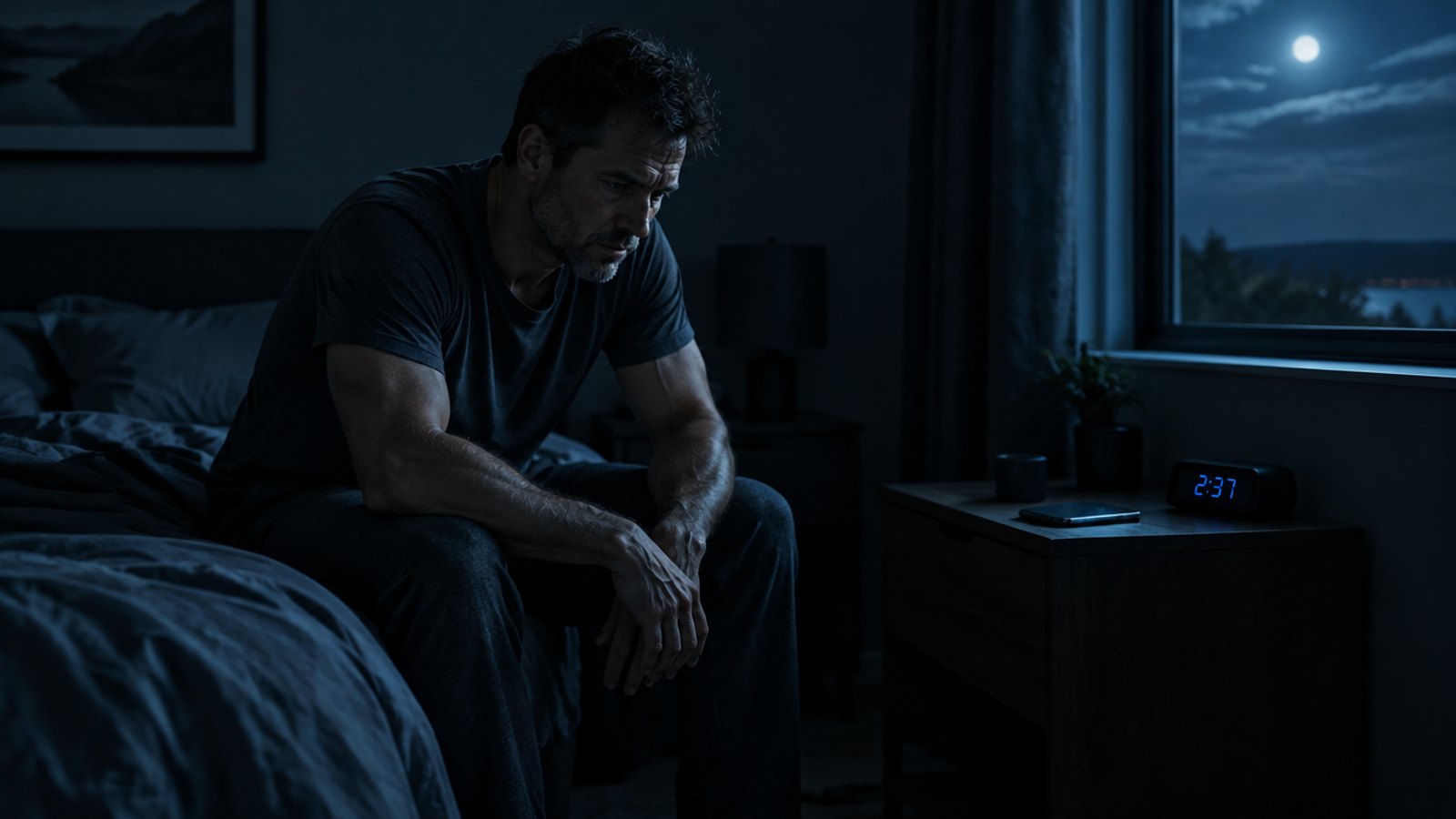
Sleep and weight loss for men are tied together more tightly than most guys expect: on the same diet, men and women who slept 5.5 hours instead of 8.5 lost 55 percent less fat and 60 percent more lean mass (Nedeltcheva et al., 2010). That was a small, two-week lab study, but the pattern shows up again and again. Short sleep makes you hungrier, pushes you to eat more, and tilts the weight you lose away from fat and toward muscle. The good news runs the other way too. When short sleepers added about an hour a night, they ate 270 fewer calories a day without trying (Tasali et al., 2022). For a man who is dieting hard and sleeping six hours, sleep may be the cheapest lever he is not pulling.
This is education, not medical advice. If you snore loudly, stop breathing at night or wake up exhausted no matter how long you sleep, see a doctor before you blame your willpower.
Does sleep affect weight loss for men?
Sleep affects weight loss for men mainly by changing what the weight loss is made of, not just how much comes off. In the Nedeltcheva trial, 10 overweight adults (7 of them men, average age 41) ate the same reduced-calorie diet twice, once with 8.5 hours in bed and once with 5.5. Total weight loss was similar. But with short sleep, fat loss dropped from 1.4 kg to 0.6 kg, and lean mass loss rose from 1.5 kg to 2.4 kg (Nedeltcheva et al., 2010). The dieters were also hungrier.
A longer trial backs it up. In 36 overweight adults on an 8-week diet, cutting about an hour of sleep on five nights a week led to the same weight loss but a smaller share of it coming from fat, and sleeping in on weekends did not undo it (Wang et al., 2018). For a man who wants to keep his muscle while he leans out, that is the result that matters. We cover the rest of that job in the training and protein rules for losing fat without losing muscle.
Why short sleep makes you eat more
Short sleep makes men eat more because it raises hunger signals and leaves daily calorie burn about the same. In 12 healthy young men, two nights of 4 hours in bed cut the fullness hormone leptin by 18 percent, raised the hunger hormone ghrelin by 28 percent, and raised hunger by 24 percent, with the strongest pull toward sweets, salty snacks and starchy foods (Spiegel et al., 2004).
When researchers pooled 11 sleep-loss studies, people ate about 385 more calories a day after short nights, with more fat and less protein in the mix, while total energy burned did not change (Al Khatib et al., 2017). That is a surplus big enough to erase a typical diet. A lot of those extra calories land late in the evening, which is why what late-night eating really does to body composition is worth reading next to this one.
Does lack of sleep cause weight gain?
Lack of sleep is strongly linked to weight gain, though population studies alone cannot prove it causes it. Across 604,509 adults worldwide, short sleepers were 55 percent more likely to have obesity, and each extra hour of sleep went with a BMI about 0.35 units lower (Cappuccio et al., 2008). The authors were clear that these surveys cannot rule out other causes, like stress, shift work or poor health driving both short sleep and weight.
The lab trials fill that gap. Cutting sleep raises intake and changes how weight comes off, and even one night of lost sleep in healthy young men shifted fat tissue toward storage and muscle tissue toward breakdown (Cedernaes et al., 2018). Put together, it is fair to say poor sleep makes weight gain more likely and fat loss harder.
Can more sleep help you lose weight?
More sleep helped short sleepers eat less in the best trial so far. In 80 adults aged 21 to 40 with overweight who usually slept under 6.5 hours, one counseling session to stretch time in bed toward 8.5 hours added about 1.2 hours of sleep a night. Over two weeks at home, with no diet advice, that group ate 270 fewer calories a day than the control group and lost weight (Tasali et al., 2022). Half the volunteers were men.
That trial was short, and it studied people who were already sleeping too little. Sleeping nine hours will not melt fat on a man who already gets seven or eight. The win is for the guy running on five or six.
How much sleep do men need to lose weight?
Men trying to lose weight should aim for at least 7 hours of actual sleep a night, which usually means 7.5 to 8 hours in bed. In a 15 to 24 week diet program with 123 overweight adults, each extra hour of reported sleep at the start went with about 0.7 kg more fat lost, and better sleep quality predicted better results too (Chaput and Tremblay, 2012). That study was observational, so it shows a link rather than proof, but it lines up with the trials above.
Sleep, testosterone and belly fat
Sleep loss lowers testosterone in men, and low testosterone makes it harder to hold muscle and easier to store belly fat. In 10 young men, one week of 5 hours a night cut daytime testosterone by 10 to 15 percent (Leproult and Van Cauter, 2011). We broke down that study and the others like it in what the sleep-restriction studies did to testosterone.
Sleep and weight loss for men over 40 and over 50
Sleep matters more for men over 40 and over 50 because sleep gets lighter with age, muscle is harder to keep, and sleep apnea becomes common. Apnea is the big one. It fragments sleep all night, often without the man knowing, and it is far more common in heavier men. If your partner hears you snore or stop breathing, read the signs of sleep apnea most men ignore and get tested. Treating it can make every other part of the plan easier. Our weight loss plan for men over 40 covers the diet and training side.
How to sleep better while losing weight
The habits that improve sleep for a dieting man are simple and free. Set a fixed wake time, then count back 8 hours for your bedtime. Keep caffeine to the morning. Cap alcohol, which knocks you out but wrecks the second half of the night. Finish your last big meal 2 to 3 hours before bed, and do not cut calories so hard that hunger wakes you up. Keep the room cool, dark and quiet, and get outside light early in the day. If evening hunger is the thing keeping you up, our guide to the appetite levers that work for men starts with protein and fiber, not pills.
Sleep will not replace a calorie deficit, lifting or protein. But it decides how much of the weight you lose is fat, and how hard the diet feels while you do it. More body composition guides live in our muscle and fat loss section.
References
- Nedeltcheva AV, Kilkus JM, Imperial J, Schoeller DA, Penev PD. Insufficient sleep undermines dietary efforts to reduce adiposity. Ann Intern Med. 2010. https://pubmed.ncbi.nlm.nih.gov/20921542/
- Tasali E, Wroblewski K, Kahn E, Kilkus J, Schoeller DA. Effect of sleep extension on objectively assessed energy intake among adults with overweight in real-life settings: a randomized clinical trial. JAMA Intern Med. 2022. https://pubmed.ncbi.nlm.nih.gov/35129580/
- Wang X, Sparks JR, Bowyer KP, Youngstedt SD. Influence of sleep restriction on weight loss outcomes associated with caloric restriction. Sleep. 2018. https://pubmed.ncbi.nlm.nih.gov/29438540/
- Spiegel K, Tasali E, Penev P, Van Cauter E. Brief communication: sleep curtailment in healthy young men is associated with decreased leptin levels, elevated ghrelin levels, and increased hunger and appetite. Ann Intern Med. 2004. https://pubmed.ncbi.nlm.nih.gov/15583226/
- Al Khatib HK, Harding SV, Darzi J, Pot GK. The effects of partial sleep deprivation on energy balance: a systematic review and meta-analysis. Eur J Clin Nutr. 2017. https://pubmed.ncbi.nlm.nih.gov/27804960/
- Cappuccio FP, Taggart FM, Kandala NB, et al. Meta-analysis of short sleep duration and obesity in children and adults. Sleep. 2008. https://pubmed.ncbi.nlm.nih.gov/18517032/
- Cedernaes J, Schönke M, Westholm JO, et al. Acute sleep loss results in tissue-specific alterations in genome-wide DNA methylation state and metabolic fuel utilization in humans. Sci Adv. 2018. https://pubmed.ncbi.nlm.nih.gov/30140739/
- Chaput JP, Tremblay A. Sleeping habits predict the magnitude of fat loss in adults exposed to moderate caloric restriction. Obes Facts. 2012. https://pubmed.ncbi.nlm.nih.gov/22854682/
- Leproult R, Van Cauter E. Effect of 1 week of sleep restriction on testosterone levels in young healthy men. JAMA. 2011. https://pubmed.ncbi.nlm.nih.gov/21632481/
Common questions
Can you lose weight while sleeping?
Your body burns calories all night, but sleep itself is not a fat-loss method. The real effect is indirect: men who sleep enough eat fewer calories the next day and keep more muscle on a diet (Tasali et al., 2022; Nedeltcheva et al., 2010).
Is 6 hours of sleep enough to lose weight?
Six hours of sleep is enough to lose weight if you hold a calorie deficit, but less of what you lose may be fat. In one trial, about an hour less sleep on weeknights shifted the loss away from fat even though total weight loss was the same (Wang et al., 2018).
Does catch-up sleep on weekends help?
Weekend catch-up sleep did not fully reverse the effect of short weeknight sleep in an 8-week diet trial; the short-sleep group still lost a smaller share of fat (Wang et al., 2018). A steady schedule beats sleeping in.
Should I take melatonin to sleep better on a diet?
Melatonin is a timing signal, not a sedative, and low doses taken at the right hour work best for shifting a late body clock. Start with the habits above; our guide to melatonin dose and timing covers when a supplement makes sense.