Muscle & Fat Loss
How Much Protein a Day to Lose Weight for Men: The Real Number
Double the RDA is not a gym myth. In a calorie deficit it is what keeps the weight you lose coming off as fat.
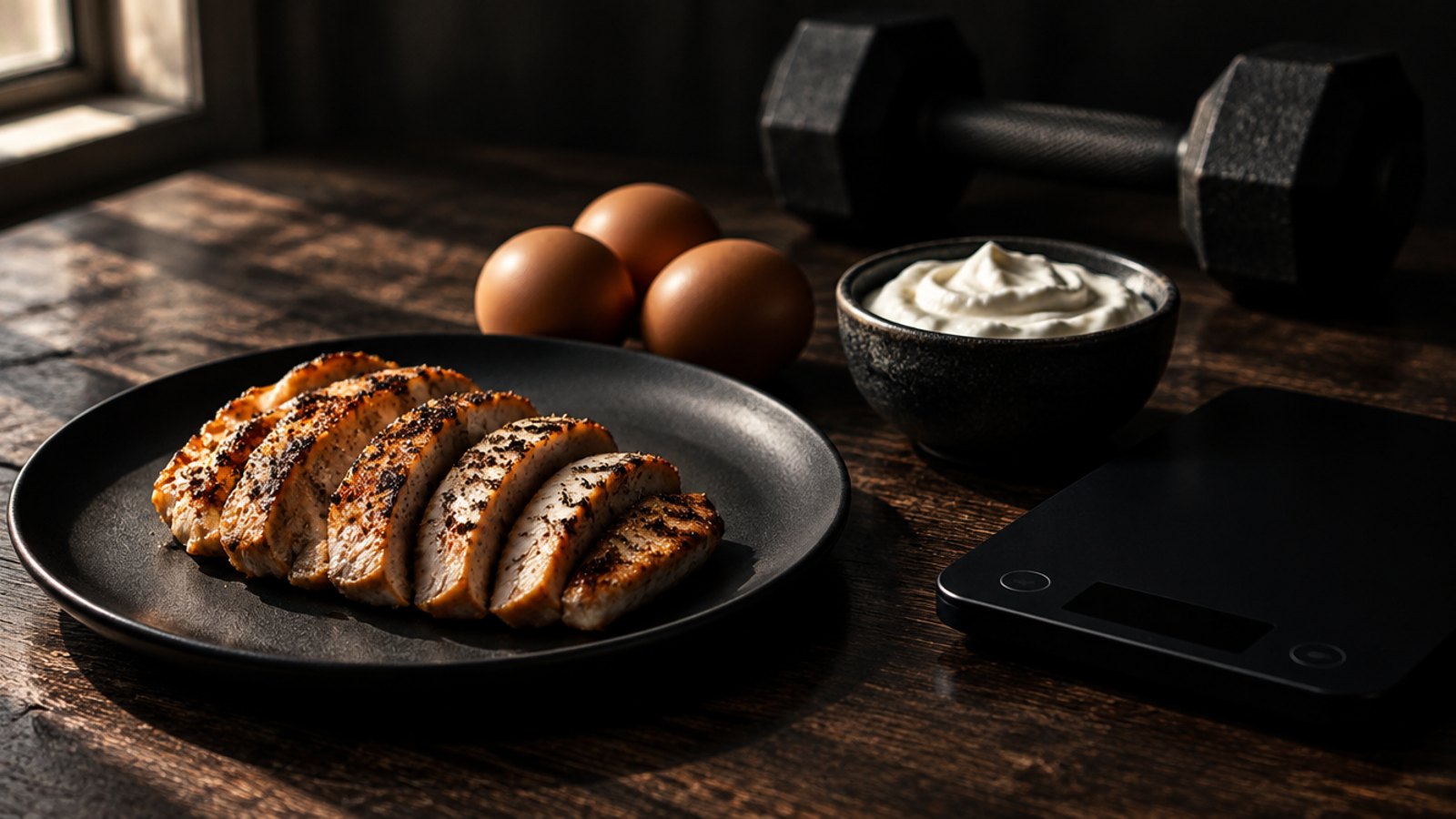
How much protein a day to lose weight for men? Most men losing weight do best on 1.6 to 2.2 grams of protein per kilogram of body weight a day, which is about 0.7 to 1 gram per pound. For a 200 pound man that works out to roughly 145 to 200 grams a day. If you have a lot of weight to lose, base the number on your goal weight instead of your current one.
That is about twice the standard recommendation, and there is a good reason for it. In a calorie deficit your body is more willing to burn muscle along with fat, and protein is the main thing in your diet that pushes back. It also keeps you fuller on fewer calories. Below is the math for your bodyweight, what the trials found, and how the number shifts after 40. This is education, not medical advice.
How much protein a day to lose weight: the number for men
The best target for most men in a deficit is 1.6 to 2.2 grams of protein per kilogram of body weight a day. The bottom of that range is enough for the average guy losing weight at a steady pace. The top is for men who are already fairly lean, cutting hard, or training several days a week.
A review of the weight loss trials by a panel of protein researchers put the floor at 1.2 to 1.6 grams per kilogram, with at least 25 to 30 grams at each meal, for better appetite control and body composition (Leidy et al., 2015). For men who lift, the muscle data point a bit higher. A meta-analysis of 49 trials found muscle gains from resistance training kept improving with protein up to about 1.6 grams per kilogram and flattened out after that (Morton et al., 2018). A deficit makes muscle harder to hold, which is why the range for dieting runs higher than the range for building.
The standard RDA of 0.8 grams per kilogram is a floor set to prevent deficiency in people eating enough calories. It was never meant as a target for a man trying to lose fat and keep his muscle.
How much protein per pound to lose weight
Per pound, the target for losing weight is about 0.7 to 1 gram of protein for every pound you weigh. That is the same 1.6 to 2.2 grams per kilogram range, converted. The one-gram-per-pound rule you hear in gyms sits at the top end, which is fine but more than most men need.
There is one catch. If you are carrying a lot of extra fat, your current weight overstates how much muscle you have to protect. A 300 pound man does not need 300 grams of protein. For men with a lot to lose, use your goal weight, or a weight about halfway between where you are and where you are headed.
How much protein for a 180, 200 or 250 pound man
A 180 pound man losing weight should aim for about 130 to 180 grams of protein a day. Here is the same range worked out for common bodyweights, using 0.73 to 1 gram per pound:
- 160 pounds: about 115 to 160 grams a day.
- 180 pounds: about 130 to 180 grams a day.
- 200 pounds: about 145 to 200 grams a day.
- 220 pounds: about 160 to 220 grams a day.
- 250 pounds or more: work from your goal weight. A man at 250 aiming for 200 should target about 145 to 200 grams.
If you want the same math for building muscle at maintenance, we break it down number by number in how much protein to eat to build muscle at your bodyweight.
Why protein matters more when you are losing weight
Protein matters more in a diet because a calorie deficit pushes your body to break down muscle, and a higher protein intake cuts that loss. Muscle is what keeps you strong, keeps your metabolism up and makes the weight you lose look like fat loss instead of shrinking.
The pooled data are clear on this. A meta-analysis of 24 weight loss trials with 1,063 people compared higher protein diets with standard protein diets at the same calories. The higher protein groups lost about 0.9 kg more fat and held on to about 0.4 kg more lean mass, and their resting metabolic rate dropped less (Wycherley et al., 2012).
Tightly controlled trials show the same thing up close. In a U.S. Army study, 39 adults spent three weeks on a diet 40 percent below their needs. Those eating 0.8 grams per kilogram lost a bigger share of their weight as lean mass than those eating 1.6 or 2.4 grams per kilogram. The 2.4 group did no better than the 1.6 group (Pasiakos et al., 2013). In 20 resistance-trained athletes dieting for two weeks, the group eating about 2.3 grams per kilogram lost 0.3 kg of lean mass, while the group eating about 1.0 gram lost 1.6 kg (Mettler et al., 2010).
The most striking result came from 40 young men at McMaster University. For four weeks they ate 40 percent fewer calories than they burned and trained hard six days a week. The men eating 2.4 grams per kilogram gained 1.2 kg of lean mass and lost 4.8 kg of fat. The men eating 1.2 grams per kilogram gained almost no lean mass and lost 3.5 kg of fat (Longland et al., 2016). That was a short, punishing protocol in young men, so do not expect the same numbers at home. The direction is still the useful part: more protein, more muscle kept, more fat lost.
For lean, trained men cutting hard, a systematic review set the target even higher, at 2.3 to 3.1 grams per kilogram of lean mass, scaled up the leaner you get (Helms et al., 2014).
Does more protein help you eat less?
More protein helped people eat fewer calories without trying in a well-known feeding study. Nineteen adults moved from a diet that was 15 percent protein to one that was 30 percent protein, with carbs held steady. Allowed to eat as much as they wanted, they ate about 441 fewer calories a day and lost an average of 4.9 kg over 12 weeks, 3.7 kg of it fat (Weigle et al., 2005).
That is a small study, and not every trial finds an effect that large. The review of the acute feeding studies found a modest boost in fullness from higher protein meals, more reliable than any change in how much people ate at the next meal (Leidy et al., 2015). For a man who gets hungry on a diet, a modest boost still counts. Protein is one of several levers we cover in the appetite controls that hold up in trials for men.
How much protein per meal to lose weight
Aim for 30 to 50 grams of protein per meal across three or four meals when you are losing weight. Splitting it up makes a high daily total easy to hit and gives you a filling dose at every meal.
The per-meal floor rises with age. When researchers pooled their lab data on muscle building after a protein dose, men around 22 maxed out at about 0.24 grams per kilogram per meal. Men around 71 needed about 0.40 grams per kilogram to get the full response (Moore et al., 2015). For a 200 pound older man, that is about 35 to 40 grams a meal. Hitting the daily total still matters more than exact timing.
How much protein to lose weight over 40, over 50 and over 60
Men over 40 losing weight should stay in the same 1.6 to 2.2 grams per kilogram range and lean toward the top of it, because muscle gets harder to keep with every decade. Age blunts how strongly your muscles respond to each meal, so the same total spread over fewer, smaller meals does less.
- Over 40: 1.6 to 2.2 grams per kilogram, with at least 30 grams at each meal.
- Over 50: the same daily range, with 35 to 40 grams per meal for most men. We lay out the rest of the plan in what actually works for weight loss after 50.
- Over 60: the European geriatric expert group recommends at least 1.0 to 1.2 grams per kilogram for adults over 65 at baseline, and more for active people or people with illness (Bauer et al., 2013). For a man over 60 who is dieting and lifting, 1.6 grams per kilogram is a sensible target.
Men with kidney disease are the exception at any age. The same expert group notes that people with severely reduced kidney function may need to limit protein. If that is you, set your number with your doctor.
Is 100 grams of protein enough to lose weight?
For most men, 100 grams of protein a day is too little to protect muscle while losing weight. At 0.7 grams per pound, 100 grams only covers a man of about 140 pounds. A 200 pound man eating 100 grams is at about 1.1 grams per kilogram, below the range the dieting trials support.
That does not mean 100 grams is worthless. If you currently eat 60 grams a day, getting to 100 is a real step up. It is just a waypoint for most men, not the finish line.
Can too much protein stop weight loss?
Protein does not stop weight loss unless it pushes your total calories above what you burn. Calories from protein still count. In practice, protein is the hardest macronutrient to overeat, because it fills you up quickly.
One trial tested an extreme. Thirty resistance-trained young men and women were told to eat 4.4 grams of protein per kilogram a day for eight weeks, more than 300 grams on average. They ate more calories as a result, yet their body weight and fat mass did not change compared with a control group (Antonio et al., 2014). That was a small, short study in young, healthy, trained people. It does not mean protein is free, but it does suggest the protein itself is not the problem when weight stalls. If your weight has stopped moving, look first at why weight loss stalls for men and how to get it moving.
When higher protein did not make a difference
Higher protein diets did not beat standard protein diets in the large POUNDS LOST trial, and the reason is worth knowing. The trial assigned adults to diets with either 25 or 15 percent of calories from protein, and researchers tracked body composition in 424 of them for two years. At six months and at two years, there was no difference in fat lost, lean mass lost, belly fat or liver fat between the groups (de Souza et al., 2012).
The catch is that people did not eat the diets they were assigned. By their own food reports, the real gap in protein between the groups was closer to 2 percent of calories than 10. Protein can only help if it actually lands on your plate. That is the honest lesson from the longer trials: the benefit shows up in people who stick with the higher intake, so make it easy enough to keep doing.
Easy ways to hit your protein number
The easiest way to hit a high protein target is to build every meal around a protein food first and fill in the rest after. A few practical anchors:
- Breakfast: three eggs plus a cup of Greek yogurt is about 40 grams.
- Lunch and dinner: six to eight ounces of chicken, lean beef, fish or pork is 40 to 55 grams.
- Snack: a scoop of whey in water or milk is 25 to 35 grams for very few calories.
- Before bed: cottage cheese or a casein shake adds 25 to 30 grams.
A shake is not required, but it is the cheapest calorie-for-calorie way to close a gap. If you want one, here is our pick for the best protein powder for men over 40. For more on keeping fat loss and muscle on the same page, browse our muscle and fat loss hub.
References
- Leidy HJ, Clifton PM, Astrup A, et al.. The role of protein in weight loss and maintenance. Am J Clin Nutr. 2015. https://pubmed.ncbi.nlm.nih.gov/25926512/
- Morton RW, Murphy KT, McKellar SR, et al.. A systematic review, meta-analysis and meta-regression of the effect of protein supplementation on resistance training-induced gains in muscle mass and strength in healthy adults. Br J Sports Med. 2018. https://pubmed.ncbi.nlm.nih.gov/28698222/
- Wycherley TP, Moran LJ, Clifton PM, Noakes M, Brinkworth GD. Effects of energy-restricted high-protein, low-fat compared with standard-protein, low-fat diets: a meta-analysis of randomized controlled trials. Am J Clin Nutr. 2012. https://pubmed.ncbi.nlm.nih.gov/23097268/
- Pasiakos SM, Cao JJ, Margolis LM, et al.. Effects of high-protein diets on fat-free mass and muscle protein synthesis following weight loss: a randomized controlled trial. FASEB J. 2013. https://pubmed.ncbi.nlm.nih.gov/23739654/
- Mettler S, Mitchell N, Tipton KD. Increased protein intake reduces lean body mass loss during weight loss in athletes. Med Sci Sports Exerc. 2010. https://pubmed.ncbi.nlm.nih.gov/19927027/
- Longland TM, Oikawa SY, Mitchell CJ, Devries MC, Phillips SM. Higher compared with lower dietary protein during an energy deficit combined with intense exercise promotes greater lean mass gain and fat mass loss: a randomized trial. Am J Clin Nutr. 2016. https://pubmed.ncbi.nlm.nih.gov/26817506/
- Helms ER, Zinn C, Rowlands DS, Brown SR. A systematic review of dietary protein during caloric restriction in resistance trained lean athletes: a case for higher intakes. Int J Sport Nutr Exerc Metab. 2014. https://pubmed.ncbi.nlm.nih.gov/24092765/
- Weigle DS, Breen PA, Matthys CC, et al.. A high-protein diet induces sustained reductions in appetite, ad libitum caloric intake, and body weight despite compensatory changes in diurnal plasma leptin and ghrelin concentrations. Am J Clin Nutr. 2005. https://pubmed.ncbi.nlm.nih.gov/16002798/
- Moore DR, Churchward-Venne TA, Witard O, et al.. Protein ingestion to stimulate myofibrillar protein synthesis requires greater relative protein intakes in healthy older versus younger men. J Gerontol A Biol Sci Med Sci. 2015. https://pubmed.ncbi.nlm.nih.gov/25056502/
- Bauer J, Biolo G, Cederholm T, et al.. Evidence-based recommendations for optimal dietary protein intake in older people: a position paper from the PROT-AGE Study Group. J Am Med Dir Assoc. 2013. https://pubmed.ncbi.nlm.nih.gov/23867520/
- Antonio J, Peacock CA, Ellerbroek A, Fromhoff B, Silver T. The effects of consuming a high protein diet (4.4 g/kg/d) on body composition in resistance-trained individuals. J Int Soc Sports Nutr. 2014. https://pubmed.ncbi.nlm.nih.gov/24834017/
- de Souza RJ, Bray GA, Carey VJ, et al.. Effects of 4 weight-loss diets differing in fat, protein, and carbohydrate on fat mass, lean mass, visceral adipose tissue, and hepatic fat: results from the POUNDS LOST trial. Am J Clin Nutr. 2012. https://pubmed.ncbi.nlm.nih.gov/22258266/
Common questions
How much protein should a man eat a day to lose weight?
A man losing weight should eat about 1.6 to 2.2 grams of protein per kilogram of body weight a day, or roughly 0.7 to 1 gram per pound. For a 200 pound man that is about 145 to 200 grams. In weight loss trials, intakes in this range kept more muscle and lost more fat than standard intakes (Wycherley et al., 2012).
Is 150 grams of protein enough to lose weight?
150 grams of protein a day is enough for most men up to about 200 pounds who are losing weight, since it lands inside the 0.7 to 1 gram per pound range. A heavier or very lean, hard-training man may want more. A man carrying a lot of extra fat can base the target on his goal weight.
Should I base my protein on my current weight or my goal weight?
Men with a lot of weight to lose should base protein on their goal weight, or a weight halfway between current and goal. Current weight overstates how much muscle there is to protect, so a 300 pound man does not need 300 grams. Men who are close to lean can use their current weight.
Will eating more protein make me gain weight?
Extra protein only causes weight gain if it pushes total calories above what you burn. In an eight-week trial, 30 trained young adults eating 4.4 grams per kilogram a day ate more calories but did not gain body weight or fat compared with controls (Antonio et al., 2014). Protein is also the most filling macronutrient, which makes it hard to overeat.
Do I need protein shakes to lose weight?
Protein shakes are not required to lose weight; food works just as well when it gets you to your daily number. A shake is simply a cheap, low-calorie way to add 25 to 35 grams when meals fall short. Eggs, Greek yogurt, meat, fish and cottage cheese cover most men without one.
How many grams of protein per meal should a man eat to lose weight?
A man losing weight should aim for 30 to 50 grams of protein per meal across three or four meals. Older men need more per meal for the same muscle response: about 0.40 grams per kilogram in men around 71 versus 0.24 in men around 22 (Moore et al., 2015).