Supplements
Do Weight Loss Patches Work? What Skin Will Actually Let Through
The nicotine patch proves skin delivery works. Run the same three tests on a weight loss patch and it falls apart on dose, which is the one nobody in the ads wants to discuss.
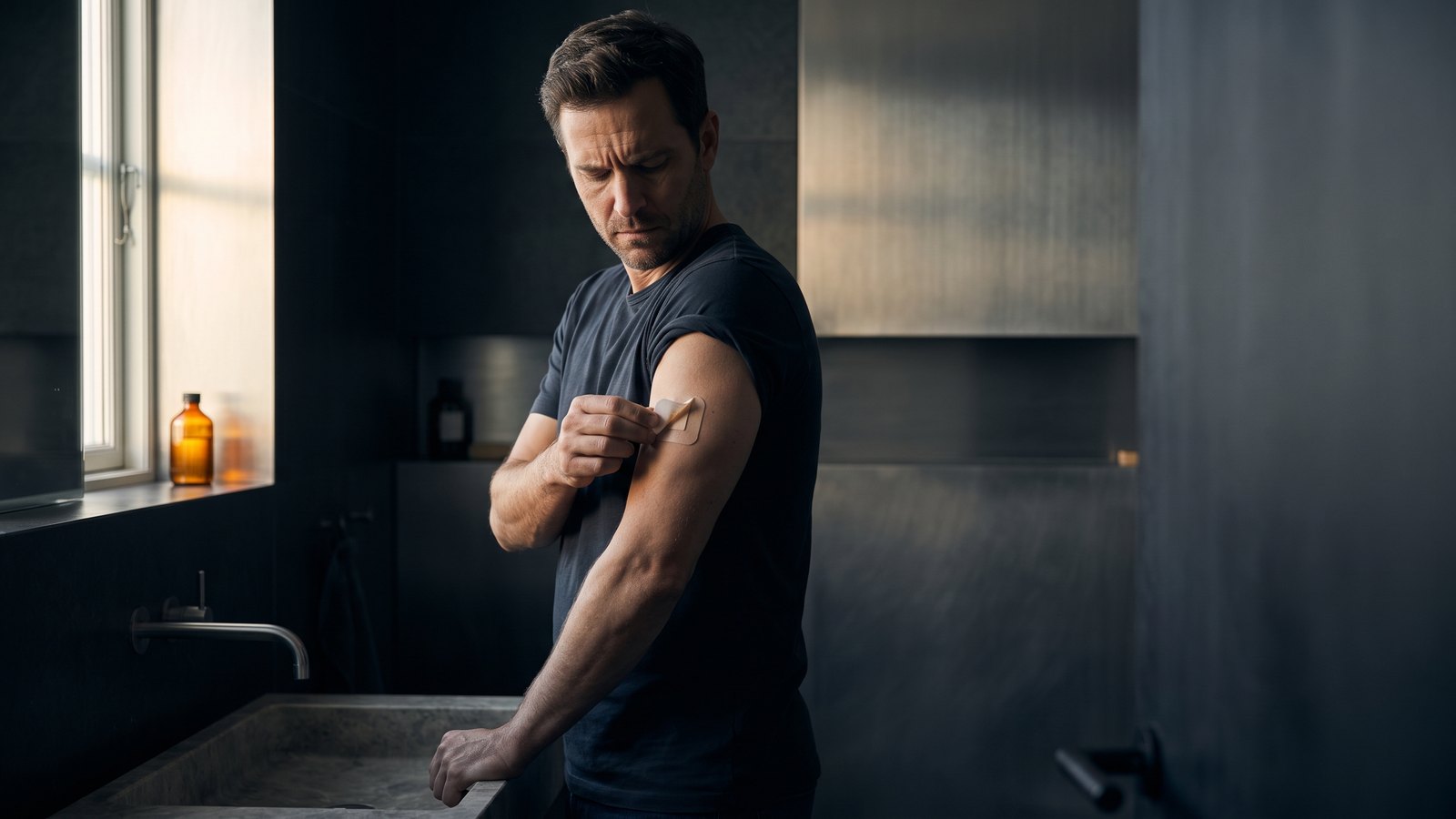
Weight loss patches sell a good story. Stick it on your arm in the morning, forget about it, and let the ingredients drip into you all day. No pills to remember, nothing to swallow, nothing to taste. If you have ever seen a nicotine patch work for somebody trying to quit smoking, the idea does not even sound far fetched.
Here is the verdict up front. Patches are a legitimate way to get a drug into a person. The problem is not the sticker. The problem is that almost nothing sold as a weight loss ingredient can get through skin in a dose that matters, and nobody selling these has run the trial that would prove otherwise.
That is worth understanding properly, because once you know the three things a molecule needs to cross skin, you can look at any patch on the market and work out the answer yourself in about ten seconds. This is education, not medical advice.
Patches are not the problem
Start with the thing that works, because it proves the delivery route is real. The nicotine patch has been through more randomized trials than most prescription drugs. A 2023 Cochrane network meta-analysis pooled 105 randomized trials covering 37,319 people and found the nicotine patch alone raised quit rates compared with control, with an odds ratio of 1.37 and high certainty behind it (Lindson, 2023). That is a modest effect honestly measured, and it is real.
So skin can deliver a drug into your blood. The question is which drugs, and how much.
The three things a molecule needs
Mark Prausnitz and Robert Langer laid this out in a review that is still the standard summary of the field. First generation transdermal systems, which is what every patch on a pharmacy shelf is, work for drugs that are small, lipophilic, and low dose (Prausnitz, 2008). All three, not one out of three.
Small. Your outer layer of skin is built to keep things out, and it is good at it. Dermatologists put a number on the ceiling: a compound generally has to be under 500 daltons of molecular weight to get through the corneal layer at all. Every drug used in transdermal delivery systems sits under that line, and so does essentially every known contact allergen, which is the tell that larger molecules simply are not getting in (Bos, 2000).
Lipophilic. The barrier is a wall of lipids. Fat soluble molecules dissolve into it and move through. Water soluble ones sit on top.
Low dose. This is the one that kills weight loss patches, and it is the one nobody talks about. A patch delivers milligrams per day through a few square inches of skin. Nicotine works as a patch partly because 21 milligrams a day is a meaningful dose of nicotine. Fentanyl works because micrograms matter. Both are potent at tiny amounts.
Run the test on what is actually in these patches
Now take the ingredient list off a typical weight loss patch. Garcinia cambogia, green coffee bean extract, guarana, bitter orange, forskolin, L-carnitine, sometimes seaweed or "detox" botanicals.
Most of those clear the size test. Hydroxycitric acid from garcinia is about 208 daltons. Caffeine is 194. They are small enough. They fail on dose, and it is not close.
The largest trial of garcinia cambogia gave people 1,500 milligrams of hydroxycitric acid a day, by mouth, for twelve weeks, in a randomized double blind design with 135 overweight adults. Both groups lost weight because both groups were put on a diet. Between the groups there was no significant difference in weight lost and no difference in fat mass lost (Heymsfield, 1998). Read that twice. The full oral dose, delivered straight to the gut, did nothing beyond placebo.
A patch cannot deliver 1,500 milligrams a day of anything through your forearm. So the honest question is not whether the patch dose works. It is why you would want a skin route for a compound that already failed at a dose the skin could never come close to.
Green coffee extract has the same shape of story with a worse ending. A 2010 systematic review found only three usable trials, all at high risk of bias, and concluded the results were promising but the methodology was poor (Onakpoya, 2010). The single study that launched the whole green coffee craze was later retracted by its own authors, after the Federal Trade Commission found the sponsor had paid for a trial in which weights and other measurements were altered and subjects were misassigned between placebo and treatment. The sponsor paid a $3.5 million settlement in 2014.
What the regulator already concluded
This is not a new question. The FTC sued a diet patch manufacturer and a retailer back in 2004 over claims that a skin patch caused substantial weight loss, and stated plainly that skin patches do not cause weight loss. In 2007 the manufacturer paid $180,000 and was banned outright from selling weight loss patches. The order barred any claim that a product worn on or rubbed into the skin is effective for weight loss.
Two decades later, no transdermal weight loss product has FDA approval. The patches on the market are sold as cosmetics or supplements, which means nobody checked whether the dose on the box is the dose in the patch, or whether any of it reaches your bloodstream.
Search PubMed for a randomized controlled trial of a transdermal weight loss patch against placebo and you get nothing. Not a weak trial, not a small one. Nothing. For a product category this large, that absence is the finding.
The nicotine patch question
Plenty of men skip the herbal patches and go straight to the one that clearly does something to appetite. It is worth answering directly, because the answer is more interesting than a flat no.
Nicotine does suppress appetite and does raise energy expenditure a little. The evidence for that is mostly indirect, and it comes from what happens when people stop. A meta-analysis of 62 studies found that smokers who quit gained an average of 4 to 5 kilograms in the first twelve months, with most of it in the first three months. What matters here is that weight gain estimates were similar whether people quit on their own or used nicotine replacement, bupropion, or varenicline (Aubin, 2012). The patch did not prevent the gain.
So even in the population where nicotine is being delivered at a proven dose, it is not doing much for body weight. Add that nicotine is addictive, is not approved for weight loss, and raises heart rate and blood pressure, and using a nicotine patch as a diet tool is a bad trade for a man who does not smoke. If you are a smoker who wants to quit and is worried about the weight, that is a real conversation to have with your prescriber, not something to sort out on your own.
Where the delivery-route thinking actually pays off
None of this means the route a compound takes is irrelevant. It matters enormously, which is exactly why the patch pitch is seductive. It just has to be the right route for that molecule. The difference between which form of butyrate survives long enough to be absorbed is a real, defensible distinction with pharmacokinetic data behind it. Route matters when somebody has measured it. It is marketing when nobody has.
The same filter cleans up the rest of the supplement aisle fast. It is why the honest read on tongkat ali and fadogia looks so different from the ad copy, and why berberine holds up better than most things men buy for metabolic health. Ask what the dose was, how it was given, and who ran the trial. Most products cannot answer all three.
What to do instead
The boring answer is the one with the evidence behind it, and it is not as grim as it sounds.
- Protein and fiber at every meal. They are the two levers that reduce how much you eat without you having to white knuckle it.
- Lift twice a week, minimum. Holding muscle while you lose fat is most of what separates looking better from looking smaller.
- Sleep. Short sleep raises hunger and wrecks the decisions you make about food at 9pm.
- Fix the alcohol math. It is usually the single biggest hidden line item in a man's week.
- Then, and only then, consider a supplement, and pick one with human trials at the dose on the label.
If you want the specifics on the training and diet side, start with what actually shifts belly fat after 35. And if the appeal of these patches was the GLP-1 angle, the honest breakdown of which natural GLP-1 approaches have real human evidence will save you a lot of money. More of our supplement verdicts are collected here.
The verdict
Weight loss patches fail on the least glamorous of the three requirements. The ingredients are small enough to cross skin. They are not potent enough to matter at the dose a patch can deliver, and the ones that have been tested properly did not work even when swallowed at full strength. Twenty years of regulatory action and zero randomized trials is not a gap in the evidence. It is the evidence.
Save the money. Put it toward food you will actually eat and a gym membership you will actually use.
References
- Prausnitz MR, Langer R. Transdermal drug delivery. Nat Biotechnol. 2008. https://pubmed.ncbi.nlm.nih.gov/18997767/
- Bos JD, Meinardi MM. The 500 Dalton rule for the skin penetration of chemical compounds and drugs. Exp Dermatol. 2000. https://pubmed.ncbi.nlm.nih.gov/10839713/
- Lindson N, Theodoulou A, Ordonez-Mena JM, et al. Pharmacological and electronic cigarette interventions for smoking cessation in adults: component network meta-analyses. Cochrane Database Syst Rev. 2023. https://pubmed.ncbi.nlm.nih.gov/37696529/
- Heymsfield SB, Allison DB, Vasselli JR, et al. Garcinia cambogia (hydroxycitric acid) as a potential antiobesity agent: a randomized controlled trial. JAMA. 1998. https://pubmed.ncbi.nlm.nih.gov/9820262/
- Onakpoya I, Terry R, Ernst E. The use of green coffee extract as a weight loss supplement: a systematic review and meta-analysis of randomised clinical trials. Gastroenterol Res Pract. 2010. https://pubmed.ncbi.nlm.nih.gov/20871849/
- Aubin HJ, Farley A, Lycett D, Lahmek P, Aveyard P. Weight gain in smokers after quitting cigarettes: meta-analysis. BMJ. 2012. https://pubmed.ncbi.nlm.nih.gov/22782848/
Common questions
Do weight loss patches actually work?
There is no published randomized controlled trial of a transdermal weight loss patch against placebo. The ingredients used are generally not potent enough to matter at the milligram doses a patch can deliver through skin, and several of them failed to beat placebo even when swallowed at full oral dose. Garcinia cambogia at 1,500 mg a day for twelve weeks produced no more weight loss or fat loss than placebo in 135 overweight adults (Heymsfield, 1998). The FTC stated in 2004 that skin patches do not cause weight loss, and in 2007 banned one manufacturer from selling them.
Why do nicotine patches work if weight loss patches do not?
Nicotine patches work because nicotine passes all three tests for transdermal delivery. It is small, it is fat soluble, and it is potent at a low dose, which is what first generation patches require (Prausnitz, 2008). A 2023 Cochrane network meta-analysis of 105 trials in 37,319 people found the nicotine patch alone raised quit rates with an odds ratio of 1.37 (Lindson, 2023). Weight loss ingredients clear the size test but fail badly on dose.
Can you use a nicotine patch for weight loss?
A nicotine patch is not approved for weight loss and it is a poor trade. Nicotine does blunt appetite, but a meta-analysis of 62 studies found smokers who quit gained 4 to 5 kg over twelve months whether they used nicotine replacement or nothing at all, so the patch did not prevent the gain (Aubin, 2012). Nicotine is addictive and raises heart rate and blood pressure. If you smoke and want to quit without gaining weight, talk to your prescriber.
What about GLP-1 patches?
GLP-1 and its drug analogues are peptides, far heavier than the roughly 500 dalton ceiling for crossing the corneal layer of skin (Bos, 2000). A conventional patch cannot deliver them. Anything sold as a natural GLP-1 patch is delivering botanical extracts at doses well below what the oral research used, with no trial behind the patch itself.
Are weight loss patches safe?
The main risk is wasted money rather than acute harm, but they are unapproved products sold without dose verification, so nobody has confirmed what is in them or how much crosses the skin. Skin irritation under the adhesive is the most common complaint. Anything containing stimulants such as bitter orange or high dose caffeine deserves caution if you have high blood pressure or a heart condition. Talk to your doctor before adding any of it.