Muscle & Fat Loss
Cold Plunge: What Works, What Backfires
Ice baths are sold as a shortcut to recovery, mood, and toughness. The research says one thing clearly: if you plunge right after you lift, you are paying for it in muscle.
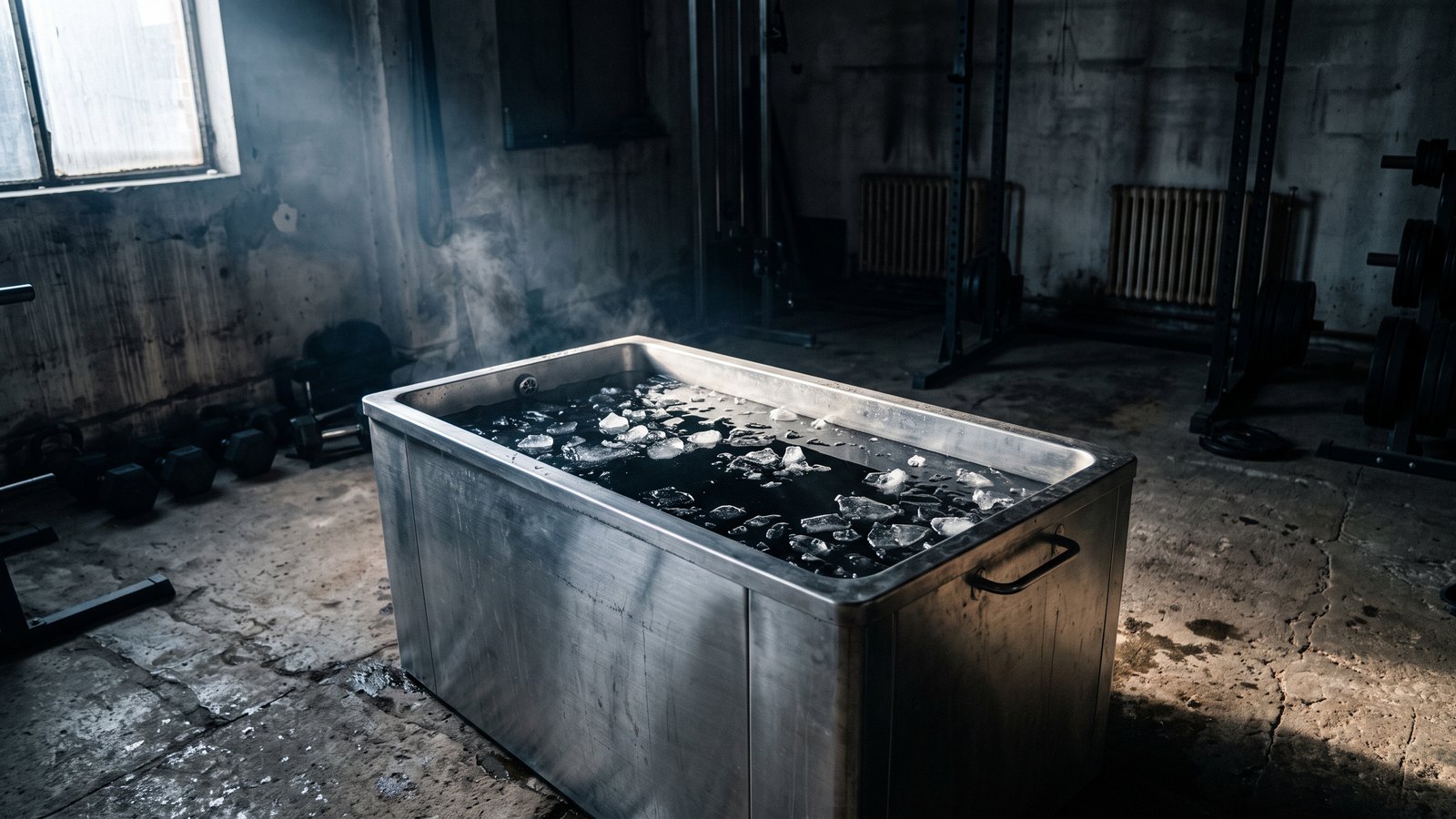
The cold plunge went from an athlete's recovery tub to a garage status symbol in about five years. The pitch is that a few minutes in freezing water makes you recover faster, think clearer, feel better, and generally become harder to kill.
Here is the verdict up front. Cold water immersion genuinely reduces muscle soreness, and researchers have even worked out the right temperature and time. But if you take that plunge right after a lifting session, you are quietly cutting into the muscle growth you just earned. The mood and wellbeing claims are the thinnest part of the story, right next to the idea that cold water raises your testosterone. Cold works. It just does not work at every hour of your week, and the timing is the whole ballgame.
What cold water actually does well
The soreness effect is the most solid thing on the list. A Cochrane review pooled 17 trials covering 366 people and found that cold water immersion reduced delayed onset muscle soreness compared with just resting, and the effect held at 24, 48, 72, and 96 hours afterward. The reviewers were blunt about the limits: the trials were small, study quality was low, and most did not properly track side effects (Bleakley et al., 2012).
So it works, and the evidence behind it is not as sturdy as the marketing implies. Both things are true.
The useful part is that a separate meta-analysis went looking for the right dose instead of just asking whether cold works at all. Across nine randomized trials, cold water immersion beat passive rest for soreness, and the best results came from water between 11 and 15 degrees Celsius, roughly 52 to 59 Fahrenheit, for 11 to 15 minutes (Machado et al., 2016).
That is worth sitting with, because it is colder and shorter than most men assume. You do not need a tub full of ice at 3 degrees. You need cool water and about a quarter of an hour. Going harder than that does not buy you more, and it is the part guys get wrong while trying to prove something.
The catch nobody in the plunge business mentions
Now the part that should change how you use it.
Researchers took 21 physically active men and had them strength train for 12 weeks, twice a week. After every session, half did 10 minutes of cold water immersion and half did active recovery. Strength and muscle mass increased more in the active recovery group. Isokinetic work went up 19 percent, type II muscle fiber size went up 17 percent, and the number of myonuclei per fiber went up 26 percent in the active recovery group, and none of those changes reached significance in the cold group (Roberts et al., 2015).
The same paper looked at what was happening underneath. Cold blunted the rise in satellite cells, the repair cells that let a muscle fiber grow, and it blunted the signaling kinases that drive hypertrophy. The authors' own conclusion was that using cold water as a regular post-workout routine should be reconsidered.
A second, independent group ran a similar test and landed in nearly the same place with one interesting difference. Sixteen men trained three days a week for seven weeks, each session followed by either 15 minutes at 10 degrees Celsius or passive recovery. Gains in leg press one-rep max were similar between the groups, but growth in type II muscle fiber size was clearly attenuated in the cold group, alongside blunted anabolic signaling and raised markers of muscle breakdown. Their summary was direct: post-exercise cold water immersion should be avoided if muscle growth is the goal (Fyfe et al., 2019).
Then a meta-analysis pulled the training studies together. Across eight controlled studies, regular cold water immersion paired with resistance training had a harmful effect on strength outcomes, including one-rep max, maximum isometric strength, and strength endurance, and a similar harmful effect on ballistic power. Pooled effect sizes came in around -0.60, which is a real and moderate hit (Malta et al., 2021).
Read those three together and the picture is consistent even where the details differ. Every one of them found cold blunts muscle fiber growth after lifting. They disagree on whether raw strength survives it. That is a fair scientific argument, and it does not change the practical call: if you lift to build or hold muscle, do not finish the session in cold water.
Endurance training is a different story
Here is the exception, and it is a useful one. That same meta-analysis found no effect of regular cold water immersion on endurance performance. Time-trial power, time-trial duration, and maximal aerobic power in graded testing all came out unchanged (Malta et al., 2021).
So the penalty is specific to the adaptations you are chasing when you lift. If your hard session was a long ride, a run, or conditioning work, cold water looks like a reasonable recovery tool rather than a tax on your results.
The mood and wellbeing claims
This is where the internet gets loudest and the evidence gets thinnest.
A 2025 systematic review and meta-analysis pooled 11 randomized studies covering 3,177 people, looking at cold water immersion for stress, sleep, mood, immunity, and general wellbeing in healthy adults. The findings were mixed and very time-dependent. Stress was significantly reduced 12 hours after a plunge, but not immediately after, not at one hour, not at 24 hours, and not at 48. Inflammation actually went up right after immersion and at one hour. Immune function showed no significant change in the pooled analysis, though the authors noted a study where cold showers were linked to 29 percent fewer days of sickness absence. Sleep quality and quality of life improved. Mood did not (Cain et al., 2025).
The reviewers were careful, and you should be too. There are few good trials, sample sizes are small, and the populations studied are not diverse. If a plunge makes you feel sharp and in control, that is a real thing and worth keeping. Just do not confuse it with proven, durable effects on your mental health.
How to actually use it
The rules fall out of the research pretty cleanly.
Do not plunge right after lifting. This is the one that matters most. If muscle and strength are the point of your training, cold water immediately after your session works against you.
Put distance between the two. If you want both, separate them. Plunge on a rest day, in the morning before an evening session, or several hours after you lift rather than in the parking lot with a wet towel.
Use it after conditioning, not after strength work. The endurance data shows no penalty, so that is where cold earns its keep.
Use it when recovery beats adaptation. In a tournament weekend, a two-a-day, or a stretch where you need to perform again tomorrow and are not chasing growth, cutting soreness is the right trade. In a normal training block, it is not, and the same logic runs through how deloads and overreaching actually work.
Get the dose right. Around 11 to 15 degrees Celsius for 11 to 15 minutes is what the soreness research supports. Colder and longer is ego, not strategy.
The verdict
Cold water immersion is a real tool with a narrow job. It reliably takes the edge off soreness at a well-defined dose, it does not appear to hurt endurance adaptations, and some men clearly like how it makes them feel. What it will not do is help you get bigger or stronger, and used at the wrong moment it will hold you back. Three separate lines of research agree that plunging right after you lift blunts the muscle growth you trained for.
Use cold on purpose, in the right slot in your week, the same way the sauna earns its slot. Do not let a cold tub undo the work you did an hour earlier. More recovery calls like this one live in our muscle and fat-loss guides.
This article is for general education and is not medical advice. Cold water immersion puts real stress on your heart and blood pressure. If you have heart disease, a heart rhythm problem, high or low blood pressure, Raynaud's, or you take blood pressure or heart medication, talk to your prescriber before starting. Never plunge alone in open water.
References
- Bleakley C, McDonough S, Gardner E, et al. Cold-water immersion (cryotherapy) for preventing and treating muscle soreness after exercise. Cochrane Database Syst Rev. 2012. https://pubmed.ncbi.nlm.nih.gov/22336838/
- Machado AF, Ferreira PH, Micheletti JK, et al. Can Water Temperature and Immersion Time Influence the Effect of Cold Water Immersion on Muscle Soreness? A Systematic Review and Meta-Analysis. Sports Med. 2016. https://pubmed.ncbi.nlm.nih.gov/26581833/
- Roberts LA, Raastad T, Markworth JF, et al. Post-exercise cold water immersion attenuates acute anabolic signalling and long-term adaptations in muscle to strength training. J Physiol. 2015. https://pubmed.ncbi.nlm.nih.gov/26174323/
- Fyfe JJ, Broatch JR, Trewin AJ, et al. Cold water immersion attenuates anabolic signaling and skeletal muscle fiber hypertrophy, but not strength gain, following whole-body resistance training. J Appl Physiol. 2019. https://pubmed.ncbi.nlm.nih.gov/31513450/
- Malta ES, Dutra YM, Broatch JR, Bishop DJ, Zagatto AM. The Effects of Regular Cold-Water Immersion Use on Training-Induced Changes in Strength and Endurance Performance: A Systematic Review with Meta-Analysis. Sports Med. 2021. https://pubmed.ncbi.nlm.nih.gov/33146851/
- Cain T, Brinsley J, Bennett H, Nelson M, Maher C, Singh B. Effects of cold-water immersion on health and wellbeing: A systematic review and meta-analysis. PLoS One. 2025. https://pubmed.ncbi.nlm.nih.gov/39879231/
Common questions
Does a cold plunge really kill your gains?
A cold plunge blunts muscle growth when you do it right after lifting. In a 12-week training study, the group doing active recovery gained more strength and muscle than the cold water group, with type II fiber size up 17 percent in the active recovery group only. A second trial and a meta-analysis of eight studies found the same pattern. The fix is timing, not abstinence. Keep cold water away from your lifting sessions.
How cold and how long should a cold plunge be?
For soreness, the research points to water between 11 and 15 degrees Celsius, roughly 52 to 59 Fahrenheit, for 11 to 15 minutes. That is the dose that produced the best results in a meta-analysis of nine randomized trials. Colder water and longer sits did not deliver better outcomes, so there is no reward for suffering more.
When is the best time to cold plunge?
On rest days, in the morning before an evening lift, several hours after strength work, or after conditioning and endurance sessions. The performance penalty shows up specifically with resistance training adaptations. Pooled research found no effect of regular cold water immersion on endurance performance.
Do cold plunges help with stress and mood?
The evidence is thin and mixed. A 2025 meta-analysis of 11 studies found stress was lower 12 hours after immersion but not immediately, at one hour, at 24 hours, or at 48. Sleep quality and quality of life improved, but mood did not, and inflammation actually rose right afterward. If it makes you feel good, that counts for something. Just do not treat it as a proven mental health tool.
Is cold water immersion safe for everyone?
Cold water immersion is not safe for everyone. Cold immersion is a real jolt to your heart rate and blood pressure. If you have heart disease, a rhythm problem, blood pressure issues, or you take heart or blood pressure medication, talk to your prescriber before you start. Never plunge alone in open water, where cold shock can be dangerous fast.