Supplements
Omega-3 for Men: What Fish Oil Actually Does
Fish oil is one of the best-selling supplements there is. Here is where the evidence for men is strong, where it is modest, and how to take it without wasting money.
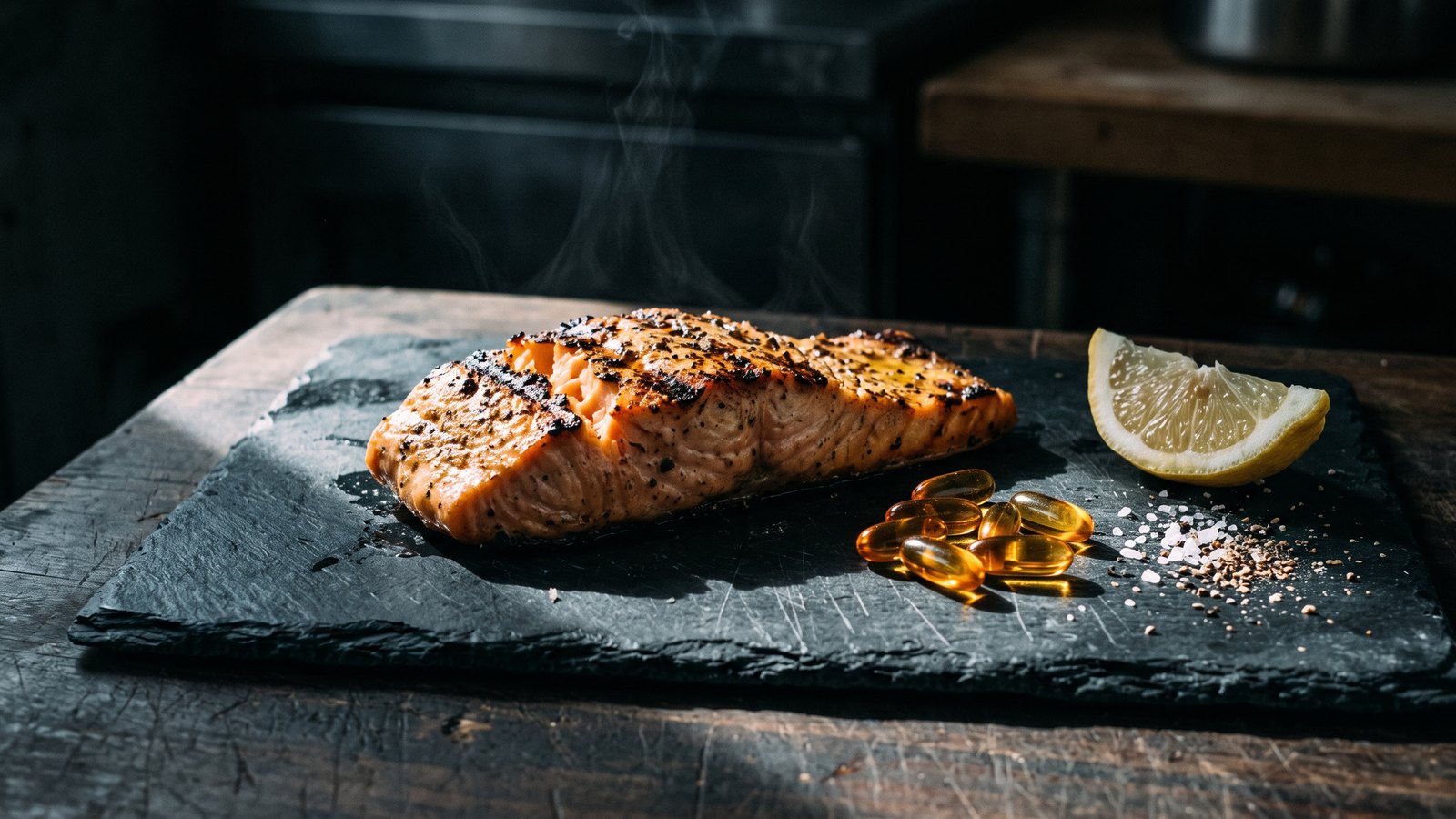
Fish oil sits in almost every man's medicine cabinet, sold as good for your heart, your brain, your joints, and just about everything else. Some of that holds up. A lot of it is marketing that ran way ahead of the science.
Here is the honest starting point. Omega-3 fats are genuinely useful, but they are not magic, and the size of the benefit depends a lot on what you are trying to fix. They are excellent for one specific blood marker, solid for your heart and your mood, and only modest for muscle recovery. This is education, not medical advice.
What omega-3 actually is
Omega-3 is a family of fats your body needs but cannot make well on its own. Three matter. EPA and DHA are the long-chain kinds found in oily fish like salmon, sardines, and mackerel, and they are the ones with most of the research behind them. ALA is a shorter version from plants like flax and walnuts, and your body converts only a small fraction of it into EPA and DHA.
That distinction matters. When a study shows a benefit, it is almost always from the fish-based EPA and DHA, not the plant version. So when you read the label on a bottle, the number that counts is the combined EPA plus DHA, not the total fish oil.
The strong evidence: triglycerides
If omega-3 does one thing reliably, it lowers triglycerides, a type of fat in your blood tied to heart risk when it runs high, though ApoB is the number that tells you more. This is the least controversial benefit there is.
The most extensive review to date, a Cochrane analysis of 86 trials, found that fish-based omega-3 reduced triglycerides by about 15 percent, and the effect got stronger with higher doses (Abdelhamid et al., 2020). At the prescription doses used for men with genuinely high triglycerides, around 4 grams a day of EPA and DHA, the American Heart Association reports drops of 30 percent or more (Skulas-Ray et al., 2019).
Those high doses are a medical decision, not a grab off the shelf. If your triglycerides are high, that is a conversation with your doctor about whether a prescription-strength dose makes sense for you, not something to self-prescribe from a bulk bottle.
The solid evidence: your heart
This is where the story gets more honest than the ads let on. Eating fish and swallowing a fish oil capsule are not the same bet.
Men who eat more oily fish tend to have healthier hearts. A meta-analysis of 40 studies covering over a million people found that higher fish intake was linked to about 15 percent lower risk of dying from coronary heart disease, with the risk dropping steadily as fish intake went up (Zhang et al., 2020). That is an association, not proof, but it is a strong and consistent one.
Capsules are a weaker bet than the fish itself. The big Cochrane review found that omega-3 supplements only slightly reduced the risk of heart disease events and heart disease death, and made little or no difference to the risk of dying from any cause (Abdelhamid et al., 2020). One notable exception stands out. In a large trial of high-risk men already on a statin, a high dose of prescription EPA cut major cardiovascular events by about 25 percent (Skulas-Ray et al., 2019). The honest read: whole fish looks better than a cheap capsule for a healthy man, and the dramatic drug-level results come from prescription doses in specific patients, guided by a doctor.
The solid evidence: your mood
Your brain is loaded with omega-3, so researchers have long asked whether more of it helps mood. The answer is a cautious yes, with a catch about which type.
A meta-analysis of 26 trials found that omega-3 improved symptoms of depression overall (Liao et al., 2019). The interesting detail is that the benefit came from EPA-heavy formulas, the ones that are at least 60 percent EPA, while DHA-heavy blends did not show the same effect. So if mood is your reason for taking it, the ratio on the label matters. Look for a product where EPA clearly outweighs DHA. This is a supporting tool, not a replacement for real treatment. If you are struggling, talk to a doctor.
The modest evidence: recovery
Lifters like the idea that fish oil eases sore muscles. The evidence here is real but thin, and it leans on high doses.
In one dose-response trial, resistance-trained men who took 6 grams a day of fish oil had less muscle soreness and bounced back faster after a hard, damaging workout than men on a placebo, while lower doses did less (VanDusseldorp et al., 2020). That is a promising signal, but 6 grams is a big dose, other studies have come up empty, and soreness is not the same as building more muscle. Treat easier recovery as a possible bonus, not the main reason to buy.
How to actually take it
The practical side is simple once you ignore the hype on the bottle.
- Food first: The strongest heart signal comes from eating oily fish. Two servings a week of salmon, sardines, or mackerel covers the basics, doubles as a food source of vitamin D, and beats most capsules.
- If you do not eat fish: A capsule delivering around 250 to 500 mg of combined EPA and DHA a day is a sensible floor. Read the back label for the EPA plus DHA number, not the total fish oil number, which is always bigger.
- For a specific goal: Higher doses, 1 to 4 grams a day, are where the mood and triglyceride effects show up. Anything in that range for a medical reason like high triglycerides belongs in a talk with your prescriber.
- Quality: Buy a product that lists its EPA and DHA clearly and is third-party tested for freshness. Rancid fish oil is common and a waste of money.
Is it safe?
For most men, omega-3 is well tolerated. The common complaints are minor: fishy burps, a bit of stomach upset, or loose stools, usually at higher doses. Taking it with a meal and keeping capsules in the fridge helps.
The one real caution is at high doses. Omega-3 can thin your blood slightly, so if you take a blood thinner, have a bleeding condition, or have surgery coming up, clear it with your doctor first (Skulas-Ray et al., 2019). For a healthy man at normal doses, the safety record is strong.
The verdict
Omega-3 is a solid, evidence-backed supplement as long as you keep your expectations honest. It reliably lowers triglycerides, it supports your heart, and EPA-heavy versions can help your mood. The muscle-recovery angle is real but modest and needs big doses. And for your heart, eating oily fish beats leaning on a cheap capsule.
Get most of it from food. If you do not eat fish, a clean capsule with a clear EPA and DHA count is cheap insurance. Save the high doses for a specific goal and a doctor's input. Strong where the evidence is strong, honest where it is thin, the same bar the rest of our supplement reviews have to clear. That is the verdict.
References
- Abdelhamid AS, et al. Omega-3 fatty acids for the primary and secondary prevention of cardiovascular disease. Cochrane Database Syst Rev. 2020. https://pubmed.ncbi.nlm.nih.gov/32114706/
- Zhang B, et al. Fish Consumption and Coronary Heart Disease: A Meta-Analysis. Nutrients. 2020. https://pubmed.ncbi.nlm.nih.gov/32751304/
- Skulas-Ray AC, et al. Omega-3 Fatty Acids for the Management of Hypertriglyceridemia: A Science Advisory From the American Heart Association. Circulation. 2019. https://pubmed.ncbi.nlm.nih.gov/31422671/
- Liao Y, et al. Efficacy of omega-3 PUFAs in depression: A meta-analysis. Transl Psychiatry. 2019. https://pubmed.ncbi.nlm.nih.gov/31383846/
- VanDusseldorp TA, et al. Impact of Varying Dosages of Fish Oil on Recovery and Soreness Following Eccentric Exercise. Nutrients. 2020. https://pubmed.ncbi.nlm.nih.gov/32727162/
Common questions
How much omega-3 should a man take per day?
For general health, aim to eat oily fish like salmon or sardines twice a week. If you do not eat fish, a capsule with about 250 to 500 mg of combined EPA and DHA a day is a reasonable floor. Read the EPA plus DHA number on the back, not the bigger total fish oil number. Higher doses of 1 to 4 grams a day are used for specific goals like lowering high triglycerides, and that range should be guided by your doctor.
Is it better to eat fish or take a fish oil pill?
Eat the fish when you can. A meta-analysis of over a million people found that higher fish intake was linked to a lower risk of dying from heart disease, while the largest review of supplements found capsules only slightly reduced heart events and did not lower overall death (Abdelhamid, 2020; Zhang, 2020). A capsule is useful backup if you do not eat fish, but whole oily fish is the stronger bet.
Does omega-3 help with muscle soreness?
Omega-3 helps with muscle soreness a little, and mostly at high doses. In one trial, resistance-trained men taking 6 grams a day had less soreness and faster recovery after a hard workout than men on a placebo, while lower doses did less (VanDusseldorp, 2020). Other studies found no effect, and reduced soreness is not the same as building more muscle. Treat it as a minor bonus, not the reason to buy.
Does the EPA to DHA ratio matter?
The EPA to DHA ratio matters for mood. A meta-analysis found that the benefit for depression symptoms came from EPA-heavy formulas that were at least 60 percent EPA, while DHA-heavy blends did not show the same effect (Liao, 2019). If mood is your reason for taking omega-3, choose a product where EPA clearly outweighs DHA. For general heart and triglyceride benefits, the total EPA plus DHA is what matters most.
Is fish oil safe to take every day?
For most healthy men, fish oil is safe to take every day. The usual side effects are minor, like fishy burps or mild stomach upset, and taking it with food helps. The main caution is at high doses, where omega-3 can thin your blood slightly. If you take a blood thinner, have a bleeding condition, or have surgery coming up, clear it with your doctor first.