Supplements
Fadogia Agrestis vs Tongkat Ali: Which One Is Worth Taking?
Tongkat ali has five pooled randomized trials in men. Fadogia agrestis has a five-day rat study. Here is the side by side, plus where the stack and ashwagandha fit.
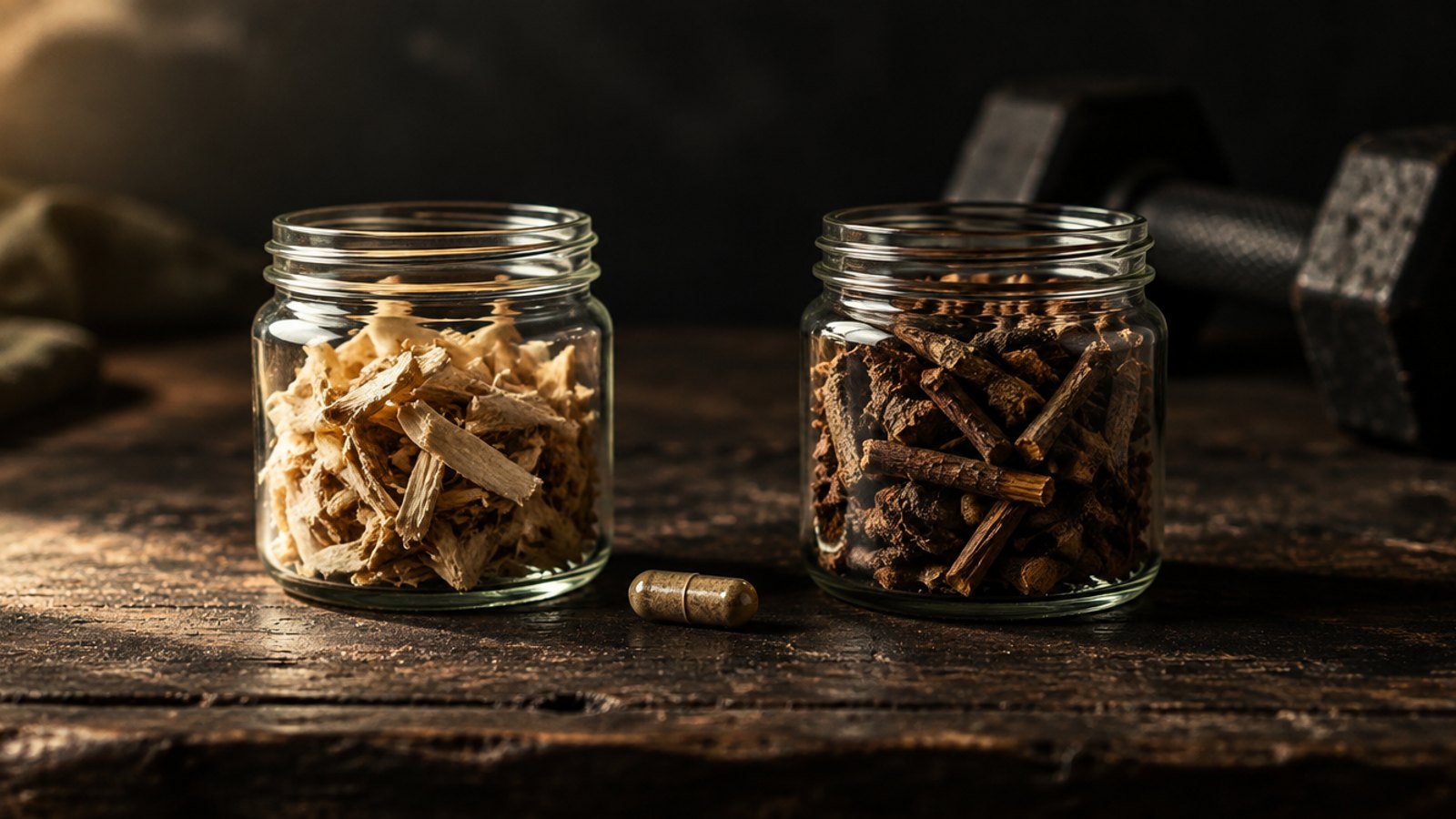
Fadogia agrestis vs tongkat ali is not a close contest. Tongkat ali has randomized trials in men and a meta-analysis showing a real rise in total testosterone. Fadogia agrestis has never been tested in a single human, and its whole reputation rests on one five-day rat study from 2005. If you are choosing between the two, buy tongkat ali on its own, at 200 to 400 mg a day of a standardized root extract, and skip Fadogia until somebody runs a trial in men.
That is the short answer. This is education, not medical advice.
Fadogia agrestis vs tongkat ali: what each one is
Tongkat ali is the root of Eurycoma longifolia, a tree from Malaysia and Indonesia. It has a long history of traditional use, and it has been studied in randomized human trials for testosterone, stress and sexual function.
Fadogia agrestis is a shrub from West Africa, used in Nigerian folk medicine as an aphrodisiac. It reached American supplement shelves through podcasts, not through research. We went through the full research history of both herbs in why one of these herbs has human trials and the other has a rat study. This page is the side by side.
The criteria
- Human evidence. Randomized trials in men, not rodents.
- Size of the effect. What moved, and by how much.
- Dose disclosed and tested. Whether the amount on the label matches an amount a study used.
- Safety data. What is known about the liver, kidneys and testes.
- Label accuracy. Whether the capsule holds what it claims.
- Stimulant or not. All four options here are stimulant-free, so none of them will touch your sleep the way a caffeine-based test booster can.
Tongkat ali
Tested dose: 200 to 600 mg a day of a standardized root extract. Stimulant: no.
The pooled evidence is the reason it wins. A 2022 systematic review found nine human studies and combined five randomized controlled trials. Total testosterone rose significantly in men taking tongkat ali, with a standardized mean difference of 1.35 and a confidence interval from 0.57 to 2.14, and the result held in the subgroup of men with low testosterone (Leisegang et al., 2022). The interval is wide because the trials are small. The direction is consistent.
The single trials fill in the picture. In 32 healthy men averaging 24 years old, 600 mg a day for two weeks raised total and free testosterone compared with placebo. Luteinizing hormone did not move, so the herb does not seem to work by telling the testes to make more (Chan et al., 2021). In 63 moderately stressed adults, four weeks of a standardized hot-water root extract lowered salivary cortisol 16 percent and raised salivary testosterone 37 percent, with tension, anger and confusion scores all down (Talbott et al., 2013). And in a six-month trial of 45 men averaging 47 with symptoms of low androgens, 200 mg a day improved erectile function, with the best results in the men who also trained three times a week (Leitao et al., 2020).
The honest downsides: the trials are small and mostly short, and the effect is a nudge, not a prescription. It shows up most clearly in men who are stressed or start on the low side.
Fadogia agrestis
Tested dose in men: none. Stimulant: no.
Here is the entire case for it. Male rats were given 18, 50 or 100 mg per kg of a water extract of the stem for five days. Mounting behavior went up and serum testosterone rose in a dose-dependent way (Yakubu et al., 2005). That is the study the market was built on.
As of October 2026, a PubMed search for Fadogia agrestis returns ten records. None is a human trial. So the few hundred milligrams on a typical label is not a studied human dose. It is a guess scaled from rats.
The same lab kept going, and the follow-ups matter. Rats given the same doses for 28 days showed changes the authors called adverse effects on testicular function, with recovery mainly at the lowest dose (Yakubu et al., 2007). A second 28-day rat study found enzymes leaking out of liver and kidney tissue into the blood, which the authors read as damage to those cells' membranes (Yakubu et al., 2009). Rat findings do not prove harm in men. They do mean the only long-term data that exists points the wrong way, and nobody has checked in humans.
There is a label problem too. Researchers at the University of Mississippi tested 17 supplements that claimed to contain Fadogia. In five of them, the plant's marker compounds were not detected at all (Avula et al., 2018).
Is Fadogia agrestis or tongkat ali better for testosterone?
Tongkat ali. It has five pooled randomized trials in men showing a rise in total testosterone. Fadogia has a five-day rat study. Any claim that Fadogia "raises luteinizing hormone" in men comes from that rat work and from marketing copy, not from a human measurement.
Can you take Fadogia agrestis and tongkat ali together?
You can buy them stacked in one capsule, and plenty of men do. No study has tested the combination, in animals or in people. So the stack has exactly as much human evidence as the tongkat ali inside it. The Fadogia adds an unknown, not a proven extra effect. If you want to test whether tongkat ali does anything for you, take it alone. Then you know what you are judging.
Fadogia agrestis vs tongkat ali vs ashwagandha
Ashwagandha is the third herb in this conversation, and it deserves a seat. Tested dose: 300 mg of root extract twice a day in the best-known strength trial. Stimulant: no.
In an eight-week crossover trial of overweight men aged 40 to 70 with mild fatigue, a standardized extract was associated with a 14.7 percent greater rise in testosterone than placebo. Fatigue, vigor and sexual well-being did not differ between groups (Lopresti et al., 2019). In 57 young men new to lifting, 300 mg twice a day for eight weeks alongside training produced bigger gains in bench press, arm size and testosterone than placebo (Wankhede et al., 2015).
Its downside is a real one. A case series from Iceland and the US Drug-Induced Liver Injury Network described five people with liver injury linked to ashwagandha supplements. Liver tests returned to normal within one to five months in four of them, one was lost to follow-up, and none went into liver failure (Bjornsson et al., 2020). It is rare, but stop and see a doctor if you notice yellowing skin, dark urine or itching. We covered the full picture in what the ashwagandha trials show on stress, sleep and testosterone.
How to choose between the two herbs that have human data: if your main complaint is stress and poor sleep, ashwagandha has the deeper stress research. If it is drive and low-normal testosterone, tongkat ali has the more direct testosterone evidence.
Side by side
- Tongkat ali: five pooled randomized trials in men. Testosterone up, cortisol down in stressed adults. Tested at 200 to 600 mg a day for up to six months. The 2022 review called it a safe and promising option while asking for more research. Winner.
- Ashwagandha: multiple randomized trials. Modest testosterone rise, stronger stress data. Tested at 300 mg twice a day. Rare liver injury reports. Runner-up, and the pick if stress is the real problem.
- Fadogia agrestis: zero human trials. One five-day rat study for the benefit, two 28-day rat studies pointing at testicular, liver and kidney stress. No tested human dose. Five of 17 products tested had no detectable marker compounds. Skip.
- The stack of both: never tested. Same evidence as tongkat ali alone, with an unknown added.
How much tongkat ali should a man take?
The trials ran from 200 to 600 mg a day. The six-month trial in men in their 40s used 200 mg, so 200 to 400 mg a day is a sensible range to start. Buy a product that states the extract standardization on the label, since the trials used standardized root extracts and plain root powder is not the same thing. Give it eight to twelve weeks. If you want a real answer, get a morning blood test before and after.
Is Fadogia agrestis safe? Do you need to cycle it?
Nobody knows if it is safe in men, because nobody has tested it in men. The "three weeks on, one week off" advice you see online is not from a study. It is a hedge against the rat findings, and there is no evidence that cycling makes those concerns go away. A plan built around limiting possible harm from an ingredient with no proven human benefit is a strange trade.
For men over 40
The best tongkat ali data in this age group is the six-month trial in men averaging 47, where the supplement worked best paired with training (Leitao et al., 2020). That is the pattern across this whole shelf: the herb rides on top of the basics. One week of five-hour nights cut daytime testosterone 10 to 15 percent in healthy young men (Leproult and Van Cauter, 2011), which is more than any herb here has been shown to add back. Start with how much testosterone a week of short sleep costs you and the habits that move testosterone in men who are not clinically low.
If you have real symptoms, low drive, low energy, fewer morning erections, get two morning blood tests before you spend money on any capsule. Truly low testosterone is a medical conversation, and our guide to who qualifies for TRT and what the trials found lays out what to ask. If you take any medication or have a liver, kidney or hormone condition, talk to your prescriber before adding either herb.
The verdict
Fadogia agrestis vs tongkat ali comes down to one question: which one has been tested in men? Tongkat ali has. Five pooled randomized trials show total testosterone rising, the stress data is encouraging, and 200 to 400 mg a day of a standardized extract is a fair thing to try for a few months on top of training and sleep. Fadogia agrestis has a rat study, two more rat studies that raise safety questions, and a real chance the bottle does not hold it.
Buy tongkat ali alone. Consider ashwagandha if stress is the bigger problem. Leave Fadogia on the shelf. More straight calls like this one are in our supplement reviews.
That is the verdict.
References
- Leisegang K, Finelli R, Sikka SC, Panner Selvam MK. Eurycoma longifolia (Jack) improves serum total testosterone in men: a systematic review and meta-analysis of clinical trials. Medicina (Kaunas). 2022. https://pubmed.ncbi.nlm.nih.gov/36013514/
- Chan KQ, Stewart C, Chester N, Hamzah SH, Yusof A. The effect of Eurycoma longifolia on the regulation of reproductive hormones in young males. Andrologia. 2021. https://pubmed.ncbi.nlm.nih.gov/33559971/
- Talbott SM, Talbott JA, George A, Pugh M. Effect of tongkat ali on stress hormones and psychological mood state in moderately stressed subjects. J Int Soc Sports Nutr. 2013. https://pubmed.ncbi.nlm.nih.gov/23705671/
- Leitao AE, Vieira MCS, Pelegrini A, da Silva EL, Guimaraes ACA. A 6-month, double-blind, placebo-controlled, randomized trial to evaluate the effect of Eurycoma longifolia (tongkat ali) and concurrent training on erectile function and testosterone levels in androgen deficiency of aging males (ADAM). Maturitas. 2020. https://pubmed.ncbi.nlm.nih.gov/33541567/
- Yakubu MT, Akanji MA, Oladiji AT. Aphrodisiac potentials of the aqueous extract of Fadogia agrestis (Schweinf. Ex Hiern) stem in male albino rats. Asian J Androl. 2005. https://pubmed.ncbi.nlm.nih.gov/16281088/
- Yakubu MT, Akanji MA, Oladiji AT. Effects of oral administration of aqueous extract of Fadogia agrestis (Schweinf. Ex Hiern) stem on some testicular function indices of male rats. J Ethnopharmacol. 2007. https://pubmed.ncbi.nlm.nih.gov/18023305/
- Yakubu MT, Oladiji AT, Akanji MA. Mode of cellular toxicity of aqueous extract of Fadogia agrestis (Schweinf. Ex Hiern) stem in male rat liver and kidney. Hum Exp Toxicol. 2009. https://pubmed.ncbi.nlm.nih.gov/19755438/
- Avula B, Bae JY, Raman V, et al. Quantification of phenolic compounds from Fadogia agrestis and dietary supplements using UHPLC-PDA-MS. Planta Med. 2018. https://pubmed.ncbi.nlm.nih.gov/30170324/
- Lopresti AL, Drummond PD, Smith SJ. A randomized, double-blind, placebo-controlled, crossover study examining the hormonal and vitality effects of ashwagandha (Withania somnifera) in aging, overweight males. Am J Mens Health. 2019. https://pubmed.ncbi.nlm.nih.gov/30854916/
- Wankhede S, Langade D, Joshi K, Sinha SR, Bhattacharyya S. Examining the effect of Withania somnifera supplementation on muscle strength and recovery: a randomized controlled trial. J Int Soc Sports Nutr. 2015. https://pubmed.ncbi.nlm.nih.gov/26609282/
- Bjornsson HK, Bjornsson ES, Avula B, et al. Ashwagandha-induced liver injury: a case series from Iceland and the US Drug-Induced Liver Injury Network. Liver Int. 2020. https://pubmed.ncbi.nlm.nih.gov/31991029/
- Leproult R, Van Cauter E. Effect of 1 week of sleep restriction on testosterone levels in young healthy men. JAMA. 2011. https://pubmed.ncbi.nlm.nih.gov/21632481/
Common questions
Is Fadogia agrestis or tongkat ali better for testosterone?
Of Fadogia agrestis and tongkat ali, tongkat ali is better for testosterone. A 2022 systematic review pooled five randomized controlled trials and found a significant rise in total testosterone in men taking it (Leisegang et al., 2022). Fadogia agrestis has never been tested in humans. Its testosterone claim comes from one five-day study in rats (Yakubu et al., 2005).
Can you take Fadogia agrestis and tongkat ali together?
Fadogia agrestis and tongkat ali are sold together, but no study has tested the combination in animals or people. The stack has the same human evidence as the tongkat ali in it, plus an ingredient with no human safety data. If you want to know whether tongkat ali works for you, take it alone.
Is Fadogia agrestis safe?
The safety of Fadogia agrestis is unknown in men because it has not been studied in men. In rats, 28 days of dosing produced changes the authors described as adverse effects on testicular function (Yakubu et al., 2007) and signs of stress to liver and kidney cells (Yakubu et al., 2009). Rat findings do not prove harm in humans, but there is no human data to set against them.
Do you need to cycle Fadogia agrestis?
The common three weeks on, one week off advice does not come from any study. It is a precaution based on the rat toxicity findings, and there is no evidence that cycling removes those concerns.
How much tongkat ali should I take?
Human trials used 200 to 600 mg a day of a standardized root extract. A six-month trial in men averaging 47 used 200 mg (Leitao et al., 2020), so 200 to 400 mg a day is a sensible starting range. Choose a product that states its standardization, and give it eight to twelve weeks.
Is ashwagandha better than tongkat ali?
Ashwagandha and tongkat ali suit different problems. Ashwagandha has the deeper stress research and a modest testosterone signal, including a 14.7 percent greater rise than placebo in overweight men aged 40 to 70 (Lopresti et al., 2019). Tongkat ali has the more direct testosterone evidence. Ashwagandha also carries rare reports of liver injury (Bjornsson et al., 2020).
How long does tongkat ali take to work?
Hormone changes showed up within two weeks in healthy young men (Chan et al., 2021) and within four weeks in stressed adults (Talbott et al., 2013). The trial in men in their 40s ran six months (Leitao et al., 2020). Eight to twelve weeks is a fair test.