Health
Morning Sunlight: What the Circadian Research Actually Supports
Morning light pulls your clock earlier, evening light pushes it later, and most men are getting too little of the first and too much of the second. The fix is free and takes fifteen minutes.
There is a version of this advice that deserves the eye roll it gets. Stand outside at dawn, stare at the sun, unlock your primal biology. That is not what the research says, and it is not what this is.
Here is what the research does say. Your body runs on an internal clock, that clock is set almost entirely by light hitting your eyes, and most men now live in a lighting environment that is nothing like the one the clock evolved to read. Fixing that costs you nothing and takes about fifteen minutes. It is one of the highest return, lowest effort changes available to a man who feels tired in the morning and wired at night.
This is education, not medical advice.
Your clock is a light meter
Deep in your brain sits a cluster of cells that keeps time for the rest of your body. It decides when you get sleepy, when your core temperature drops, when cortisol rises to get you out of bed. Left alone in the dark it runs slightly long, a bit over 24 hours, which means it drifts later every day unless something resets it. That something is light.
Researchers mapped exactly how this works by exposing people to bright light at different points around the clock and measuring how far their melatonin rhythm shifted. The pattern is clean. Light in the hours after your body's low point, which is early morning for most men, pulls your clock earlier. Light in the late evening pushes it later. Same light, opposite effect, and the only variable is when it lands (Khalsa, 2003).
That single finding is the whole practical story. Morning light makes you a slightly earlier person. Night light makes you a later one. Most men are getting the second one by accident.
The camping study
The cleanest demonstration of how far off we have drifted came from taking people out of the modern lighting environment entirely.
Researchers measured the internal clocks of adults living normal lives with electric lights and screens, then sent them camping for a week in summer with no flashlights and no phones. Only sunlight and campfire. After a week of that, their internal biological night lined up with solar time: it began around sunset and ended right around sunrise, just before wake time. Living in the built environment had done the opposite, cutting daytime sunlight, adding light after dark, and pushing their clocks later (Wright, 2013).
The part that matters most to a man with a job: the men and women who ran latest to begin with, the ones who would call themselves night owls, shifted the most. Natural light made their clock timing look much more like the early risers. That is not a personality trait you are stuck with. It is a light exposure pattern.
The same group then tested whether you need a full week. You do not. A single weekend camping in summer produced about 69 percent of the shift a full week had produced (Stothard, 2017). Two days of real daylight bought most of the correction.
The gap is bigger than you think
Men underestimate this because our eyes are excellent at hiding it. A well lit office feels bright. Standing outside on an overcast morning does not feel dramatically brighter. Measured in actual light intensity, it is not close. Indoor lighting is built for seeing, not for setting a clock, and it lands in the low hundreds of lux. Outdoors on a clear morning, even with the sun behind clouds, you are into the thousands.
In UK Biobank, the median adult reported spending 2.5 hours a day outdoors in daylight. Each additional hour was associated with less frequent low mood, lower odds of lifetime major depression, less frequent tiredness, fewer insomnia symptoms, an easier time getting up in the morning, and an earlier chronotype. That held after adjusting for demographics, lifestyle, and employment, across more than 400,000 people (Burns, 2021).
Be honest about what that is. It is observational. Men who spend more time outside differ from men who do not in a hundred ways, and no adjustment catches all of them. But it points in the same direction as the controlled work, and the controlled work is where the causal claim lives.
What it shows up in
Sleep is the most direct effect. A study of office workers compared those in windowless workspaces with those who had daylight at their desks. The men and women with windows got more light during the workweek, reported better overall sleep quality and fewer sleep disturbances, scored higher on vitality, and slept longer by actigraphy (Boubekri, 2014). Small study, 49 people, so hold it loosely. It is consistent with everything else.
Mood has the strongest controlled evidence. A meta-analysis of 15 randomized trials in 883 patients with non-seasonal major depression found bright light therapy improved depression scores with a standardized mean difference of 0.48, a moderate effect, with higher response rates than control (Tong, 2024). That is a clinical population using 10,000 lux boxes, not a healthy man stepping onto his porch. But it establishes that light exposure moves mood, which is the mechanism you are borrowing.
Keep the skepticism sharp on the gadget end of this. When researchers pooled nine randomized trials of blue light therapy specifically, it beat neither active nor inactive control conditions (Do, 2022). The wavelength marketing is well ahead of the wavelength evidence. Plain bright light, ideally the free kind, is what has been tested.
Body composition has a hint, not a finding. In 54 adults wearing light monitors for a week, the average clock time of moderate light exposure predicted BMI, independently of sleep timing and duration (Reid, 2014). Men who got their light earlier in the day were leaner. That is a correlation in a small sample and it should be read as a lead worth watching, not a fat loss strategy.
The other half: what happens after dark
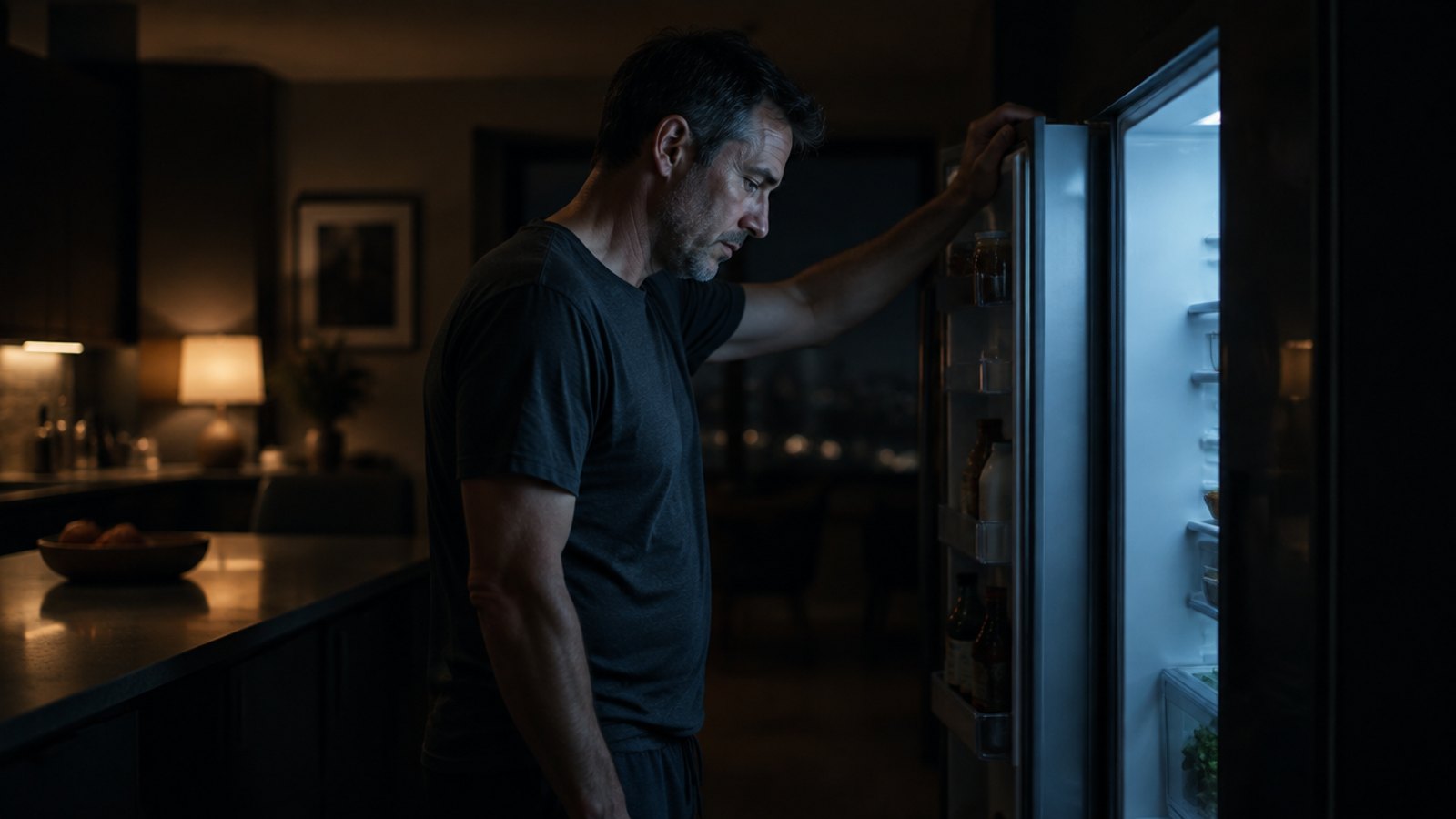
Morning light is only useful if you are not undoing it at 11pm. The evidence on night light is now the stronger half of this story.
In nearly 85,000 UK Biobank participants who wore light sensors for a week, brighter nights predicted higher risk of developing type 2 diabetes over roughly eight years of follow-up, stepping up across exposure levels to a 53 percent higher adjusted risk in the brightest group compared with the darkest. Night light and genetic risk predicted independently. The gap between bright nights and dark nights was similar in size to the gap between low and moderate genetic risk (Windred, 2024).
Observational again, with the usual caveats about what else bright nights track with. But the direction agrees with the laboratory work, and the fix is free.
What to actually do
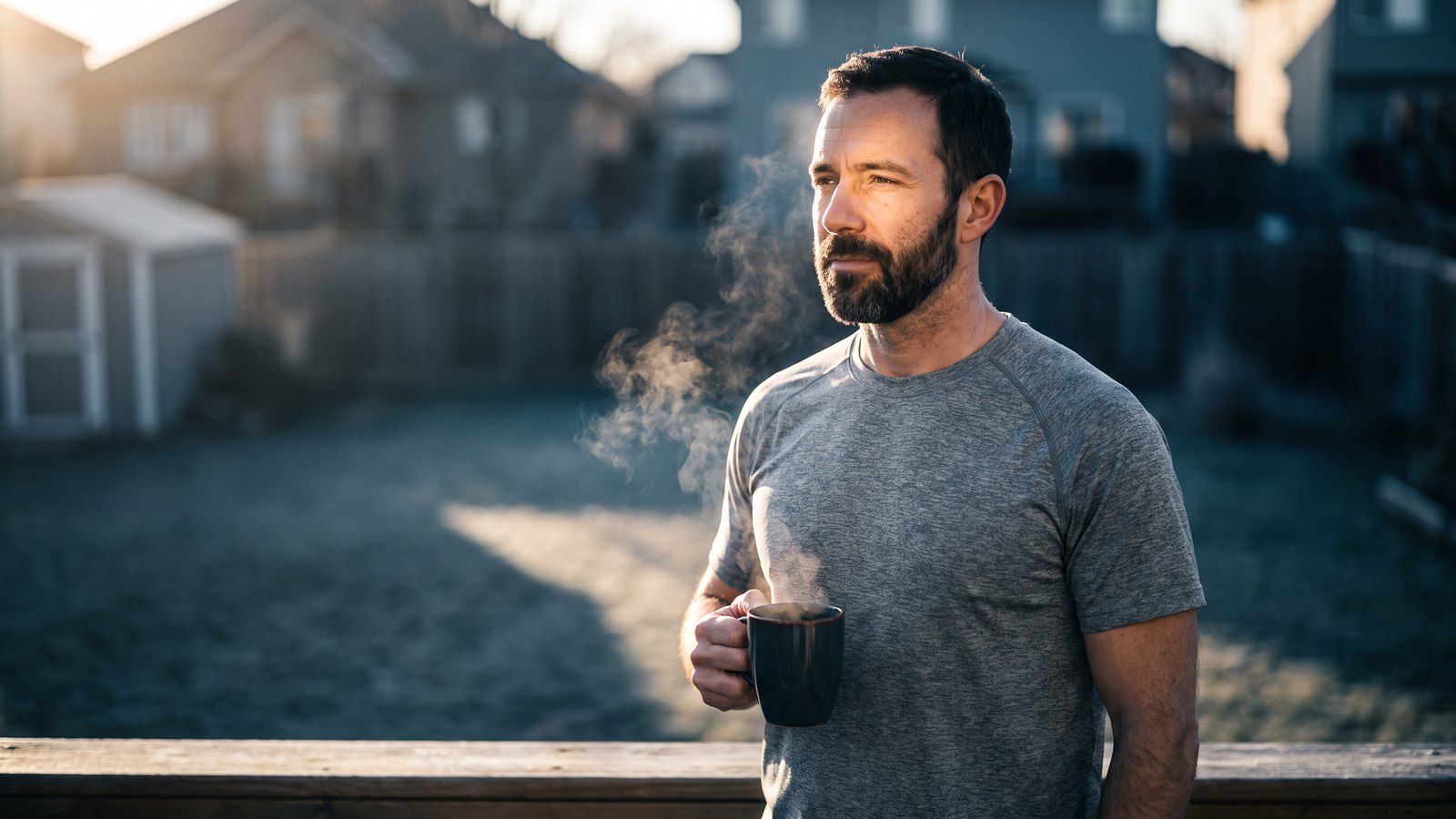
Get outside within an hour or so of waking, for ten to twenty minutes. Overcast counts. Longer is better in winter. Take the coffee out to the porch, walk the dog, walk to the train, park at the far end of the lot. You do not need to look at the sun, and you should not.
Do not do it through a window. Glass and windshields cut a lot of what you want and the intensity drops off fast the further you sit from the pane.
Skip sunglasses for the morning walk if it is comfortable. Wear them later in the day when it is bright and you actually need them.
Get light again around midday if you work indoors. Eat lunch outside. This is the single easiest habit to stack onto an office job.
Then defend the back end. Dim the house after dark, keep the overhead lights off in the last hour, and get the bedroom actually dark. This half matters at least as much as the morning half.
Give it two weeks before you judge it. You are moving a clock, not taking a stimulant.
The verdict
This is not a biohack and it is not a personality. Your internal clock is set by light, morning light pulls it earlier, evening light pushes it later, and the modern indoor day delivers too little of the first and too much of the second. A week in natural light was enough to snap people back onto solar time, and a weekend got most of the way there.
Fifteen minutes outside in the morning, dark evenings, no equipment, no cost. Most of what gets sold to men for energy is worse than this and more expensive. Go outside.
This is general education, not medical advice. If you have a diagnosed sleep disorder, bipolar disorder, an eye condition, or you take a medication that affects light sensitivity, talk to your doctor before starting formal light therapy.
References
- Khalsa SB, Jewett ME, Cajochen C, Czeisler CA. A phase response curve to single bright light pulses in human subjects. J Physiol. 2003. https://pubmed.ncbi.nlm.nih.gov/12717008/
- Wright KP, McHill AW, Birks BR, et al. Entrainment of the human circadian clock to the natural light-dark cycle. Curr Biol. 2013. https://pubmed.ncbi.nlm.nih.gov/23910656/
- Stothard ER, McHill AW, Depner CM, et al. Circadian entrainment to the natural light-dark cycle across seasons and the weekend. Curr Biol. 2017. https://pubmed.ncbi.nlm.nih.gov/28162893/
- Burns AC, Saxena R, Vetter C, et al. Time spent in outdoor light is associated with mood, sleep, and circadian rhythm-related outcomes: a cross-sectional and longitudinal study in over 400,000 UK Biobank participants. J Affect Disord. 2021. https://pubmed.ncbi.nlm.nih.gov/34488088/
- Boubekri M, Cheung IN, Reid KJ, et al. Impact of windows and daylight exposure on overall health and sleep quality of office workers: a case-control pilot study. J Clin Sleep Med. 2014. https://pubmed.ncbi.nlm.nih.gov/24932139/
- Tong H, Dong N, Lam CLM, Lee TMC. The effect of bright light therapy on major depressive disorder: a systematic review and meta-analysis of randomised controlled trials. Asian J Psychiatr. 2024. https://pubmed.ncbi.nlm.nih.gov/39067131/
- Do A, Li VW, Huang S, et al. Blue-light therapy for seasonal and non-seasonal depression: a systematic review and meta-analysis of randomized controlled trials. Can J Psychiatry. 2022. https://pubmed.ncbi.nlm.nih.gov/35522196/
- Reid KJ, Santostasi G, Baron KG, et al. Timing and intensity of light correlate with body weight in adults. PLoS One. 2014. https://pubmed.ncbi.nlm.nih.gov/24694994/
- Windred DP, Burns AC, Rutter MK, et al. Personal light exposure patterns and incidence of type 2 diabetes: analysis of 13 million hours of light sensor data and 670,000 person-years of prospective observation. Lancet Reg Health Eur. 2024. https://pubmed.ncbi.nlm.nih.gov/39070751/
Common questions
How long do I actually need to be outside in the morning?
Ten to twenty minutes within an hour or so of waking is the practical target, and overcast days still count because outdoor light on a cloudy morning is far more intense than indoor lighting. Longer helps in winter when mornings are dim. The mechanism is well established: bright light in the hours after your body clock low point shifts your rhythm earlier, while evening light shifts it later (Khalsa, 2003).
Does light through a window work?
Light through a window works much less well than stepping outside. Glass cuts a meaningful share of the light, and intensity falls off quickly as you move away from the pane. The office worker study that found better sleep and higher vitality compared people who had daylight at their desks with people in windowless spaces, so windows beat no windows, but stepping outside beats both (Boubekri, 2014).
Should I buy a light therapy lamp?
Buy a light therapy lamp only if you cannot get outside, which mostly means winter, night shifts, or a workplace with no daylight. Bright light therapy has real controlled evidence in non-seasonal major depression, with a moderate effect across 15 randomized trials (Tong, 2024). Be skeptical of blue light specific devices: when researchers pooled nine randomized trials of blue light therapy, it did not beat inactive or active control conditions (Do, 2022).
I am a night owl. Is that just how I am built?
Partly genetic, but far less fixed than most men assume. When researchers took people camping for a week with only natural light, the participants who ran latest shifted the most, and their clock timing ended up looking much more like the early risers (Wright, 2013). A single weekend of natural light produced about 69 percent of the shift a full week produced (Stothard, 2017).
Does the evening half really matter that much?
Evening light may matter more than morning light. In nearly 85,000 adults who wore light sensors, brighter nights predicted a stepwise increase in type 2 diabetes risk over about eight years of follow-up, reaching 53 percent higher adjusted risk in the brightest group versus the darkest, independent of genetic risk (Windred, 2024). That is observational, not proof of cause, but dimming the house after dark costs nothing.