Muscle & Fat Loss
Best Milk for Weight Loss for Men: 6 Milks Ranked
Skim, whole, soy, almond, oat or ultra-filtered: which one actually helps a man lose fat and keep his muscle.
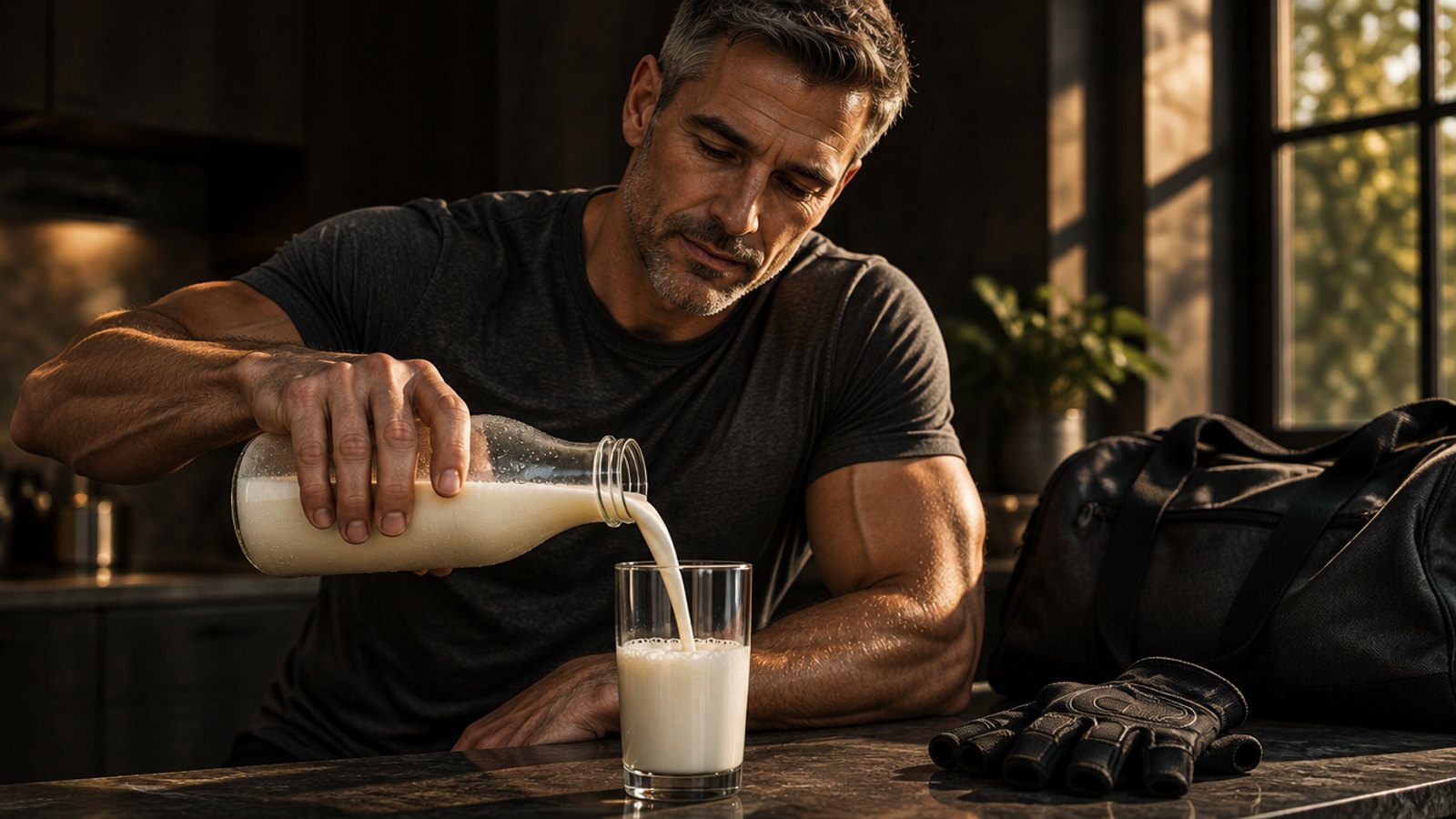
The best milk for weight loss for men is skim or 1% cow's milk, with ultra-filtered milk as the pick if you want the most protein per calorie. A cup of skim gives about 8 grams of protein for roughly 80 to 90 calories, and in trials, milk and dairy helped men and women on a diet lose a little more fat and keep a little more muscle than the same diet without it (Abargouei et al., 2012). Unsweetened soy milk is the best choice if you skip dairy. Oat milk is the weakest pick for a man trying to lean out.
No milk melts fat on its own. Milk helps when it replaces something worse, like juice, soda or a sweet coffee drink, and when it adds protein to a meal that was short on it. This is education, not medical advice.
Best milk for weight loss for men: the short version
| Milk (1 cup, unsweetened) | Calories, roughly | Protein, roughly | Keeps you full? | Verdict |
|---|---|---|---|---|
| Skim or 1% cow's milk | 80 to 110 | 8 g | Good | Winner |
| Ultra-filtered milk (Fairlife style) | 80 to 120 | 13 g | Good | Best for protein |
| Unsweetened soy milk | 80 to 100 | 7 g | Fair to good | Best non-dairy pick |
| Whole or 2% milk | 120 to 150 | 8 g | Good | Fine if the calories fit |
| Unsweetened almond milk | 30 to 40 | About 1 g | Poor | Fine for coffee, not as a protein source |
| Oat milk | About 120 | About 3 g | Fair | Weakest pick for fat loss |
How we compared them
We ranked each milk on four things: calories per cup, protein per cup, how full it keeps a grown man, and what the trials actually tested. Figures are typical label values for unsweetened versions; brands differ, so check yours.
Is milk good for weight loss?
Milk is good for weight loss when it sits inside a calorie deficit, and the trials show a small but real edge there. In a pooled analysis of 14 trials, high-dairy weight loss diets lost about 1.3 kg more weight and 1.1 kg more fat than the same diets with less dairy, and kept about 0.7 kg more lean mass (Abargouei et al., 2012). A larger review of 29 trials found the same benefit in energy-restricted and short-term trials, but no benefit, and even slight gain, when people just added dairy without cutting calories (Chen et al., 2012).
One honest note for men: the strongest dairy result comes from trials that were about 90 percent women, and the fat-loss edge disappeared in studies that also had people lifting, though dairy still protected lean mass (Stonehouse et al., 2016). The calcium in milk is not the reason either: calcium pills did nothing for weight or fat across 20 supplement arms (Booth et al., 2015). The protein and the swap are what count.
1. Skim or 1% milk: the winner
Skim or 1% milk wins because it gives the most real-world protein for the fewest calories, and it is the milk the best men's study used. In a 12-week trial, 56 young men new to lifting drank fat-free milk, a matched soy drink or a carb drink right after training and again an hour later. The milk group gained more lean mass and more muscle fiber size than both other groups (Hartman et al., 2007). Strength rose the same in all three.
Skim milk also fills you up. In a crossover trial of 34 overweight men and women, about 600 mL of skim milk at breakfast kept people fuller all morning and led them to eat about 8.5 percent less at lunch than the same calories from a fruit drink (Dove et al., 2009). That is the swap that matters: milk in place of juice or soda.
The downside is taste and texture. If skim tastes like water to you, 1% is a fair middle ground. If dairy upsets your stomach, lactose-free milk has the same protein and calories, since only the lactose is broken down.
2. Ultra-filtered milk: the best for protein
Ultra-filtered milk is the best milk for a man chasing protein, because filtering pulls out some of the sugar and concentrates the protein to about 13 grams a cup. Two cups get you over 25 grams, close to a scoop of whey. It costs more than regular milk, and no trial has tested it for weight loss specifically, so it earns its place on the label numbers: more protein per calorie is what keeps muscle in a deficit. Our guide to how much protein a man needs each day to lose weight shows where those grams fit.
3. Unsweetened soy milk: the best non-dairy pick
Unsweetened soy milk is the best plant milk for weight loss because it is the only common one close to cow's milk on protein (Vanga and Raghavan, 2018). In the lifting trial above, soy still built muscle, just a bit less than milk.
The testosterone worry does not hold up. A meta-analysis of 41 studies covering more than 1,700 men found soy protein and soy isoflavones did not change total testosterone, free testosterone or estrogen, at any dose or study length (Reed et al., 2021). If you want the full picture on what does move it, see what normal testosterone looks like for men over 40.
4. Whole or 2% milk: fine if the calories fit
Whole milk works for weight loss if you count it, because the protein is the same and the extra 40 to 70 calories a cup come from fat. Whole milk is not the villain it was made out to be. In a review of observational studies, people who ate more full-fat dairy were leaner in 11 of 16 studies (Kratz et al., 2013). Those studies show a link, not cause and effect, and three big glasses a day is about 450 calories that are easy to forget.
5. Almond milk: fine for coffee, weak as a protein source
Unsweetened almond milk is the lowest-calorie milk at 30 to 40 calories a cup, but it carries about 1 gram of protein, so it does almost nothing for fullness or muscle (Vanga and Raghavan, 2018). Use it to lighten coffee, not as protein.
6. Oat milk: the weakest pick for fat loss
Oat milk is the weakest pick for a man losing weight because it brings about as many calories as 2% milk with less than half the protein, and most of its calories come from carbohydrate. Barista versions often add oil and sugar on top.
How to use milk when you are losing weight
Use milk as a swap and a protein top-up, not an add-on. Replace juice, soda or a sugary coffee drink with a glass of skim or ultra-filtered milk, the same swap that tops our ranking of the best drinks for weight loss for men. Add a cup to your breakfast if it is light on protein. Drink a glass after lifting, which is cheaper than a shake and works about as well for the timing questions in how long the anabolic window really lasts.
Count it in your calorie target, and keep training: dairy protects muscle best when you are also lifting, which is the core of losing weight without losing muscle. If you would rather drink your protein from a scoop, our ranking of the best protein powders for men losing weight pairs well with a cup of skim. More on the basics lives in our muscle and fat loss guides.
Best milk for weight loss for men over 40 and 50
Men over 40 and 50 get more from milk's protein, because muscle gets harder to keep with age and a diet speeds the loss. If you are on medication for blood pressure, cholesterol or blood sugar, check with your doctor or prescriber before big changes to your diet.
References
- Abargouei AS, Janghorbani M, Salehi-Marzijarani M, Esmaillzadeh A. Effect of dairy consumption on weight and body composition in adults: a systematic review and meta-analysis of randomized controlled clinical trials. Int J Obes (Lond). 2012. https://pubmed.ncbi.nlm.nih.gov/22249225/
- Chen M, Pan A, Malik VS, Hu FB. Effects of dairy intake on body weight and fat: a meta-analysis of randomized controlled trials. Am J Clin Nutr. 2012. https://pubmed.ncbi.nlm.nih.gov/22932282/
- Stonehouse W, Wycherley T, Luscombe-Marsh N, Taylor P, Brinkworth G, Riley M. Dairy intake enhances body weight and composition changes during energy restriction in 18-50-year-old adults: a meta-analysis of randomized controlled trials. Nutrients. 2016. https://pubmed.ncbi.nlm.nih.gov/27376321/
- Booth AO, Huggins CE, Wattanapenpaiboon N, Nowson CA. Effect of increasing dietary calcium through supplements and dairy food on body weight and body composition: a meta-analysis of randomised controlled trials. Br J Nutr. 2015. https://pubmed.ncbi.nlm.nih.gov/26234296/
- Hartman JW, Tang JE, Wilkinson SB, Tarnopolsky MA, Lawrence RL, Fullerton AV, Phillips SM. Consumption of fat-free fluid milk after resistance exercise promotes greater lean mass accretion than does consumption of soy or carbohydrate in young, novice, male weightlifters. Am J Clin Nutr. 2007. https://pubmed.ncbi.nlm.nih.gov/17684208/
- Dove ER, Hodgson JM, Puddey IB, Beilin LJ, Lee YP, Mori TA. Skim milk compared with a fruit drink acutely reduces appetite and energy intake in overweight men and women. Am J Clin Nutr. 2009. https://pubmed.ncbi.nlm.nih.gov/19474132/
- Vanga SK, Raghavan V. How well do plant based alternatives fare nutritionally compared to cow's milk? J Food Sci Technol. 2018. https://pubmed.ncbi.nlm.nih.gov/29358791/
- Reed KE, Camargo J, Hamilton-Reeves J, Kurzer M, Messina M. Neither soy nor isoflavone intake affects male reproductive hormones: an expanded and updated meta-analysis of clinical studies. Reprod Toxicol. 2021. https://pubmed.ncbi.nlm.nih.gov/33383165/
- Kratz M, Baars T, Guyenet S. The relationship between high-fat dairy consumption and obesity, cardiovascular, and metabolic disease. Eur J Nutr. 2013. https://pubmed.ncbi.nlm.nih.gov/22810464/
Common questions
Does drinking milk make you gain weight?
Milk does not cause weight gain on its own, but adding it on top of your usual eating can. In a review of 29 trials, dairy helped weight loss only when calories were cut; when people simply added dairy without cutting anything, weight held steady or crept up slightly. Count milk in your daily calories and use it to replace juice, soda or sweet coffee drinks.
How much milk should a man drink a day to lose weight?
Two to three cups of milk a day is a sensible amount for a man losing weight. The dairy weight loss trials mostly used two to four servings a day inside a calorie deficit. Past that, the calories add up fast, especially with whole milk.