Supplements
Best Fiber Supplement for Weight Loss for Men: 5 Fibers Compared
One cheap powder has the best trial record, plus a cholesterol bonus. Here is the dose, the timing, and the fibers that are not worth the money.
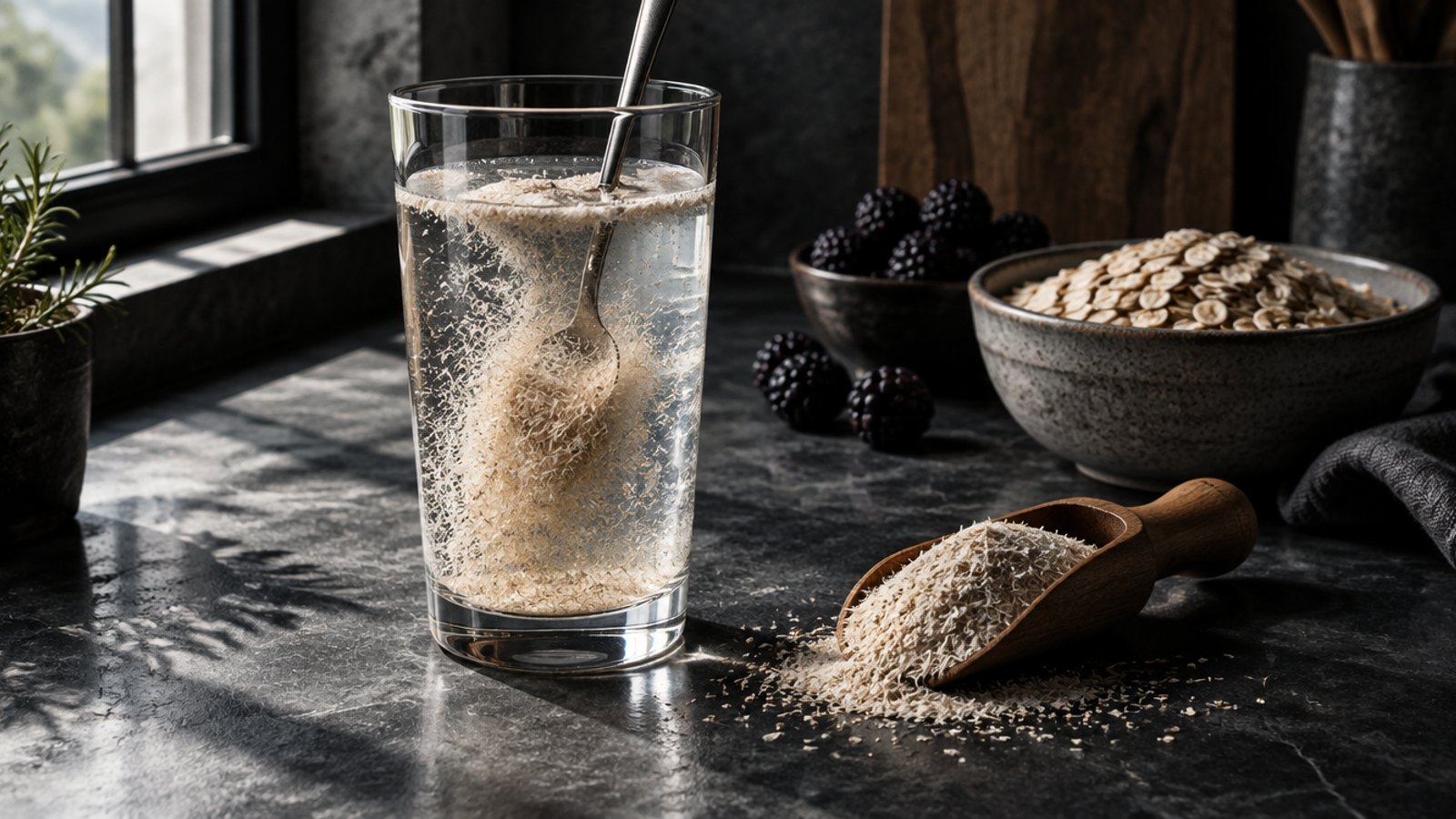
The best fiber supplement for weight loss for men is plain psyllium husk, about 5 grams in a big glass of water 15 to 30 minutes before your two largest meals. In a pooled analysis of six trials in adults with overweight or obesity, psyllium dosed before meals at about 11 grams a day for roughly five months took off about 2.1 kg more than control (Gibb et al., 2023). It is cheap, it is the most studied fiber on the shelf, and it also lowers LDL cholesterol, which most men over 40 can use.
Keep the size of that win in mind. A fiber supplement is a small helper that makes a calorie deficit easier to stick to. It does not burn fat. Glucomannan is a reasonable second choice, and the inulin-style fibers, guar gum and most gummies are not worth buying for weight loss. This is education, not medical advice. If you take any daily medication, take fiber at least two hours apart from it and check with your prescriber.
Best fiber supplement for weight loss for men: the short version
Psyllium wins for men trying to lose weight because it has the most weight-loss trials, the best fullness data and a cholesterol benefit on top, all for a few cents a day.
| Fiber | Weight result in human trials | Fullness | Tolerability | Verdict |
|---|---|---|---|---|
| Psyllium husk | About 2.1 kg when taken before meals; mixed when timing was not controlled | Less hunger between meals in placebo-controlled trials | Good if you ramp up and drink water | Winner |
| Glucomannan (konjac) | About 1.3 kg in one analysis, close to zero in another | Swells a lot, feels filling | Must be taken with plenty of water | Runner-up |
| Inulin and other fructans | No significant weight effect against placebo | Weak | Gas and bloating are common | Skip for weight loss |
| Guar gum | No difference from placebo across 11 trials | Some | Cramps, gas, diarrhea | Skip |
| Methylcellulose | No solid weight-loss trials we could verify | Unclear | Gentle, does not ferment | Fine for regularity, not a weight tool |
What we judged fiber supplements on
We ranked fiber supplements for weight loss on five things a man should check before he buys: weight results in randomized human trials, effect on hunger between meals, side effects at a useful dose, extra health benefits, and cost per day. The total fiber in your diet matters more than any single product, so we also compared every supplement against simply eating more fiber from food.
One rule shaped the ranking. A fiber needs to be viscous, meaning it forms a thick gel in water, to slow digestion and keep you full. Psyllium, glucomannan and guar gum are viscous. Inulin and wheat dextrin, the base of many "clear mixing" powders, are not. In a pooled analysis of 15 trials in people already on a calorie-restricted diet, adding viscous fiber took off another 0.81 kg of body weight and 1.39 points of body fat percentage (Jovanovski et al., 2020). Small, but real, and graded moderate certainty.
Psyllium for weight loss: the winner
Psyllium is the best fiber supplement for weight loss because it is the only one with a positive pooled result, a fullness effect in controlled trials and a proven cholesterol benefit at the same dose.
The weight data is honest work, not a slam dunk. Across six trials and 354 people with overweight or obesity, psyllium taken just before meals cut body weight by about 2.1 kg, BMI by 0.8 and waist size by 2.2 cm compared with control (Gibb et al., 2023). That analysis was written by researchers at Procter and Gamble, which makes Metamucil, so weigh it with that in mind. A larger network analysis of 111 supplement trials, run by an independent group, put psyllium's effect at about 3.7 kg with moderate certainty, among the largest of any of the 18 supplements it ranked (Shahinfar et al., 2023).
Not every analysis agrees. A 2019 review of 22 trials that mixed doses, timing and populations found no significant effect on weight overall (Darooghegi Mofrad et al., 2019). The pattern across all three points to timing. Psyllium seems to help weight when it is taken right before meals, which is how it works on hunger, and not much when it is stirred into whatever, whenever.
The fullness effect has been tested directly. In two placebo-controlled crossover trials, 6.8 g of psyllium before breakfast and lunch reduced hunger and the desire to eat between meals and increased fullness, with side effects similar to placebo (Brum et al., 2016). Less hunger at 3 p.m. is how a supplement makes a diet easier to follow. If between-meal hunger is your real problem, our breakdown of which appetite suppressants for men actually have trial support covers the non-fiber options too.
The bonus is your bloodwork. Across 28 trials, about 10 g of psyllium a day lowered LDL cholesterol by about 13 mg/dL and also lowered apoB (Jovanovski et al., 2018). If you have been told your numbers are creeping up, here is why apoB is the cholesterol number worth tracking. In people with type 2 diabetes, psyllium did not change weight but did lower fasting blood sugar and HbA1c (Xiao et al., 2020).
The downsides are manageable. Psyllium causes gas and bloating if you start at full dose, it can block absorption of some medications if taken at the same time, and the flavored versions often carry sugar or sweeteners you do not need. Buy plain husk or plain capsules.
Glucomannan for weight loss: the runner-up
Glucomannan, the fiber from konjac root, is a fair second choice for men who prefer capsules, but its weight data is weaker and more mixed than psyllium's.
Glucomannan absorbs a large amount of water and forms a thick gel, so it feels filling. The trial results are split. One review of eight trials in people with overweight or obesity found no significant difference from placebo, about 0.22 kg (Onakpoya et al., 2014). A later analysis of placebo-controlled trials found about 1.27 kg more weight lost, which was statistically significant but below the 2.5 kg the authors set for a meaningful result (Bessell et al., 2021). The network analysis put it at about 1.36 kg with low certainty (Shahinfar et al., 2023).
Read that as a modest helper with a real fullness effect and inconsistent weight data. If you use it, take it before meals with a full glass of water. That water matters more than with any other fiber: glucomannan swells fast, so never take it dry or right before lying down.
Inulin, wheat dextrin and fiber gummies
Inulin-type fibers, the base of most clear-mixing powders and many gummies, are not a good pick for weight loss because they do not form a gel and did not beat placebo on weight.
In the same placebo-controlled analysis that found a small effect for glucomannan, fructans such as inulin showed no statistically significant effect on weight (Bessell et al., 2021). These fibers feed gut bacteria, which is not a bad thing (adding bacteria is a separate question, covered in which probiotic strains helped men lose belly fat), but they are fermented quickly, which is where the gas comes from, and they do little to slow a meal down. Gummies add another problem: most deliver 2 to 4 grams of fiber per serving with sugar alongside it. You would need a handful to match one spoon of psyllium.
Guar gum and methylcellulose
Guar gum is the one to skip outright, and methylcellulose is a regularity product that has not earned a place as a weight tool.
A meta-analysis of 11 placebo-controlled guar gum trials found essentially no weight difference, about 0.04 kg, and the authors noted abdominal pain, gas, diarrhea and cramps as the common side effects (Pittler and Ernst, 2001). Older reviews of the whole weight-loss supplement shelf reached the same conclusion about guar and found nothing beyond reasonable doubt for most of the rest (Pittler and Ernst, 2004).
Methylcellulose, sold as Citrucel, is a synthetic fiber that does not ferment, so it causes less gas than psyllium or inulin. That makes it a decent choice for regularity. We could not find solid randomized trials showing it helps with weight, so it does not make the podium here.
Fiber supplement vs eating more fiber
Eating more fiber from food beats any fiber supplement for weight loss, and the supplement is for closing whatever gap is left.
The food evidence is stronger than most men expect. In the POUNDS Lost trial, 345 adults on a calorie-restricted diet for six months, fiber intake was the single strongest predictor of how much weight people lost, independent of calories and macros, and it tracked with how well they stuck to their diet (Miketinas et al., 2019). In a separate 12-month trial of 240 adults with metabolic syndrome, a group told only to eat 30 grams of fiber a day lost about 2.1 kg, close to the 2.7 kg lost by a group following the full, more complicated American Heart Association diet (Ma et al., 2015).
Most men eat about half the fiber they should. Beans, lentils, oats, berries and vegetables at every meal close most of that gap, and our weight loss meal plan for men is built around exactly that. We explain the bigger picture, including what fiber does for a man's cholesterol, blood sugar and appetite, in our main fiber guide.
Does fiber help you lose belly fat?
Fiber supplements trim the waist a little, about 2 cm in the psyllium trials that dosed before meals, but no fiber targets belly fat directly.
The waist result in the psyllium analysis was 2.2 cm (Gibb et al., 2023), and the viscous fiber analysis found body fat down by about 1.4 percentage points but no clear change in waist size (Jovanovski et al., 2020). Belly fat comes off with overall fat loss. Here is what actually works for losing belly fat after 35, and fiber fits in as a supporting player.
How much fiber should a man take to lose weight?
Men losing weight should aim for 30 to 38 grams of total fiber a day from food and supplements combined, with a psyllium dose of about 5 grams before one or two meals.
The psyllium weight trials averaged about 11 grams a day split before meals (Gibb et al., 2023), and the cholesterol trials used about 10 grams (Jovanovski et al., 2018). Start with 3 to 5 grams once a day for a week, then add a second dose. Drink at least 8 ounces of water with every dose. If you jump straight to 10 grams, expect bloating, and expect to quit.
When to take fiber for weight loss
The best time to take fiber for weight loss is 15 to 30 minutes before your biggest meals, because the gel needs to be in your stomach when the food arrives.
That timing is the difference between the trials that worked and the ones that did not (Gibb et al., 2023; Darooghegi Mofrad et al., 2019). For most men that means before lunch and dinner. If evening eating is where your diet falls apart, a dose before dinner is the one to keep. Take it at least two hours apart from medications, thyroid pills and other supplements, since fiber can slow how they are absorbed.
Fiber supplements for men over 40 and over 50
Fiber supplements make even more sense after 40, because the cholesterol and blood sugar benefits start to matter as much as the scale.
The LDL drop from psyllium (Jovanovski et al., 2018) and the blood sugar improvement in people with diabetes (Xiao et al., 2020) are both outcomes a man over 50 is likely being tested for. Men over 50 also tend to be on more medications, so the two-hour spacing rule matters more. If you take a blood sugar medication, talk to your prescriber before adding psyllium, since your readings may come down.
The verdict
Plain psyllium husk is the best fiber supplement for weight loss for men. Take about 5 grams with a full glass of water 15 to 30 minutes before your two biggest meals, build up over two weeks, and expect help with hunger and a kilo or two over several months on top of a sensible deficit, plus a lower LDL. Glucomannan is a fair runner-up in capsule form. Skip guar gum, and do not count on inulin powders or gummies for weight loss. Food fiber still does the heavy lifting. See the rest of our supplement verdicts before you buy anything else.
This article is for general education and is not medical advice. If you take daily medication, have diabetes, or have a history of bowel obstruction or trouble swallowing, talk to your doctor before starting a fiber supplement.
References
- Gibb RD, Sloan KJ, McRorie JW. Psyllium is a natural nonfermented gel-forming fiber that is effective for weight loss: a comprehensive review and meta-analysis. J Am Assoc Nurse Pract. 2023. https://pubmed.ncbi.nlm.nih.gov/37163454/
- Shahinfar H, Jayedi A, Torabynasab K, et al. Comparative effects of nutraceuticals on body weight in adults with overweight or obesity: a systematic review and network meta-analysis of 111 randomized clinical trials. Pharmacol Res. 2023. https://pubmed.ncbi.nlm.nih.gov/37778464/
- Darooghegi Mofrad M, Mozaffari H, Mousavi SM, Sheikhi A, Milajerdi A. The effects of psyllium supplementation on body weight, body mass index and waist circumference in adults: a systematic review and dose-response meta-analysis of randomized controlled trials. Crit Rev Food Sci Nutr. 2019. https://pubmed.ncbi.nlm.nih.gov/30880409/
- Jovanovski E, Mazhar N, Komishon A, et al. Effect of viscous fiber supplementation on obesity indicators in individuals consuming calorie-restricted diets: a systematic review and meta-analysis of randomized controlled trials. Eur J Nutr. 2020. https://pubmed.ncbi.nlm.nih.gov/32198674/
- Brum JM, Gibb RD, Peters JC, Mattes RD. Satiety effects of psyllium in healthy volunteers. Appetite. 2016. https://pubmed.ncbi.nlm.nih.gov/27166077/
- Jovanovski E, Yashpal S, Komishon A, et al. Effect of psyllium (Plantago ovata) fiber on LDL cholesterol and alternative lipid targets, non-HDL cholesterol and apolipoprotein B: a systematic review and meta-analysis of randomized controlled trials. Am J Clin Nutr. 2018. https://pubmed.ncbi.nlm.nih.gov/30239559/
- Xiao Z, Chen H, Zhang Y, et al. The effect of psyllium consumption on weight, body mass index, lipid profile, and glucose metabolism in diabetic patients: a systematic review and dose-response meta-analysis of randomized controlled trials. Phytother Res. 2020. https://pubmed.ncbi.nlm.nih.gov/31919936/
- Onakpoya I, Posadzki P, Ernst E. The efficacy of glucomannan supplementation in overweight and obesity: a systematic review and meta-analysis of randomized clinical trials. J Am Coll Nutr. 2014. https://pubmed.ncbi.nlm.nih.gov/24533610/
- Bessell E, Maunder A, Lauche R, Adams J, Sainsbury A, Fuller NR. Efficacy of dietary supplements containing isolated organic compounds for weight loss: a systematic review and meta-analysis of randomised placebo-controlled trials. Int J Obes (Lond). 2021. https://pubmed.ncbi.nlm.nih.gov/33976376/
- Pittler MH, Ernst E. Guar gum for body weight reduction: meta-analysis of randomized trials. Am J Med. 2001. https://pubmed.ncbi.nlm.nih.gov/11403757/
- Pittler MH, Ernst E. Dietary supplements for body-weight reduction: a systematic review. Am J Clin Nutr. 2004. https://pubmed.ncbi.nlm.nih.gov/15051593/
- Miketinas DC, Bray GA, Beyl RA, Ryan DH, Sacks FM, Champagne CM. Fiber intake predicts weight loss and dietary adherence in adults consuming calorie-restricted diets: the POUNDS Lost study. J Nutr. 2019. https://pubmed.ncbi.nlm.nih.gov/31174214/
- Ma Y, Olendzki BC, Wang J, et al. Single-component versus multicomponent dietary goals for the metabolic syndrome: a randomized trial. Ann Intern Med. 2015. https://pubmed.ncbi.nlm.nih.gov/25686165/
Common questions
What is the best fiber supplement for weight loss for men?
Plain psyllium husk is the best fiber supplement for weight loss for men. Taken before meals at about 11 grams a day, it took off about 2.1 kg more than control across six trials (Gibb et al., 2023), and it lowers LDL cholesterol at the same dose. Glucomannan is a reasonable runner-up.
Does Metamucil help you lose weight?
Metamucil is psyllium, and psyllium helps with weight loss modestly when taken 15 to 30 minutes before meals. In trials dosed that way, people lost about 2 kg more over several months and felt less hungry between meals. The plain, unflavored version avoids added sugar and sweeteners.
Is psyllium or glucomannan better for weight loss?
Psyllium is better than glucomannan for weight loss on the current evidence. Pooled psyllium trials dosed before meals show about 2.1 kg lost, while glucomannan results range from close to zero (Onakpoya et al., 2014) to about 1.3 kg (Bessell et al., 2021). Psyllium also lowers LDL cholesterol.
How much fiber should a man take a day to lose weight?
A man trying to lose weight should aim for 30 to 38 grams of total fiber a day from food and supplements combined. A practical supplement dose is about 5 grams of psyllium before one or two meals, built up over two weeks, with at least 8 ounces of water each time.
When is the best time to take fiber for weight loss?
The best time to take fiber for weight loss is 15 to 30 minutes before your largest meals, usually lunch and dinner. The trials that dosed psyllium just before meals showed weight loss, while analyses that mixed timing did not. Keep fiber at least two hours away from medications.
Can you take a fiber supplement every day?
Daily fiber supplements are safe for most healthy men and were taken daily for months in the weight and cholesterol trials. Start low to avoid gas and bloating, drink water with every dose, and talk to your doctor first if you take blood sugar medication or have a history of bowel obstruction.
Do fiber gummies work for weight loss?
Fiber gummies are a poor choice for weight loss. Most use inulin-type fibers that did not beat placebo on weight (Bessell et al., 2021), and a serving usually delivers only 2 to 4 grams of fiber along with added sugar. One spoon of plain psyllium does more.